
Why Sheffield's British Business Bank is betting on UK's small firms after Castore's £1bn success
British Business Bank chief executive Louis Taylor is driving a bolder approach to backing the UK’s army of entrepreneurs. He spoke to Chris Burn during a visit to Leeds this week.
It is rare to see a branch of the UK government admit it is taking risks with public money, let alone make that an explicit strategic aim. But that is exactly the intent of the British Business Bank as it provides billions to help smaller businesses secure finance to let them start, scale and stay in the UK.
The Sheffield-headquartered organisation published a five-year plan in November which included a direct pledge to ‘take more risk’ as one of its four strategic pillars.
The bank is particularly looking at supporting emerging technologies which could be world-leaders in future decades, backing specialist venture capital funds and supporting regional university and science clusters.
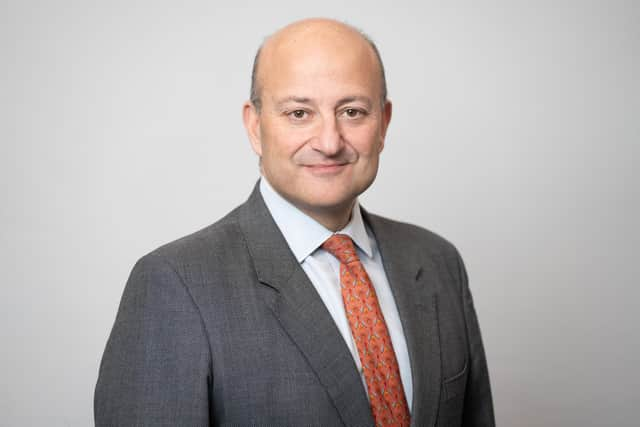

Louis Taylor CBE, who has been the organisation’s chief executive since 2022 after holding senior private sector roles at the likes of Standard Chartered and JP Morgan and then going on to run the Government's UK Export Finance body for seven years, explains: “Of course we need to protect public money, but we need to protect public money like a corporate chief executive protects shareholders' money, or a charity chief executive protects charity money.
"Our purpose is to back smaller businesses, which are inherently risky. The mitigants to those risks are many, not least diversification. Just like any other venture capital investor, we would expect that some of our companies will not make it, but the ones that do ought to make enough to be able to more than cover costs and get a decent return.”
One element of the bank’s work involves providing start-up loans of up to an initial £25,000 to new businesses. Mr Taylor says: "We're mandated to try and keep the default rate to below 35 per cent and actually that default rate is 26 per cent or so. It's a fantastically valuable programme. There's about £6 of benefit to the economy for every pound that it actually costs.
"If you don't have rich friends and family, it's effectively your own version to help you start a business. It really is meeting a need for underserved entrepreneurs. The postal code analysis is predominantly people from less well off areas, with 40 per cent female founders and 20 per cent ethnic minority founders, as the recipients.”
Among those to benefit in recent years from such support is sports clothing brand Castore which was founded by brothers Tom and Phil Beahon in Liverpool in 2015. The firm is now valued at around £1bn and supplies kits for several Premier League football clubs and the England cricket and rugby teams among many others.
Mr Taylor says: “It is a great story but very few start-up loan recipients will become unicorns. That is fine because we need a broad-based economy, we need high street businesses that are really important in their communities.”
He says since taking over the British Business Bank in October 2022 he has reshaped the way it operates.
"The government set this up 11 years ago with the right intentions. It ended up being, understandably in the early days, quite programmatic and quite siloed. Each of its programmes had criteria that turned away a lot of people as well as embraced a few.
"We ended up with an organisation that was a programme deliverer rather than a provider of solutions. We’ve changed that, we’ve knocked down the silos, we have an investment business, which is mostly equity, and a banking business, which is helping lenders lend more to small businesses.
"The bank is set up to work with entrepreneurs who are value maximisers. Government is more of a loss minimiser. For a leadership team, it is being the gearbox between those two perspetives; making sure our frontline teams are commercial enough to work with commercial operators but at the same time that we are delivering value for money for the taxpayer.
"Why the bank works really well is the outcomes desired by the taxpayer are absolutely compatible with generating good returns and good businesses that can stand on their own two feet.”
Mr Taylor was in Leeds in Monday to participate in the Great North Investment Summit organised by the region’s mayors as a way of promoting £14bn worth of infrastructrure projects including the York Central regeneration scheme, carbon capture and hydrogen proposals for the Humber, plans for 20,000 new homes in Leeds and an advanced manufacturing, defence and innovation corridor linking Sheffield and Rotherham.
He says the collective ambition shown by regional mayors is a welcome “step change” for the North. Among the bank’s major ongoing projects is the Northern Powerhouse Investment Fund, with its first tranche seeing the bank invest £440m and attract another £560m of private sector money. The second fund, which is two years old, has already seen £275m provided to 400 companies across the North.
The bank’s 600 employees are largely split between Sheffield and London and Mr Taylor it admits it can sometimes be “quite hard” to get London-based investors out of the capital.
He adds: “We held an event around tech companies in Newcastle and for the London investors, I think jaws dropped at the quality of the opportunity. We're trying to show the investment community the opportunity there is to make really decent returns outside of London and the South East.
“We have no problem with entrepreneurial spirit in this country, 800,000 companies set up on Companies House last year. At an individual level, we are strongly entrepreneurial. The issue is when they get to need institutional financial help and risk appetite is not really there to help smaller businesses, so we're really trying to change that.”
Mr Taylor originally hails from the North, having grown up in Newcastle.
"Any job requires you to understand context, and having grown up in Newcastle in the 1970s and 1980s, I've got a fair bit of context about the regeneration of northern cities.”
His career included a three-year spell as Standard Chartered’s CEO for Vietnam, Laos and Cambodia in the early 2010s; a role he says has parallels with his current job.
"It was an extraordinary place to be. It is just so incredibly dynamic at an entrepreneurial level. It was a great experience doing banking of a genuinely developmental kind. It was really quite similar to what I’m doing; helping entrepreneurs to realise potential, employ people, build communities and all that great stuff.”
He says there are definite commonalities about successful entrepreneurs the world over; “clarity of purpose, clarity of vision, real resilience, creativity, and determination”.
Mr Taylor says he has his own determination to help the entrepreneurs of the North to flourish.
"Our commitment to the North and the regions of the UK is demonstrated by the fact we're reconfiguring our local growth team, where we are increasing the seniority level and capability of people we have in region, in order to be able to have a proper dialogue with mayoral authorities and local authorities, whose ambition is really very strong. We want to make sure that they can mobilise the bank's resources in support of the ambitious vision local leaders have.”