
Yorkshire firms urged to 'take the plunge' on hiring graduates in AI age
CGI’s Christina Geary tells Michael Crossland how the Yorkshire region could be better placed than most of the country to tackle the impact of AI on entry-level jobs.

Proponents of AI frequently speak of a ‘post-work society’. A society where the vast majority of all work is automated, and the idea of traditional employment has become obsolete.
While such an eventuality may be years away from occurring, the early impacts of AI on employment are already starting to play out.
Multiple warnings have been issued on graduate and trainee jobs becoming more rare, as businesses opt to use AI platforms including ChatGPT and Claude for tasks such as copy writing and simple coding.
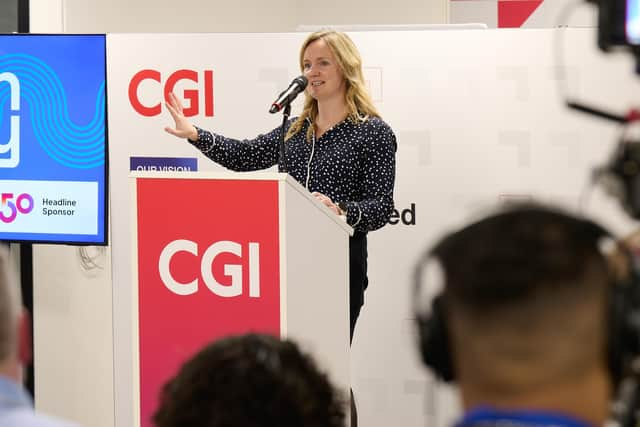

But according to Christina Geary, a senior Leeds staff member at technology consultancy CGI, the Yorkshire region could be better placed than elsewhere in the country to overcome the barriers AI brings for early-stage workers.
“I feel like we're probably in quite a good position to tackle the issue,” says Geary, who is senior vice president, Consulting Services and Business Unit Leader for Leeds at CGI.
“The advantage that Yorkshire has is that we are quite a small, tightly formed community, meaning that the universities, and what the universities are teaching, links up to what we need in the workplace.
“That really close connection means that our grads, I think, are probably better equipped to get into the working world and succeed.”
According to the Office for National Statistics, the number of UK businesses with 10 or more employees using AI increased from 12 per cent in 2023 to 35 per cent in 2026, with larger firms more likely to have adopted the technology.
Geary argues, however, that the increasing popularity of AI makes the need for UK firms to employ graduates and trainees more important than ever.
“The reality is that we still need those grads,” she says.
“We've got some graduates starting this week actually, and when you talk to them, you realise they see things in such a different way, and actually, they’re streets ahead of some of our guys who've been doing it for 20 years.
“The people who've been doing it for 20 years didn't grow up and haven't been through university with AI. Whereas now, the people coming through, they just view things differently, and we really need that.
“We need people who think differently and see things differently and understand things differently, and people with that almost AI-first mentality.”
With business costs rising, however, and the UK’s economic situation still posing a huge challenge for many companies, the temptation to opt for AI over a new employee becomes ever more understandable.
But despite this, Geary warns, businesses must still consider the long-term value of bringing in entry-level staff.
“It's about the value that the businesses are getting,” she says.
“It's less about bringing in five grads and thinking how much its going to cost you, and more about thinking what value you will get from them.
“This narrative of ‘you don't need graduates because that kind of entry level work is being done by AI now’, it's really easy to believe that. But once you've actually got some graduates in the business and you spend time talking to them, you realise you do actually need them. You just need them for a different thing than you did 10 years ago.”
Geary is now calling for more businesses to “take the plunge” of bringing in graduates.
“If you were bringing in five graduates last year, bring in five graduates this year, and see the benefit that they bring,” she says.
Geary has also called for more to be done to help young people from less affluent backgrounds into technology jobs.
A report from the Tech Talent Charter, published in 2024, found that only nine per cent of tech employees come from lower socio-economic backgrounds.
It also found that such workers earn less than their peers from more affluent backgrounds.
Those from less affluent backgrounds, Geary notes, may also be put off the traditional route of university education.
“I think there's definitely an increasing tide of young people deciding against university,” she says.
“The costs get insanely expensive, and I think that's another untapped market potential.
“There are children growing up in less well off areas that might look now at the levels of debt and just think ‘I cannot possibly do that’.
“But places like Leeds City College, they've got amazing programs to pull people from schools all across the city from all sorts of demographics, and then once they're in the college environment, they can really get them a good platform.
“It's about looking at how we can get people from those kinds of environments, not just the grammar schools and possibly the private schools, but the broader city, because there's a lot of talent there.”
Geary’s comments come after CGI last year acquired Leeds-based tech consultancy BJSS, at the time bringing the firm’s total UK headcount to around 9,000.
BJSS’s Yorkshire base, and the region’s huge technology sector, Geary notes, was a big driver in the acquisition.
“We had a small team in Yorkshire,” she says, “I think literally a handful of people, but nothing like the scale we have now.
“Essentially, we want to work and live near where our clients are, and I think that's how you build good relationships, so not having a presence in Yorkshire when there's so much going on in the region, there was a bit of a gap there.
“I remember going to my first conference in Montreal, and the owner of CGI was talking about Yorkshire and how excited he was to finally have got a foothold in the region.
"We've got people who've joined the team from all different areas of the country,” she adds, “and everybody says that there is nowhere like Leeds.”