
'An attack on the countryside' - Trail hunting ban will have 'negative impact' on rural communities
The Government has announced, what it says, is the biggest animal welfare bill in a generation, including banning trail hunting amid concerns it is a smokescreen for hunting. Emma Ryan reports.

The day after Christmas, on a crisp, bright morning, people mill on a local village green. Soft chimney smoke fills the air alongside a joyful chatter, handshakes and the wishes of the season.
Young and old gather, children playing in the safety of the countryside whilst adults warm up with a drop of whiskey and sausage rolls being handed round.
It sounds like a cosy film scene, but this is a glimpse into a real community - a community whose way of life is under threat.
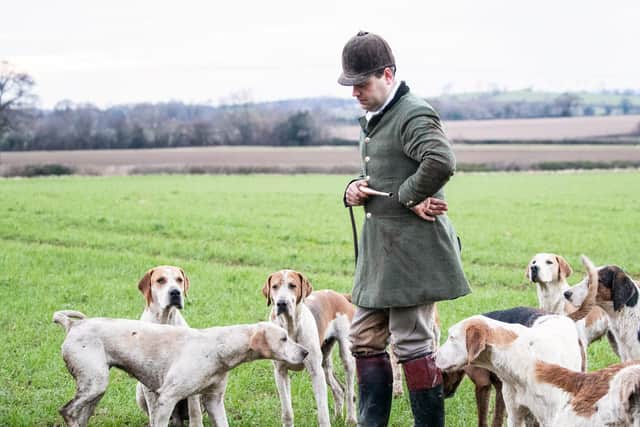

Just before Christmas the government announced, what it says, is the biggest animal welfare bill in a generation.
Proposals include reforming dog breeding practices to end puppy farming; introducing new licences for domestic rescue and rehoming organisations; promoting responsible dog ownership to protect public safety; moving away from confinement systems such as colony cages for laying hens and pig farrowing crates; banning snare traps and banning trail hunting amidst concerns it is being used as a smokescreen for hunting.
The latter prompted massive turnouts in Yorkshire, and across the country, as hunts and rural communities fight to keep a way of life they have known for countless generations.
More than a thousand people filled Bedale High Street on Boxing Day to watch the Bedale Hunt Parade, several hundreds turned out at Northallerton to see off the Hurworth Hunt, more than 800 people supported the Zetland Hunt at its New Year’s Day meet.
Several hundred people made their way to Beverley Westwood to welcome the Holderness Hunt.
Back on that village green in Lealholm, nestled in the Esk Valley near Whitby, there were more than 200 people seeing off the Staintondale Hunt running with Glaisdale and Goathland.
Lealholm itself has a population of less than 400.
The lady handing out the sausage rolls and tots of port and whiskey was from a local family business.
Her young daughter was invited to ride in the hunt for the first time after years of helping out in stables and training the hounds.
She said: “This is my daughter’s first hunt but she has trained the hounds for years. Now it could be the last one. Look at the community support and turnout.”
Ed Mangles had made the journey to see off the hunt, as he has done hundreds of times before in his life. His father was part of a hunt.
Acknowledging the turnout and support, he told the Yorkshire Post it comes with mixed feelings.
He said: “It is a lovely turnout, but there are mixed feelings because this might be the last one.
"The hounds have to go and people’s livelihoods - the master, kennel staff, they will have to find something else to do.”
If trail hunting were to go, so would a knowledge of the countryside, animals and the environment, he added.
“We have got a lot of people here today who grew up with this and it is part of the countryside. When you start losing this, you lose the knowledge of ways of the countryside.
"The animals, the flora, the fauna - that is known by people who hunt, by people who are on the land, people who know what they are talking about rather than a suit in a civil service office in Slough.”
Questions over the basis for the proposed ban are being asked by the Countryside Alliance and the British Hound Sports Association, which regulates trail hunting.
Trail hunting is the “very thing” the Labour government told hunts to do when it banned fox hunting in 2004, says the Countryside Alliance, adding the latest proposal was “virtue signalling” without taking into account science and evidence.
A recent YouGov survey shows 50 per cent of Britons would support a ban on trail hunting, compared to 29 per cent who are opposed.
The survey also revealed half of Britons who live in rural areas also back a trail hunting ban.
However, closer analysis of the figures reveal the survey was mainly conducted amongst people living in urban areas.
YouGov said the survey was of 2,317 GB adults, including 1,781 living in urban areas, 246 in town and fringe, and just 287 in rural areas.
In a poll of 2,000 people, conducted by ORB for the Countryside Alliance, about what the government should be prioritising, trail hunting was not mentioned once with priorities being listed as the economy (36 per cent), immigration/asylum/ borders (17 per cent) and health/social care (15 per cent).
Polly Portwin, Director of the Campaign for Hunting at the CA, said: “We are trying to make the government realise it is not a political priority. They should focus on what matters, not winning cheap points from backbenchers.
“It feels like a wider attack on the countryside dressed up as an Animal Welfare Bill but it will have a negative impact on our farming community.
“The hunting act works. There have been more prosecutions than under any other wildlife legislation. It is enforceable and works and there is no need to change it.”
Despite illegal fox hunting being the most prosecuted of wildlife crime, the BHSA says there have been less than 50 convictions for illegal fox hunting in the 21 years since the introduction of the Hunting Act 2004.
A spokesperson for the BHSA said many cases had collapsed due to lack of evidence. Several invitations have been made to police forces and MPs to observe a trail hunt in action but few accepted.
Meanwhile, the League Against Cruel Sports says 1,600 incidents – consisting of 474 reports relating to suspected illegal hunting, which include 397 reports of foxes being chased, and 1,117 reports of hunt havoc – were recorded in the League’s end of season fox hunting report for August 2024 to April 2025.
The government has said it will work with interested parties to deliver the strategy by the end of 2030 with consultations expected to open this year.
Environment Secretary Emma Reynolds said: ”We’re a nation of animal lovers. This government is delivering the most ambitious animal welfare strategy in a generation.
“Visiting Battersea Dogs and Cats Home reminded me that millions of families welcome pets into their homes every year. Our strategy will raise welfare standards for animals in the home, on the farm and in the wild.
“We’ve already acted to improve zoo standards, end puppy smuggling and protect livestock from dog attacks. Now, we’re planning to ban caged hens, cruel snares, trail hunting, and curb low welfare dog breeding.”