
Antiques: Following the scent of classic bottles
IF we knew then what we know now....The old adage is especially true of antiques as we kick ourselves for throwing out family heirlooms that nobody wanted and reflect on the current worth of all those discarded Dinky toys and that first-edition hardback James Bond book from the 60s that was thrown out or given away.
Think, too, of the money you could get nowadays for well-treated Art Deco ceramics, vintage kitchenware, clothing, radios, dolls' houses, corkscrews, sewing machines, garden tools, cake and sweet tins, pop memorabilia, original enamel advertisement signs...the list is almost endless.
Even stuff from the comparatively recent past can be worth decent money, such as 80s mobiles, Walkman cassette players, video games, Pokemon cards, Beanie Babies, first generation iPhones, original Polaroid cameras, old tape recorders and record players.
Now to something else many will have cause to regret discarding: scent bottles. Over the centuries, the vast majority have been thrown away or, more recently, recycled, once their precious contents have been exhausted. Since the early 1900s, glassmakers have been designing bottles for perfume manufacturers. René Lalique, one of the most famous and outstanding artists and designers of the Art Nouveau era, led the way and others quickly followed. They included Émile Gallé, Russian abstract artist Kazimir Malevich (who created an adorable polar bear on an iceberg for Russian house Brocard) and Argentine-Italian surrealist Leonir Fini. Even Spaniard Salvador Dali, famous for exploring subconscious imagery, got in on the act, designing the eye-catching bottle for Le Roi Soleil perfume.

It will come as no surprise, then, that those miniatures works of art that survived can be worth big money, so long as they are in good condition, rare, old or from an iconic brand. I remember writing for these pages a few years ago of the fabulous collection of more than 1,000 bottles of all shapes and sizes from all over the world assembled by Yorkshirewoman Jane Wilson, many of which fetched hundreds of pounds each at Tennants. Some were made of silver and dated back to Victorian times but also included many large and impressive advertising display dummies known as factices.
In 2021, another collection, with specimens dating back to the 18th century, surfaced in Leyburn, with some stunning prices, including £1,450 for a Victorian silver-mounted glass bottle modelled as a fish and many others fetching £400-£600 each. More recently, in New York, a sale of 192 bottles made more than $600,00, including a world record $102,000 for a 1914 bottle for Vinolia's Osiris, inspired by that year's discovery in Egypt of the tomb of the god Osiris.
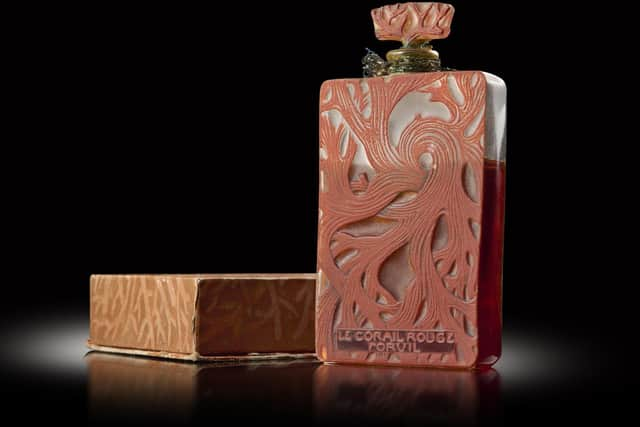
Now a further batch has surfaced at the Salisbury, Wiltshire, salerooms of Woolley & Wallis, where one rarity, a bottle of Le Corail Rouge designed by Lalique for Forvil in 1922, fetched more than £5,000. A box of three Lalique-designed Les 5 Forvil - Chypre bottles made £695. But many unusually-shaped bottles for Baccarat, Piver, Delavelle, Rigaud, Sabino, Gueldy and Worth, modelled as candles, books, bookends and butterflies, were snapped up for £100-£25.
Perfume bottles have provided a marker for social status through the ages, with the first hand-blown glass vessels appearing in Egypt in the 2nd millennium BC. Though most bottles had simple forms, some were very elaborate. The world's first recorded chemist and perfume-maker is considered to be Tapputi, a female overseer of a palace, mentioned in a tablet dated around 1200 BC in Babylonian Mesopotamia. She used flowers, oil, and calamus (a grass-like plant) along with cyperus (sedge), myrrh and balsam, adding water or other solvents before distilling and filtering. In 2005, a perfumery was discovered on Cyprus, with excavations unearthing evidence of an enormous factory that existed 4,000 years ago during the Bronze Age and housing at least 60 stills, mixing bowls, funnels and perfume bottles.
The first modern perfume was created in 1370 by the Hungarians for Elizabeth of Poland (1305-1380), Queen of Hungary by marriage to Charles I of Hungary, and soon the art of perfumery spread through Europe. In Ancient Rome, a perfume salesman would be called seplasarius, the name deriving from a street in Capua where perfumes of high quality were made. In England, perfume used peaked during the reigns of Henry VIII and Elizabeth I. All public places were scented during Elizabeth's rule, since she could not tolerate bad smells.
Finally, while researching this article, I read a newspaper report about scientists believing that perfume may one day be produced from evil-smelling "fatbergs" - vast blobs of unmentionables in our sewers held together by a congealed mass of fat and grease. Hardly a selling point….