
Birdwatching: An influx of hobbies, renowned for their flying skills
Hobbies are arriving to spend the summer here and are being seen in large numbers – 66 were reported at Eairth, Cambridgeshire, a record for the county.
At one time you had to go to wooded heathlands to find them, with Thorne and Hatfield Moors in South Yorkshire the prime locations. But over the past 25 years numbers have increased.
They are slate-blue birds, finely streaked below and with a black moustache and white cheek like a peregrine's. Under their tail and on their thighs they are bright red. They have long curved narrow wings, and can be mistaken for a swift, especially when flying towards you.
Hobbies are renowned for their flying skills, so much so that they are capable of catching a swift on the wing. But, until they have young to feed, much of their time is spent taking flying beetles and, as the weather grows warmer, dragonflies. They catch these in their talons and then, while still in flight, peel off the outer casing before transferring the rest to their beaks,
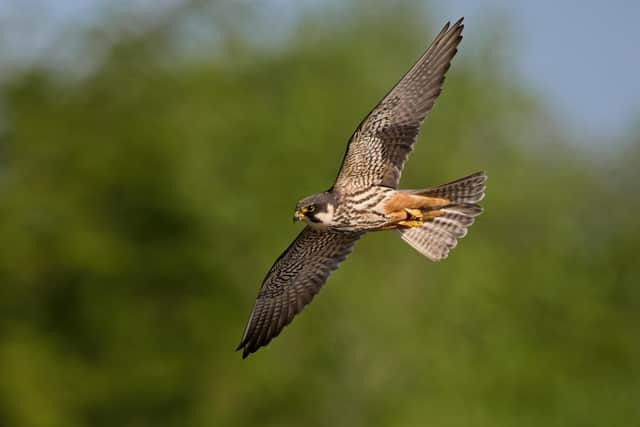

They are rather silent birds when hunting but if a pair are feeding young they make a high-pitched ‘kew kew kew’ call making it easier to find them in July and August
There has also been an arrival of a rarer vagrant, red-footed falcons with around 20 seen in South-East England including nine at one site in Norfolk.
Birders will be looking out for these among hobbies, especially on Thorne Moors where there have been several previous records. Both species share a liking for large flying insects so both are drawn to wetland areas and open country.
The male is mostly slate-grey but rusty red under the tail and, like the hobby, bright red legs. It can hover like a kestrel but often sits on telephone wires before dropping down to feed on insects – I watched one doing this near Sherburn-in Elmet.
Red-footed falcons breed in colonies from Eastern Europe to Mongolia and winter in South Africa. They are listed as of conservation concern across their range due to habitat degradation and lack of prey. They are thought to take a more westerly migration route in spring.
As a result sightings have steadily increased in the UK, so much so that at the end of 2005 it was decided that red-footed falcon sightings should no longer be considered by the British Birds Rarities Committee.
Dotterels are starting to be seen on their way back to breeding sites high in the Scottish mountains. Seven were seen near the trig point on Ingleborough. A great reed warbler was singing at Hornsea Mere and a male subalpine warbler was in a garden at Mirfield.