
Bolton Park Farm, Bolton Abbey: Diversifying… but in a different way
Finding different ways of providing a sustainable future to maintain the family farm has been the conundrum for many over the past quarter of a century since the impact of foot and mouth disease put the spotlight firmly on diversification.
It’s not everyone that has the ability, capacity or desire to do something completely contrasting, running off in another direction to what they are used to, and as Steven Crabtree of Bolton Park Farm near Bolton Abbey has found, nor is there, in some cases, a need to do so.
‘I looked up the word diversification the other day,’ says Steven. ‘And one of the definitions is about doing the similar thing, but in a different way.
‘I think it’s an important distinction to make, because all too often farmers, like me, can think that it is related to setting up such as a farm shop or a non-farm related business.
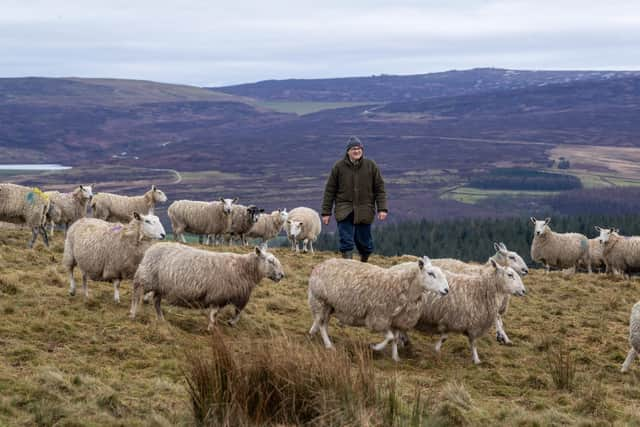

‘What we have done is to make our assets work for us by diversifying them, doing something similar to what we already do, still working the land. We’re doing what people in business call making your assets sweat for you.
Steven has undertaken several changes to the way his farmland is operated. He has in recent years changed his sheep breeding policy, numbers of sheep and cattle; he has let all of his owned land to tenancy agreements and has made use of environmental schemes, so that his farm income is far more diversified as well as producing environmental benefits.
‘Over the last fifteen years we’ve worked closely with the likes of Yorkshire Wildlife Trust, Yorkshire Dales Millennium Trust, River Ribble Trust, Natural England, the Yorkshire Dales National Park and have attracted considerable funding from FIPL (Farming in Protected Landscape) grants, all involving environmental schemes. We’ve planted trees, hedges, and improved our land for ourselves and others, notably with work we’ve done to alleviate elements of flood risk in Leeds from our position in the Upper Aire Valley,’ says Steven.
‘We’ve effectively diversified our assets to the benefit of both the environment and farming.
‘I now wear two environmental hats. One being, what we can do for the environment; and two, how we can be rewarded for that, making it work for ourselves both farming-wise and financially.
‘What I believe we have done is to make the most of what we’ve got, and with no detriment to mainstream farming.
That’s an important element of Steven’s management concern.
‘When I went to college in the 70s it was an era when it was drummed into you that you had to ‘grow two, where there used to be one’. It was a habit that gets engrained, but there are now different ways of doing things.
Steven’s age, succession and geographical location of his farming portfolio all came into his decision making both for his own farming future and better land management.
‘We farm Bolton Park Farm on a tenancy agreement, which became a joint tenancy with our son Simon five years ago, and currently farm around 550 acres here. We have owned acreages elsewhere, notably land at Hawskwick and land we had purchased at Airton 13 years ago, with other land at Timble, Grassington and my wife’s farm at Wigglesworth.
‘I’m now 68 and Simon isn’t back home as yet, as he has other farming interests elsewhere at present, and so we looked to make more constructive use of our time and concentrate our livestock enterprise here at Bolton Park. We took the decision to rent out the rest of our land, which meant we no longer had what had become an unwieldly 25 mile-wide area to travel in order to maintain what we had.
‘Everything we have livestock-wise is at Bolton Park now. We have 700 breeding ewes and over the past five years we have shifted our emphasis from Swaledale sheep to North Country Cheviot. We now have 300 North Country Cheviots and 400 Cheviot Mules, plus 180 followers. We use the Texel tup on the Cheviot Mule to produce our fat lambs that go to Dunbia or Pilgrim.
‘We’ve reduced our suckler herd to 35. They are all commercial cattle put to a Charolais bull. We also buy native store cattle to graze the upland in summer.
Steven’s environmental commitments are largely on the land he owns, although he’s done his fair share at Bolton Park Farm too.
‘We’ve planted about 3000 trees at Bolton Park and recently planted 1000 metres of hedging, but we’ve planted somewhere around 28,000 trees at Airton on what has been a major environmental effort.
We borrowed money to finance that scheme because I could see it being an advantage to what is a very wet farm, and it also helps others as it assists with natural flood management of the River Aire.
‘There was an opportunity through Yorkshire Wildlife Trust and the Upper Aire Catchment where we could fence off unproductive bits of the farm such as steep valley sides. We took out what amounted to 70 acres mainly along the riverbanks and planted trees.
‘By working our assets far better we have alleviated pressures of labour, we now spend far less time on the road and have condensed our operation. We’ve also given greater opportunities to other farmers.
‘We’ve also worked closely with Natural England over grazing agreements at Hawkswick and we are utilising a relatively new system called Nofence managed grazing, which uses GPS technology combined with a collar on each animal that enables the farmer to give the cow a ping if it is not within the grazing area defined. These collars allow the farmer to move his stock around to fit for the plants we’re trying to preserve.
Steven says the decisions he’s made in the recent past have gone some way to assuaging his concern about his farm’s future when the BPS was suddenly curtailed, but that he still has fears for what will happen when his environmental schemes come to their end.
‘When the government got rid of the whole BPS payment it came as a very real shock. All of my calculations had been based upon it ending in 2028. We’re currently working on a five-year rollover with our environmental schemes and they are a big worry because there is currently nothing on the SFI schemes that offers anything appropriate, and there’s certainly nothing for the uplands.
Steven gives much time to the future of farming through his current position as chair of the Charitable Activities Committee of the Yorkshire Agricultural Society where he presides over grant decisions and has previously served as trustee for nine years. He’s also on the management council of Yorkshire Dales Farmer Network and former county vice chair of West Riding NFU.
‘There are so many good things happening in the Society at present and the work of Lynsey Pack and her team in putting on the inaugural Yorkshire Farming Conference in January showed just how well things are done there.
‘I’m not going to say that farming overall is totally in a good place right now, but we are doing all we can here at home and in Harrogate to safeguard ours and other farmers’ businesses for the future.