
Bramham, West Yorkshire: The roots that go back for centuries
Amid gently rolling arable farmland in the gap between the Vale of York and the Pennines, Bramham cum Oglethorpe can count itself among Yorkshire’s older villages.
Just over four miles south-east of Wetherby, Bramham sits on the southern magnesian limestone ridge at the crossroads of two Roman roads, one from Tadcaster to Ilkley and the other was the Great North Road.
Ancient skeletons of a young man and a middle-aged woman, buried together and in the foetal position, were unearthed beside the route that has become the A1 at Wattle Syke, a late Iron Age settlement, to the north of Bramham, as the route was upgraded to a motorway in 2007.
Despite the 410-mile A1 moving off its straight north-south line to follow Bramham’s western boundary, white noise from the constant flow of traffic does not overwhelm the rural character of the village, such as the tapering stone windmill behind Mill House, at the top of a small incline to the east of Windmill Road.

The London to Edinburgh route ran through the centre of the village for centuries, but many historic properties, mostly created using finely-grained limestone quarried around the village, have survived in good condition, particularly in the area around Low Way, Front Street and High Street. The historic homes along the steep inclines of Bramham’s heart can now also lay claim to having survived a seismic event. The British Geological Survey has revealed at 10.44pm on May 21 a 1.2 magnitude earthquake hit the village.
The 17th century Heygate Farmhouse can be seen on the south side of the latter road almost neighbouring Manor House, an early 18th century farmhouse converted into two homes, opposite the picturesque early 17th century Malt Kiln farmhouse.
Commanding views of the village can be had a short walk away on Town Hill, where there’s yet another farmhouse, the 17th century Hillside, while on the north side of Back Lane there’s Old Hall House, once the home of 1980s stock market tycoon Tony Clegg as well as Tory Ripon MP John Lloyd Wharton. It has 1681 carved into its door lintel and a medieval tower garden folly disguising a three-seater privy.
To the south of the two-pitch recreation ground and to the east of the A1 is the impressive Bowcliffe Hall, started by Manchester cotton spinner WillIam Robinson and later the home of Blackburn Aircraft Company founder Robert Blackburn.
Last summer plans were lodged to convert the neighbouring 17th century mansion, Bramham Biggin, which was built on the site of a monk's cell for Nostell Priory and has served as a one-time base for Bramham College as well as the home of the Bennett family in the ITV series Lost In Austen. To the south of Thorner Lane stands the imposing former home of English Civil War commander Sir Thomas ‘Black Tom’ Fairfax, Hope Hall.
Less ancient, but of huge importance to Bramham’s community is the 1960s primary school to its north and pre-First World War village hall, which in May landed a grant through the Awards for All programme to help support a range of resident-led projects such as the Village Hub community café and a mums and tots group.
Next door is the oldest remaining built fabric in the settlement, on the north side of Vicarage Lane, the 12th and 13th century Church of All Saints. It has a three-bay nave and a tower with three offset stages, short octagonal spire and a clock on its west side, overlooking a beloved but unprepossessing historic curiosity.
The churchyard features a stump of a medieval cross memorial to Lord of Northumberland Henry de Percy, who was killed at the 1408 Battle of Bramham Moor. The final act of the Percy Rebellion, the usurper king Henry IV’s victory secured the Lancastrian monarchy for 53 years until Henry VI’s force was defeated by Yorkist Edward IV supporters at the battle of Towton, just over three miles from Bramham as the crow flies.
Percy's invading force was intercepted by the Sheriff of York just to the east of Bramham, near Camp Hill and after de Percy was hung, drawn and quartered, and exhibited around the country a cross to honour him was erected on Oglethorpe Whin Covert, north of Toulston Lane.
In what seems an almost unbelievable by today’s standards of heritage conservation, as the cross was moved to the now arable field’s edge in 1933 the upper part of the cross sheared off.
After again being moved to a verge by Black Wood on York Lane it was targeted by vandals before the Bramham Historic Asset Conservation Group moved it to the unusually shaped oval churchyard seven years ago.
Other noteworthy memorials include the 5m tall Maltese cross mounted on a tapering shaft to those who fell in the world wars at the centre of the junction of Front Street and Town Hill.
Meanwhile, a grade II listed monument erected to honour a “faithful” dog called Jet, in 1764, can be seen about 50m north of the Gothic Temple at Bramham Park.
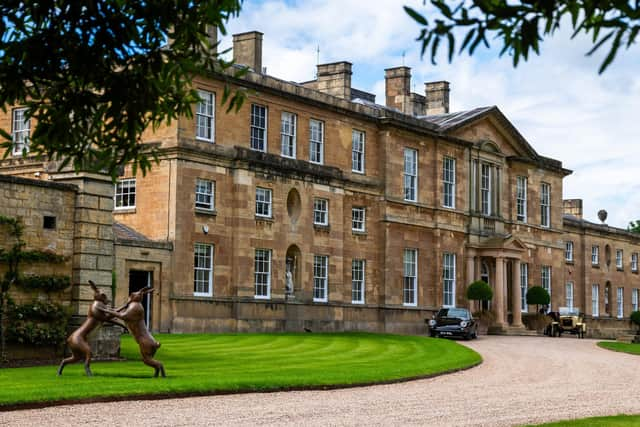
With a 1,735-acre estate to the west of the village, work began on the grade I listed Classical style property in the late 17th century and has continued under its current custodians, this year’s Great Yorkshire Show president Nick Lane Fox and his wife Rachel, the tenth generation of their family to own it.
With a multitude of listed buildings, the summer change of use of some of its parkland, planned and laid out in the French manner of Louis XIV, to a venue for some of the North’s leading summer events has catapulted the village’s name into the consciousness of the masses.
While many tens of thousands of people are attracted annually to the four-star Defender Bramham International Horse Trials champion and the Leeds Festival, extensive efforts are made to appease the village’s 1,760 residents from their impacts, with heavily discounted tickets, a one-way system and road closures.