
Brandesburton, East Yorkshire: The wartime bravery that saved lives
Shortly after 8am on January 29, 1944, a Skipton-on-Swale based Halifax returning from bombing Berlin ran into poor weather near Hornsea and was instructed to land at RAF Catfoss, just outside Brandesburton.

While making a second landing attempt the Royal Canadian Air Force aircraft with a 104ft wingspan struck a tree off the Catwick Road, and the 26-year-old pilot, creamery worker William Stiles, ordered his six crew to adopt crash positions as the heavy bomber came down in the grounds of Brandesburton Hall.
Warrant Officer Stiles was killed, but his order saved the lives of his crew. His grave is 65 miles away at Stonefall Cemetary in Harrogate, but St Mary’s Churchyard in Brandesburton has some 45 Commonwealth war graves, including four unidentified airmen, dating to the Second World War, in a plot reserved for the RAF training turned bomber base, which in the early 1960s briefly served as a site for PGM-17 Thor, the US Air Force’s first intermediate-range ballistic missile with thermonuclear warheads.
Since the closure of RAF Catfoss in 1963 firms based at the complex have become a key driver of the local economy, fuelling demand for property in Brandesburton, attracting young people to work at firms such as Premier Modular, which in April announced it would recruit 50 extra staff as it moved towards round the clock working.

Another firm based at Catfoss Industrial Estate, Newlay Asphalt, in 2024 faced hundreds of objections from locals to its successful application to create the most technically advanced asphalt plant in Yorkshire.
Residents had argued the plans threatened many small businesses behind the important local tourism industry, which is sustained by its location five miles from the coast and the many former sand and gravel pits surrounding Brandesburton having been reclaimed as venues for sports ranging from jet skiing to clay pigeon shooting to golf.
Stocked with carp, rudd, tench, perch, pike, and protected by otter fences, eight-acre Brandesburton 3 and 4 Pond and Star Carr Lakes rank among East Yorkshire's most popular fishing venues.
Featuring water hazards as well as broad fairways, Hainsworth Park Golf Club, off Starcarr Lane, bills itself “a true thinking person’s course that rewards strategy and precision”.
Also off Starcarr Lane, Dacre Lakeside Park is home to the village’s bowling and cricket clubs.
Despite the wealth of sporting opportunities on the village’s fringe, ambitions to extend them further include creating a pavilion for Brandesburton AFC, which entered this season as the holders of the Hornsea and District Hospital War Memorial Challenge Cup, to serve as a "multi-functional community space". However, the proposal sparked objections from the village’s well established Pétanque Club, also based off Catfoss Lane, amid fears for their mature gravel terrains, which have been rated among England’s best.
It’s evident the green spaces overlooking open agricultural landscapes are particularly important to the village, the heart of which is dominated by back-of-pavement-edge properties.
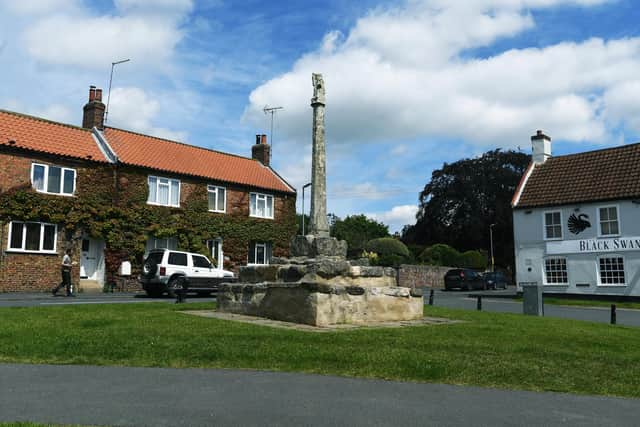
Alongside several historic cottages and a fish and chip shop Brandesburton’s compact Village Green features a medieval market cross which is considered the county’s best preserved and designated as a Scheduled Ancient Monument. The crioss, comprising an eroded 10ft high octagonal shaft on a square, stepped plinth, was once a meeting place for the Holderness Hunt and a venue for a market and annual fair, established in 1286 under a charter given to Sir Herbert de St Quintin.
The scene is completed by the Black Swan, a whitewashed 18th century coaching inn with a beer garden and an L-shaped bar beside a games room. Around the corner, but still on Main Street is Since the 16th century The Dacre Arms, which boasted stabling for 50 horses around its cobbled yard and historically one of its rooms was used as the local courtroom, while a lattice window overlooking the yard comprises some 150 glass pieces. It’s said the inn features a secret room used by smugglers which created to hide fugitives during the 1745 Jacobite rebellion and can accessed by a trapdoor.
Originally the fiefdom of the St Quintins after the Norman invasion, the manor of Brandesburton passed from Lord Dacre to the Lord Mayor of London, who with the Corporation, endowed what is believed to be East Riding’s oldest continuing school which stands opposite The Black Swan. In 2024 Ofsted rated it good in all areas.
Other points of interest off Main Street include St Mary’s Church, which has a chancel dating to the 12th century, three-stage tower and five-bay aisled nave and a converted cast iron gas lamp in the churchyard’s south-west extremity. On the north side of the street stands the early 18th century red bricked Rectory, alongside a coach house and stables.
Nearby, off Oak Tree Way, lies 18th century country house Brandesburton Hall, which in the 19th century was extended by big game hunter Colonel James Harrison, who in 1904 brought members of the Pygmy tribe of the Ituri Forest back from the Congo River basin to live in the grounds.
During 30 months in England, Chief Bokane, Princess Quarke and four others hunted birds and rabbits in the surrounding parkland, made arrowheads at the village blacksmiths as well as going on show in Brandesburton, where 3,000 people paid to see them.
The group also appeared at the House of Commons, Londesborough Hall in Market Weighton and at the assembly rooms in Beverley, Withernsea and Hornsea.
The hall was opened as Brandesburton Hall Institution for the Mentally Defective in 1932 and remained a home for children with learning difficulties until the 1980s, before becoming a nurses hostel, care home and most recently flats.