
Burnsall: Diminutive ‘Jewel in crown’ Yorkshire Dales village is defying pressures
With a population of just 156, Burnsall, dubbed a “jewel in the crown of the Yorkshire Dales”, continues to defy the pressures that constrain most small villages due to its popularity.
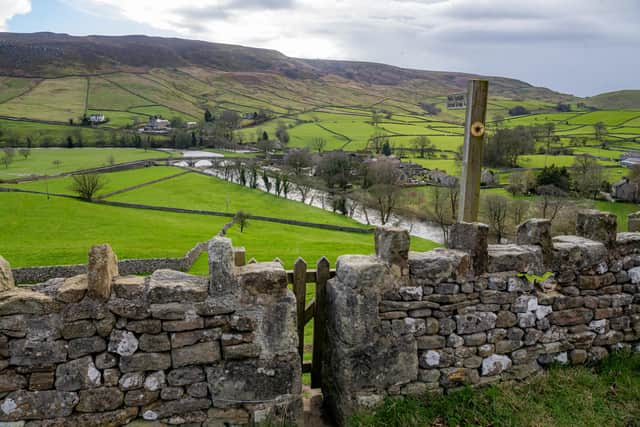
Close enough to industrial centres such as Blackburn, Burnley and Bradford yet a sufficient distance up Wharfedale to feel like being in the heart of the national park, its location and tourism has greatly contributed to the shape of the village.
Such is its popularity the village has a liberal splashing of double yellow lines, a relatively large car park on one side of River Wharfe, and another on the east bank, which dates back to 1952. On summer weekends the latter car park, Cross Field, can see several hundred cars. In addition, a stop on the popular DalesBus 74 route, Burnsall also straddles the 85-mile Dales Way and the Way of the Roses coast-to-coast cycling route.
There’s no shortage of accommodation for visitors with ten Airbnbs in and around the village, numerous other holiday lets, bed and breakfasts, alongside the 16th century Red Lion and Manor House Hotel, which stands overlooking the green. Featuring beamed ceilings and sloping floors, the inn has 12th century cellars said to be haunted by a ghost that turns off beer taps. Beside the pub’s car park to the rear stands 17th century house Riverside, which like the inn has a graduated stone slate roof.

Boasting impressive topiary and views over the village, it’s easy to see why The Fell Hotel was selected as a filming location for the 2003 movie Calendar Girls. Other establishments boosted by tourists in the village include Riverbank cafe, which serves home-baked offerings overlooking the Wharfe, which is flanked by the village green, another location in the movie as well as All Creatures Great and Small.
Overlooked by a spectacular circle of fells, the green has hosted celebrations for hundreds of years, including for the Feast of St Wilfrid and the annual Burnsall Feast Sports and Charities Day. One highlight of the annual August event is the Burnsall Classic, a race established in 1908 which sees more than 100 runners scramble up and down the 386m Burnsall Fell and back to the memorial bench-lined green.
Beyond the green, which has its own committee of volunteers to maintain it, on a low ridge are Anglo-Saxon carved stone circles, which some have claimed align with the rising sun at certain times of year.
As well as being a community focus, the green has been the target for others. Shortly before May Day celebrations in 1991 Burnsall villagers found their new maypole was missing and less than two miles away at Thorpe, a similar one, flying the Union flag, concreted into the village green. The incident was remarkably similar to one involving both villages reported in 1804.
On a more serious note, those using the large green spaces beside the river for picnics and games have beeb reminded about safety following a tragedy involving a man in an inflatable in 2024 and the Yorkshire Dales Rivers Trust discovering high levels of E.coli bacteria in the water in 2020, despite the site being awarded bathing water status by Defra the same year.
Although the green and river are the focal point of Burnsall it is its 17th century ashlar bridge which takes the noteworthy landmark prize. Its three large segmental arches and smaller ones to each side can be seen while approaching the village.
While the village has been administered from Northallerton since the 1970s, the early 19th century Bridge House, opposite the bridge, features a white West Riding of Yorkshire county bridge marker at the foot of its boundary wall beside a plinth-height stone wall with original railings.
Arriving in Burnsall from the south, points of interest include Calgarth House, a ruined 17th century farmhouse, built with coursed squared stone, in the centre of a field beside the river. As the lane winds through Lower Burnsall, a striking latre 19th century Methodist chapel rises up beside diminutive historic cottages, boasting a single-light pointed arched window and a tower rising to short octagonal section, above a moulded cornice and square stone spire topped by a weather-vane. Since its closure the building has been repurposed as the home of Hebden Lodge Nursery and Pre-School. Conveniently for parents, the village’s other educational establishment, Burnsall Primary School, is just yards up the road in a three classroom building which has welcomed pupils since 1602.
A panel above the door records how it was built with a donation by William Craven, who was born in Burnsall, a year before he was knighted at Whitehall by James I and eight years before becoming Lord Mayor of London. Recent years have seen it become part of the Upper Wharfedale Primary Federation. Like the nursery, the school heralds its “idyllic” rural location enabling outdoor play and learning, as well as its proximity to the village hall over the road.
Beside the school is the Grade I-listed St Wilfrid’s Church, Burnsall, a Grade I listed building with a history going back to its foundation by St Wilfrid of Ripon before 700AD. Fragments of ninth and tenth century stone crosses in a mix of Anglian and Viking styles, including one which is six foot high, as well as hogback tombs were unearthed during a 19th century renovation.
The church is almost entirely Perpendicular, an architectural style which offers greater stability and allows for a more expansive use of stained glass to bring in a greater amount of natural light. Fronted by an unusual Victorian lychgate with weights controlling a central spindle, the church contains an 11th-century font carved with bird and beasts and mounted in a steel case a 14th century alabaster panel of the Nativity, found by workmen in 1859, in the vestry. It is thought the panel was secreted beneath the building during Edward VI’s six-year as religious images, statues and stained glass were destroyed.