
Carthagena Farm, Malton: Going down the Lleyn reaps rewards
Driving the combine may well be a thing of the past for one North Yorkshire farmer but combining his time between assisting his nephews in the family arable farming concern at Eddlethorpe, while building a reputation for his sheep at Menethorpe is what drives him today.
Andrew Hodsman has lived at Carthagena Farm since he was 17, having moved there with his parents John and Joyce when his elder brother David took on the farmhouse at the family home at Kennels Farm.
Andrew and his wife Louise’s main focus at Carthagena, since starting with Lleyns in 2013, has been their sheep, two pedigree flocks of Charollais and Lleyn breeding ewes. They have had notable success with their Charollais tups and producing winning fatstock at Malton livestock market at the annual Christmas Fatstock show and sale in 2024.
‘Sheep are the main enterprise on the acreage my wife Louise and I have here,’ says Andrew. ‘I’m also still farming with my nephews John and Adam, particularly during cultivation and harvest at Kennels Farm, but I haven’t driven the combine for three years.
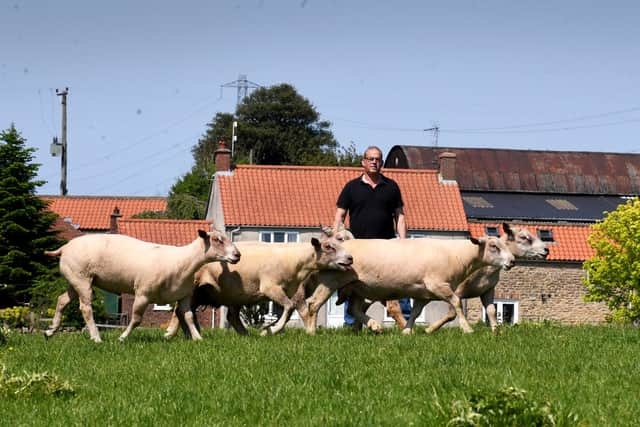

‘We started with Lleyns. Around half of the ewes are registered pedigree with the Lleyn society. Both our flocks are pretty much closed flocks, keeping our own females for replacements. All we buy-in are a couple of tups every three to four years. We’re up to nearly 80 Lleyn ewes. I put some to the Beltex tup every now and again.
Andrew tells of how he and Louise started thirteen years ago.
‘We purchased eight ewe lambs from Chris Leckenby of Oxclose Farm, Pockley and followed that up with some ewes from Linda Barnard of Hall Farm, Welham who is the regional secretary for North & East England Lleyn Sheep Breeders. Linda has been a great help to many breeders and has always been a great help to us.
‘Linda once said I could have the pick of any of her tups, because of something we’d done to help her. When I picked a tup Linda refused any payment for it. That’s the kind of person she is, and the one I picked was probably the best-bred tup we’ve had.
‘Unbeknown to me, while I was selecting, it had been the ram lamb Linda had judged as Lleyn champion at Balmoral Show. When it had come up at the society sale at Carlisle Linda had bought it.
Andrew says his and Louise’s two flocks lamb at different times of year.
‘We lamb the Lleyns in April and start selling fat lambs around September /October and try to get them away before Christmas, as our Charollais flock lambs in January.
‘We keep back around twenty to thirty ewe lambs initially and then select around fifteen as replacements in spring. We do sell some breeding ewes as breeding stock, but we haven‘t the grass to carry them through summer in addition to what we already have with lambs on the ground.
‘We enjoy selling Charollais tups and while neither of our flocks are MV accredited we have earned a bit of a reputation having started with them around ten years ago. We now have between fifty to fifty-five breeding ewes.
‘We usually keep about eight or nine tups, selecting the very best and go into them in great detail. We’ve been Signet recording for the last three years and those figures, on such as backfat scanning, are what have helped us select the best rams we can.
‘We mainly sell at Malton livestock market but we also have people who come and buy privately who keep coming back. We keep around ten to twelve ewe lambs as replacements normally, but this year we’ve kept eighteen as I’m looking to increase the flock to sixty.
Andrew and Louise are pleased with the response they’ve had from both other breeders and on the fatstock side.
‘Lamb has been a good trade for the past three years and we were up at £220 just the other week. One of our best buyers of fat lambs is Radford’s Butchers at Sleights. I was also really chuffed when we had champion at the Malton Christmas Fatstock show and sale 18 months ago. It shows we must be doing something right.
While the overall owned acreage of Kennels Farm and Carthagena is 330 acres, with Andrew having a half share, Carthagena itself has around 25 acres of permanent pasture and 15 acres of grass leys for the sheep, with another 10 acres of a local park in Menethorpe used for grazing through summer.
‘That’s the area we run our sheep on. During winter we also have the sheep on any stubble land on the main farm, where we have stubble turnips.
Andrew says the sheep enterprise provides a drawing for Louise that goes towards their day-to-day living, but that it is by no means a large income.
‘It doesn’t pay for a holiday or anything like that. We are very careful about what we spend and we aim to maintain or upgrade some machinery, but all our tractors and forklifts at Carthagena are secondhand. We run two classic tractors that we buy at sales at Murton. We can’t afford to be paying finance. We have a Case (David Brown) 1594, a red one. The other is a red and black Case 856. Our H registration JCB forklift is probably one of the best JCBs ever built and I don’t know how we’d manage without it.
‘We also have a hay field and make haybales that we sell through winter to a few customers who have horses.
The one farm diversification at Carthagena is Andrew and Louise’s daughter Leah’s flower farm.
‘Leah lives in the bungalow at the farm with her husband Shaun and their daughter and our granddaughter Emily. Leah, who is also a nurse at a local surgery, started with flowers when she and Shaun (Howe) married three years ago. She did all the flowers for it with her friend and her business started from there, growing her own cut flowers. She now supplies weddings and has a contract to supply bouquets for a business customer and trades under the name Honeysuckle Howse. She now has a workshop for flower arranging, Easter bonnet making and Christmas wreaths. She grows what she can on farm.
‘Louise also works at a cake company in Stockton on Forest and for another business that supplies desserts for wedding caterers.
For Andrew, it’s all a far cry from when he was in the thick of the arable action with his brother David who passed away around five years ago.
‘I didn’t feel that I needed the stress of running the larger part of the family business anymore, that includes renting two or three farms, contract farming for a couple of estates and various farming options. We combine about 2500 acres. John and Adam are very good at running all of that and we have expanded considerably with buildings and infrastructure.
‘I’m happy growing the sheep side here at Carthagena with Louise and producing quality sheep that sell well both for other breeders and at market – and helping Leah by providing potential for future growth of her own flowers from the farm.