
Conservation classes: Rare breeds pig farmer delivers lesson in caring for the countryside
Introducing farming, and how food is provided, to new generations while also saving rare breed pigs from extinction are among young lady farmer Rowan Simms’ guiding principles at Waterfall Farm in Ellingstring, near Masham.

“I had no idea of the amazing impact you can make by sharing experiences in farming with children,” says Rowan.
“And how some with special educational needs or other difficulties are able to benefit so significantly. We’ve had such positive feedback that it makes you realise how much difference you can make showing all ages what we do, how we look after the countryside, care for the animals and why we farm.
Rowan had planned on getting involved with education seven years ago when she and husband Tom took on what was a largely rundown small farm, but says building up their numbers of sows, starting their butchery and marketing produce took prevalence.
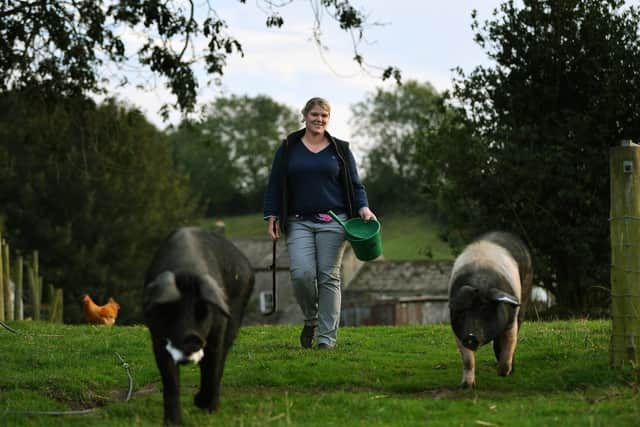

“We now have 19 breeding sows and gilts with around 100 pigs at any one time,” says Rowan. “We concentrate on rare breeds of Large Blacks, Saddlebacks and Gloucester Old Spots.
“The Large Blacks were the breed I started with on my parents’ smallholding and when I was younger didn’t realise pigs were mainly white, because we only had black ones. I always loved the type of pork the Large Black produces, a more traditional, tastier pork than supermarket pork because it has more fat, which adds to the taste.
“The breed was all but extinct and has been endangered on the Rare Breeds Survival Trust lists ever since it was formed. I began to get heavily involved with keeping the bloodlines going, something I’m also now doing with the Saddleback.
“Every breeder of any endangered species and breed keeps a very close eye on bloodlines at risk and there has been a focus on having a good geographical spread as risk strategy to ensure if something happens significantly badly in one area, such as disease that wipes out herds, then the breed isn’t wiped out completely.
“Conservation targets are put together and every year goals are published on the British Pig Association website. You can see maps that show where the pig herds are situated in the UK. Sadly, regardless of this the Large Blacks are still struggling and are still classed as critically endangered and are on the RBST’s priority list.
Rowan has several Large Black bloodlines in her herd including the Queen line, Nocturne, Sunshine and Golden Harvest and currently has quite a lot of Saddleback gilts.
“We’ve got behind the conservation programme for the breed through the British Saddleback Breeders Club and we’ve been trying to get some of their rarer lines that have got so low where bloodlines could be lost. The Alvis line had got down to just one sow and so the club bought her and she has been very carefully bred, looked after and her gilts are now coming through to keep the line going.
“They all still have to meet the breed standard and retention of the best is vital. We became part of that when we were contacted in spring this year to take the Alvis line on with a suitable gilt to have a presence to the north. It was an honour to be approached and recognition for our ongoing conservation work. Strategically we’re quite a good stepping stone here to try and get pedigree pigs into the north of England and up into Scotland.
Rowan’s growth of the herd has been accompanied by support from Swinton Estate in assisting her now Masham Pigs brand with appropriate facilities for the food side of her business.
“The estate has really got behind us. We now have a butchery facility and the capacity and means for holding our educational courses. We’ve now a kitchen where we slice and pack all our charcuterie and a separate butchery.
“One of the organisations we work with now is the Country Trust and we often see schoolchildren from underprivileged backgrounds, perhaps those who have English as their second language having been relocated through UK, or have only ever lived in inner cities. You can see the difference that just being with the animals makes and has a lasting impact giving them a moment they will remember the rest of their lives.
Rowan says the partnership she made recently with a North Yorkshire primary school teacher has given her education side a real boost.
“My plan was always to get the education thing going and Rebecca Clarkson is fantastic. Becca has a passion for what are now called STEM subjects, Science Technology, Engineering and Maths where some schools struggle to be able to deliver practical ways that children can thrive and learn from.
“Becca was looking for somewhere that involved what she calls messy science and had a background working for Ministry of Agriculture before she went into teaching so had that connection with farming.
“We now offer holiday clubs, where he have a little more flexibility over what we teach, and term time curriculum based education.
Rowan is now teaching at Askham Bryan College four days a week in addition to her farming, education at Waterfall, showing and marketing produce.
“I’m now course manager for those studying Level 1 agriculture, which can be for anyone from those who’ve maybe not had best journey through school, that can learn some farming experience and make them more employable.
“It came about after going through training funded by Farming in Protected Landscapes (FIPL) to be able to offer educational visits. We hosted a group of military people who had been leaving the army exploring future careers, undertaking a tour, talks, animal husbandry, and being in the butchery making sausages.
Rowan picked up Rare Breeds Farm of the Year in the Yorkshire Post Rural Awards 2024 and aside from juggling all of her jobs she also has three children – William (10) who showed Gloucester Old Spots this year, Pippa (9) and Eddie (1) of whom Rowan says, “They are all willing helpers.”