
Dunnington, near York: A scramble to live in sought-after area
Five miles east of York, Dunnington sits on bedrock dating back more than 240 million years on the east side of the A64, sandwiched between the A166 Driffield road to the north and the A1079 Beverley road to the south.

Its proximity to the city has made it a popular base for commuters since the 1960s. Dunnington has been ranked among Britain’s top places to raise a family due to the quality of schools, childcare provision, affordability of living and crime levels.
With views from the Vale of York village of the Yorkshire Wolds to the east, demand to live there has contributed towards its trebling in size in 60 years to about 3,000 residents.
This expansion has seen the village primary school on Pear Tree Lane, which converted into an academy in 2018, expand its pupil roll by about 20 per cent over the past 30 years.
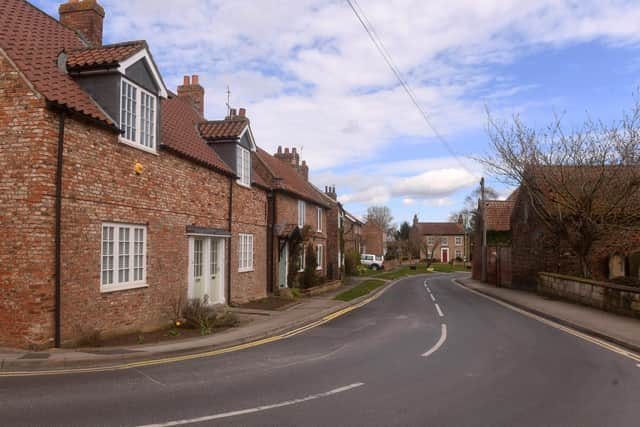

Alongside services such as a library in the Victorian Reading Room and former Temperance Hall on Church Street, GP surgery on Petercroft Lane and a dental practice on York Street, there’s a smattering of shops meeting everyday needs.
These are mostly located on York Street, and include a convenience store, hair and beauty salons and a pharmacy in a former pub premises.
Dunnington residents are well catered for. A mother and daughter team launched the Brew & Brunch cafe in October and residents expressed relief in December when a mother and son team took over the village’s last remaining pub, The Cross Keys.
Alongside regular community-focused events such as quizzes and curry nights, the inn offers an extensive menu featuring dishes such as beer batter cornichons and cauliflower steak jalfrezi.

Dunnington also lays claim to The Scrap Box fish and chip shop, just outside the large yet compact village, off the westbound lane of the A1079 towards York.
Earlier this year it scooped the Takeaway of the Year crown at the National Fish and Chip Awards.
Approaching the village from the busy route’s Four Lanes End junction to the south on Common Road involves skirting the Derwent Valley Industrial Estate before passing Hassacarr Nature Reserve, which was established three decades ago when Yorkshire Water sold its redundant sewage works to the parish council for £1.
An incredible array of species has been identified at the reserve, such as rare tubular water dropwort, scarce white-letter hairstreak butterflies and numerous types of dragonflies.
Despite abutting the industrial estate, it has the feel of a sanctuary, with the songs of birds ranging from chiffchaffs to dunnocks filling the air of the site, which once formed part of the Selby to York Derwent Valley Light Railway line, with a station and yard on Common Road.
Other prized green spaces in and surrounding the village, which make a significant contribution to Dunnington’s character are the allotments off Intake Lane and Hagg Wood further along the lane, so ancient it was referred to in the Domesday Book.
The lane also features an extensive, landscaped playground, which faces the volunteer-run Millennium Garden, which features maturing native shrubs and trees.
Nearly opposite the nature reserve on Common Lane stands what appears a huge red brick edifice in the open countryside.
While on the fringe of the village, the impressive social enterprise Dunnington Sports and Social Club has been at the heart of the community since the early 1970s, hosting functions and clubs and offering some of the best squash facilities in Yorkshire, including three glass-backed courts.
The venue has not been without controversy in the recent past with an ambition to install two padel courts rejected after objectors claimed noise would disturb people playing and watching bowls nearby, as well as posing a hazard to cricketers.
Further along Common Lane, the village’s main thoroughfare opens out, with generous greens featuring some horse chestnut trees planted in 1863 to mark the wedding of the then Prince of Wales to Princess Alexandra of Denmark. The greens are overlooked by numerous bungalows and a cycling artwork, marking the exit of Route 66, the National Cycle Network, from Dunnington.
A Victorian Methodist Church, which closed in 2022, stands as a landmark amid housing as the lane narrows towards its junction with Water Lane, where the curiosity of a mounting block fashioned from a glacial boulder can be seen in Kiln Cottage’s beech hedge.
Nearby, in the centre of the road at the junction of York Street, Common Road, Petercroft Lane and Church Street is a stone cross, surrounded by numerous historic homes. The original 12th century cross, which had a sundial added in the 15th century, stands in the garden of the former vicarage beside St Nicholas Church, where another ancient cross, dating to the 13th century can be seen.
The church, which dates from the late 11th century, has a nave with tall round-headed windows and an embattled tower with twin bell-openings to each side which was built in the 12th and 15th centuries. The place of worship is best known for its early 20th century stained glass.
While Church Street has held onto its rural appearance through hedges, a 19th century farmhouse, agricultural buildings and cottages from the era all serve to highlight the agricultural roots of the village named after Dunna’s Farmstead.
The village became renowned for the chicory it produced in the mid-19th century, when the industry reportedly employed 400 of the village’s residents. One of many chicory kilns in the village, a disused kiln, measuring 70ft by 40ft, remains at The Cross Keys pub.
In addition, names for Anglo-Saxon open fields, such as Thornhill and the Intakes, have been repurposed for village streets.