
Dutch spotted sheep - the breed that's making an impact at shows
One imported sheep breed that has had quite an impact in the showing world in the past five years is the Dutch Spotted and Deb Metcalfe of Leighton Hall Farm, Healey near Masham will be showing the best of her Dayne’s Folly flock at Kilnsey Show on Tuesday next week (August 26).
Deb farms with husband Chris and eldest son Ewan on the 800-acre hill farm that runs to 1000 feet and has its own enclosed moors stray with cattle and sheep both running to its height.
When Deb retired from her midwifery career in 2020 she decided to buy a breed of sheep she liked the look of and she could have fun showing and now Ewan, who looks after the farm’s commercial sheep operation that sees them with 700 breeding ewes, made up of 300 Mules and 400 Texel-crosses believes the Dutch Spotted is more than just a pretty face.
“I bought my first Dutch Spotted in December 2020 at Carlisle,” says Deb. “I’d had my heart set since seeing them at the Great Yorkshire Show that year. I wanted a breed I liked looking at, that I could take to a few shows, and something that would make an impact. I’ve not quite reached 20 breeding ewes yet, but they have done just that.
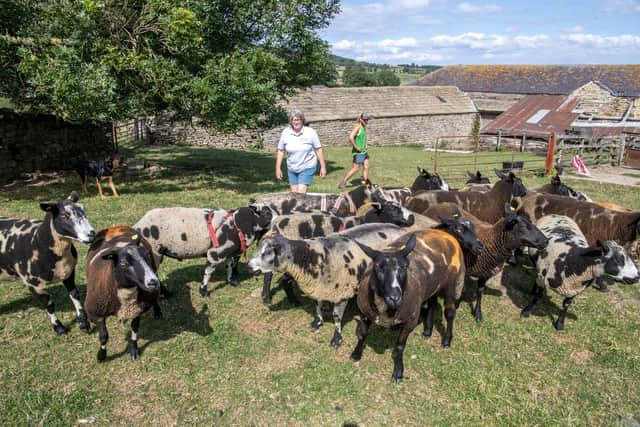

“We took them to Wensleydale and Reeth shows in our first year. We can’t take them to the Great Yorkshire because they are not MV accredited, but we enjoy going to the local shows to us and so far this year we’ve been to Aldborough & Boroughbridge, Ryedale and Arthington. We’ve Wensleydale, Kilnsey, Reeth and Masham Sheep Fair to come.
“We’ve done alright, but it’s more about having fun doing it. We had the Any Other Breed Champion at Wensleydale and Kilnsey last year. There is usually stiff competition in the AOB classes where our Dutch Spotted are alongside such as Blue Texel, Badger Faced Texel, Rouge and Bleu du Maine.
Ewan has seen the potential of the breed both in the show ring where he shows alongside his mum and in the sale ring.
“I like them, I think they’re a really good commercial sheep. I see their value and in my opinion the Dutch Spotted has to be a terminal sire. That’s how I want to breed it so that we and others can use it on commercial flocks to breed a quality fat lamb. At the end of the day everything has to pay its way and I see how it is possible with this breed.
“Their potential is already evident through their lambs. They are turning out exactly the right specification grades of lamb for meat and killing out at 50 per cent, which is a good commercial percentage.
“We are currently running Mules to breed our own whitefaced crossed ewes. By putting them to the best Texels we can afford to we get big strong ewes that run on our hill well, then we put the Beltex tups to the Texel-crosses to breed our commercial lambs, but we’ve also been selling a fair few gimmer lambs off our Beltex crosses in the past 4-5 years. We sold 40 gimmer lambs last year averaging £142.
“The Dutch Spotted are definitely creating a lot of interest at shows from commercial sheep farmers. We’ve sold tup lambs and tup shearlings to commercial breeders straight out of the pen.
Ewan says the trend of livestock markets to only sell whitefaced commercials at a premium, or rather anything else at a lesser price than whitefaced, is changing and that the Dutch Spotted may partly be bringing that about.
“The Dutch Spotted crosses are nearly always black but can carry a carcase and that’s what people are noticing. Ours are making good money.
Deb says they usually take a team of 10 to each show.
“We like to have two for each of the classes and usually end up with one at the top of the line and one at the bottom. Unlike other breeds there is no breed standard that has to be met at present over markings, other than a leg in each corner and a good mouth.
“We’re looking for a good carcase, and a more compact animal,” says Ewan. “Some are breeding a rangier animal like a Mule, so at shows it is difficult to know what’s best with the differences in the breed and being up against other breeds.
“We took two tup shearlings to Aldborough & Boroughbridge this year. One is like a Beltex with black spots, the other is like a Holstein bullock, and that one won. When we went to Ryedale the following Tuesday it was completely the other way round. It just depends on who is judging.
Deb and Chris are first generation farmers and they’ve had a journey that took them to Scotland and the North York Moors before coming home to their Dales roots.
“Chris comes from Grantley and I’m from Summerbridge,” says Deb. “His mum and dad have a smallholding and my granddad Billy Mason farmed at Appletreewick where my uncle Matt Mason farms with his son and my cousin Ted. Matt was chief sheep steward at Kilnsey Show and is president this year, just like my granddad was. Ted’s a very successful fell runner and will be commentating on the crag race. It’s always been a show I’ve gone to.
“Chris and I bought a 78-acre farm in Aberdeenshire in 1989 where we stayed seven years and had our two eldest boys. We moved to a 100-acre National Trust farm in Bransdale in the North York Moors where we had another seven years and where Oliver was born.
“We’ve been here 24 years and tenant from Swinton Estate. We’ve always been sheep and cattle farmers. Since Ewan has come on board we’ve gone more towards commercial terminal sires. We lamb the commercials from April 5 and Dutch Spotted in January and February. We synchronise their lambing and do it all inside, but everything else is outdoor lambing as we haven’t the shed space.
“We buy-in our Mules as shearlings. We used to breed Mule gimmers but have no Swaledales now. We keep our own Texel-crossed replacements. Whatever commercials we buy are generally out of Leyburn where Chris is a director, but we also buy out of Northallerton. Our lambs are sold as stores at Leyburn and Darlington, and sometimes Skipton.
Deb says that Chris is the cattle man.
“We have 80 Limousin-crossed suckler cows and followers, and four Limousin bulls. We occasionally buy-in Blue heifer calves that go into the herd and are crossed back to the Limousin and we’ve dabbled with AI for different bloodlines. We breed all our own replacements for the suckler herd. Our calves go as stores at 9-11 months, usually selling from Christmas onwards.
Deb and Chris’ two other sons Finlay and Oliver are also involved in farming. Finlay works in agricultural contracting and Oliver, presently in Australia who’s working on a cattle ranch in Northern Territory. Ewan, Finlay and Oliver all play for Wensleydale RUFC in Yorkshire Division One with Ewan club captain. Ewan and Hannah have a young family with Bonnie and recently-born Darcy.