
Eastfield Farm, Bainton: Farm that’s a project for regeneration
Making your farm work the way in which you’d like it to, is the direction in which a couple, who are new to farming but not quite new, are looking to take Eastfield Farm, between Bainton and Lund, with their new venture The Wolds Project.
Lawrence and Jennie, we’ll come to their last name later, have been working alongside Jennie’s parents Chris and Rosemary Byass since giving up their London-based careers in May 2022 and moving back to where Jennie grew up, and are all now partners in the family farm that runs to around 285 acres.
During that relatively short time they have found a premium market for 50 acres of the farm’s wheat grown the way they want to; they have reintroduced livestock to what had become a wholly arable concern, and are selling lamb direct to the local community; and this summer, very soon, they will welcome their first holidaymakers to the farm’s new straw-built holiday cabins.
‘Around Covid time Jennie and I didn’t feel like what we were doing down south was a forever thing,’ says Lawrence. ‘We wanted to get to a more outdoor life’.
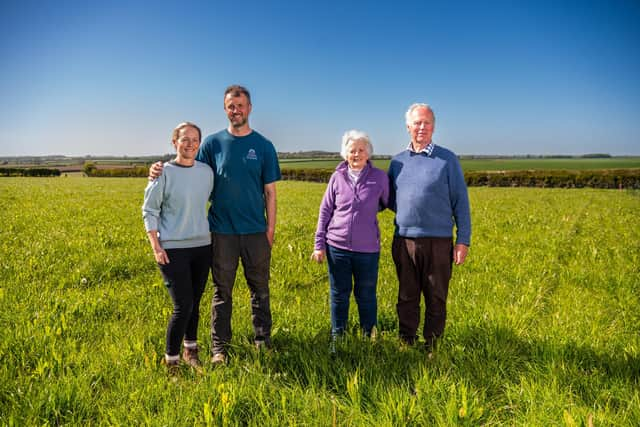

‘Jennie’s mum and dad were talking about what the future of the farm looked like, and it struck us there was an opportunity to move back to where Jennie had grown up.
‘We all knew the farm, on its own, would not provide enough income to support two families,’ says Jennie. ‘Lawrence and I had to think about diversification opportunities and that’s where The Wolds Project has come about, but it has become far more than that.
‘We talked initially about setting up tourism business ideas, while at the same time helping Jennie’s dad farm and learning the ropes,’ says Lawrence. ‘It wasn’t necessarily, at that point, with the intention of becoming farmers, but as soon as you start doing it you start falling in love with it, and now we can’t imagine our future when where we’re not farming.
While Jennie had grown up on the farm Lawrence freely admits he was, and in many ways still is, a novice.
‘There’s a lot of stuff you can learn online these days about anything, there’s a YouTube video for everything, but what there’s not is one telling you where to hit a piece of machinery with a hammer,’ says Lawrence. ‘In a lot of areas I have been way out of my depth and we are both very lucky to be able to learn from Chris.
Jennie pays tribute to her dad for his foresight, back in 2012, that aligns with what are now their feelings about care for the soil and growing crops naturally.
‘Lawrence and I have both become passionate about regenerative agriculture, farming with nature, but dad was already farming regeneratively having started direct drilling and using cover crops 14 years ago.
‘When we came back and had been reading Gabe Brown and attending Groundswell we had both committed ourselves to reducing chemical usage on the crop. Dad told us that if we wanted to do that, he was with us, but that we’d have to find a market for wheat produced that way.
‘We now have 50 acres devoted to regenerative biological farming where we are trying to bring soils back to life and grow a crop, and we’ve found a market. We now grow for Wildfarmed, which produces premium flour.
‘We are growing a higher quality product and receiving the premium payments for our time and effort. We’re growing a four-way blend, as we find blends are useful to mitigate disease. Dad has just started growing a couple of blends on some of the rest of the wheat acreage.
Eastfield Farm’s cropping currently runs to around 100 acres of winter wheat; plus borage, linseed, peas, beans, legumes and this year the return of oilseed rape across 25 acres.
Jennie works closely with her dad on soil and cultivation.
‘We’re on medium clay loam and have heavier patches but generally it’s pretty good land. Dad has been direct drilling since 2012 and we have not used the plough since then, but we are just starting with some light surface cultivations, using low disturbance subsoiling to get a little air and aggregate back into the soil.
‘It is said that you have to earn the right to direct drill and that means being able to get some air in, to get the microbial life going in the soil, and in soils like ours, that are clay dominant, you need to look at an amount of tillage and cultivation that works with your land. We don’t want to turn the land over, but we do see a place for some low level, low disturbance cultivation.
‘A challenge for all farmers is how to stop grass weeds. We are still using herbicides, but we now rarely use fungicides and have cut out insecticides, but grass weeds are my biggest battle. My belief is if we can change the profile of the soil and get the biology going and the fungal populations growing the grass weeds won’t thrive, it’s a slow process.
The return of sheep to the land provides a new income, as well as life on the farm, something that pleases both Jennie and Lawrence.
‘Lawrence and I feel really strongly about having better connection with where our produce is going and giving our customers something we would want,’ says Jennie.
‘I grew up with sheep and when we came back we both felt really passionately about reintroducing livestock and grazing the sheep across the cover crops. It makes the farm feel alive again.
‘We have Exlana sheep, shedders. Dad used to shear a lot of sheep and when we talked about having sheep, he thought shedders was the way. We met an Exlana breeder at Groundswell who put us in touch with two breeders that helped us establish our flock, which currently runs to 30 breeding ewes. We’re halfway through lambing.
‘They are very low maintenance, high welfare and they live and lamb outside the year round. They provide excellent quality lamb that we rear and then sell locally as full or half lamb boxes, processed and butchered locally too, as The Wolds Project Lamb.
‘We also now supply Plates by Oxalis in Beverley; and the local pub in Huggate, The Wolds Inn.
Lawrence says their venture into tourism is nearly ready to roll.
‘Our first straw cabin is just about to be available, with two more planned. We see three pillars of what we do. The regen of the soil; high welfare livestock; and sustainable agri-tourism. We want to connect people to food and where it comes from. We’ve other ideas but we are walking before we run.
‘Jennie’s dad was our inspiration. He’d built a summer house out of straw. It’s a beautiful story to have built something out of materials from the land, and the straw was baled from the field where the cabins will sit. We’ve built them ourselves with great help from local builder and our butcher Sam Atkinson.
Lawrence and Jennie’s name is Tatlock.
‘Everyone knows the name Byass around here,’ says Lawrence. ‘It’s easier if we stick with that.’
www.thewoldsproject.com