
Egton: The stunning Yorkshire village that really hits the heights
Between the moorland villages of Glaisdale and Grosmont and six miles from Whitby, Egton stands about 180 metres above sea level on the northern side of Esk Dale.

It's 52 years since the linear village, which extends steeply up a spur of land from the valley floor, transfered from Whitby Rural District in the North Riding of Yorkshire to become part of Scarborough Borough in North Yorkshire.
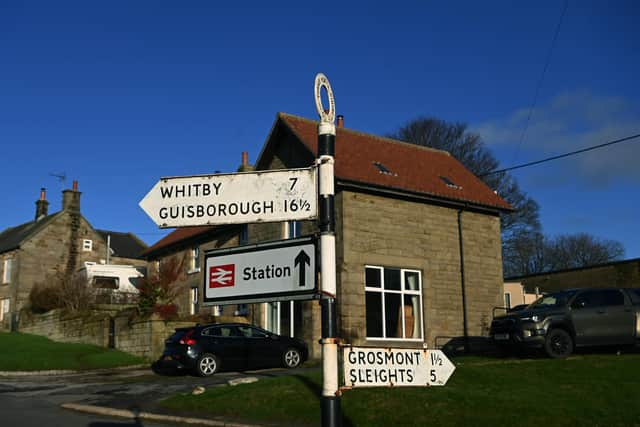
Traditional black and white North Riding Council road signs add character at the top end of the village, which is thought to have been planned and laid out by the Normans.
Historians have recorded how in 1269 Henry III granted Peter de Mauley the right to hold markets in the village on Wednesdays, but little evidence remains of the early incarnations of the settlement other that the simple street pattern, comprised of numerous traditional farmhouses, agricultural buildings and rows of cottages set behind extensive grassed areas.

However, most significantly for Egton’s development, was legislative change in 1952 which saw it become part of the North York Moors National Park, meaning extra protections.
Consequently, most of the small-scale modern developments are sympathetic to the vernacular sandstone with a grey hue and pantile roofs.
In addition, with the exception of new housing, former council houses and a few large farm buildings, the area around Egton Cliff and High Street is a conservation area.
Among the oldest buildings is Cross View a 17th century cruck-framed thatched cottage encased in tooled sandstone at the junction of the High Street and the lane to Grosmont.
Nearby is the Wheatsheaf Inn, which dates from the 18th century, and offers pub classics, as well as the Witching Post, known as the start or end of the Gallon Walk, an eight-mile, eight pub, eight-hour hiking challenge.
With the openess of the north end of the village, It is easy to imagine historic markets being staged near to where Egton's spectacular annual rural showcase is staged, with a backdrop from one of the highest settlements in the national park across enclosed farmland to the coast.
Egton Horse and Agricultural Show, which is among the region's largest one-day events, has traditionally included some of the region’s most extensive competitions for horticulture, home produce, horses, pigs, sheep and goats.
It has been run on the fields for more than 140 years and in 2022 villagers voiced outrage over a short-lived proposal by the Marquis of Normanby’s Mulgrave Estate and Egton Estate to build nine homes, relocate a public car park and build mixed industrial units on the show site east of the High Street.
Egton Estate, which has been owned by the same family since being bought in 1869 by renowned textile manufacturer John Foster, of Black Dyke Mills, Bradford, consists of 4,995 acres heather moorland, all of which is designated as Site of Special Scientific Interest, 500 acres of commercial woodland, 500 acres of pasture and arable, four miles of salmon and sea trout fishing.
High society magazine Tatler has ranked grouse shooting on the estate as among the country's finest, and highlights how moorland management for grouse benefits species such as golden plover as well as the UK’s smallest falcon, the merlin.
In 2022, the estate won a conservation award for its abundant lapwing population.
Grouse shooting is viewed as key to the sustainability of the estate, as well as the local economy, employing dozens of locals with spin-on benefits to hospitality and other businesses in the area.
The Foster family's influence can be seen in buildings such as the grade II listed St Hilda's Church, on the main route into the village from the south, Egton Cliff.
The mid-Victorian place of worship features a marble cartouche memorial tablet to the First World War on north aisle wall, carved with foliage, scrolls and angel heads, carved royal arms above the south door and an arms box made from oak from Nelson's flagship, HMS Victory.
Near the church stands Egton House, a former vicarage which was bought in 1969 to be a destination for Guiding and Scouting groups. For many visitors it is their first experience of being in the countryside.
The village is also a magnet for cyclists.
To the village's south-east, the road from Grosmont, Egton Bank, is a 1.7km climb and bridges 150m of vertical ascent with an average gradient of 8.7 per cent.
Meanwhile, Egton Cliff starts to ascend from the station, passing the Postgate Inn and is steep straight away, reaching a gradient of at least 25 per cent, of not the 33 per cent gradient on a warning sign in the village.
Last summer saw a group of villagers walk and run up and down the hill for 12 hours to raise funds for Yorkshire Air Ambulance, climbing a combined equivalent to six Mount Everests. Cleveland Wheelers cycle club describes the ascent as "hard going out of the saddle stuff".
Further up the hill is another of the village's communal buildings dating from the 1870s, Egton School, which Ofsted rated as 'good' two years ago on account of its "values of trust, friendship and respect" being "lived out by all”.
Egton also benefits from a village hall which serves as a hub for community groups and hosts regular fundraisers, last month staging a Carols by Candlelight event as well as Esk Valley Medical Practice.
However, residents say the village's infrastructure has been put under strain in recent years following approval of a polyhalite mine to the north-east of Egton.
While multi-national firm Anglo American has recently held a consultation with villagers over forthcoming proposed developments, three years ago it abandoned plans to transform Ladycross Plantation Caravan Park into a temporary village for about 400 mineworkers.
Responding to the temporary village proposal one resident wrote: “We were convinced the mine would have minimal disruption to the village. So far, this is far from true. The road is constantly like a dirt track...”