
Espersykes Farm, Old Malton: Farming family are going for a padel
Fitness and wellness are where a North Yorkshire farming couple is looking to expand its business enterprise beyond its arable and livestock roots, and they are the latest to join the world’s fastest growing sport of padel.
Fitness and wellness are where a North Yorkshire farming couple is looking to expand its business enterprise beyond its arable and livestock roots, and they are the latest to join the world’s fastest growing sport of padel.
James, his wife Laura and his father John farm in partnership and have recently moved from a farm in Scagglethorpe to Espersykes Farm in Old Malton from where they feel they are well-placed for their local community.
‘We’re just a mile and a half out of Malton and not far from Pickering,’ says James. ‘We moved to Espersykes eighteen months ago and the farm includes ten commercial tenants that let farm buildings.
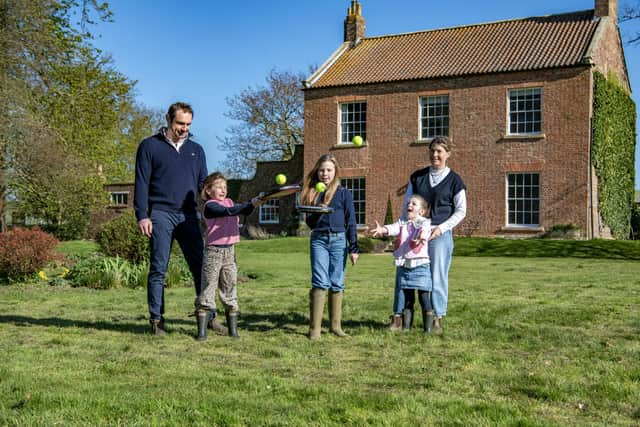

‘We felt that the current popularity of the sport of padel was something we could get into and we are looking forward to opening two courts shortly. We’re hoping that, in the longer term, that will open doors for us to attract more public activities, perhaps like a gym and fitness instruction.
The Kilbys farm around 800 acres of their owned and rented land at Espersykes and Rillington and also contract farm for other farmers bringing their total farmed acreage to 1250 acres.
‘Arable farming provides our biggest income and that arable is all we do on the contract farming side, while we have a mix of livestock on our own land. Our cropping mostly revolves around cereals. We keep things relatively simple by growing wheat, barley, oilseed rape, beans, peas and sugar beet.
‘We have around 500 acres of winter wheat and we grow around 250 acres of that as Group 1 milling wheat with the lion’s share of that going to Bradshaw’s at Driffield. Our main current variety is Cheer, but we still have some Crusoe and Skyfall.
‘Cheer did fairly well last year, so we’ve redressed a lot of that. The rest is all feed wheat, which is nearly all Beowulf. It’s generally good 4-tonne per acre medium loam wheat land at Espersykes while over near Rillington it is more blowy sand.
The other cropping includes 50 acres of sugar beet that goes into the Newark factory as the family has 1600 tonnes of sugar beet quota; 100 acres of Craft winter malting barley, 50 acres of Buccaneer winter malting and 100 acres of spring malting barley Laureate with whatever they grow going into Munton’s Flamborough or Fawcett’s Castleford; 100 acres of oilseed rape, 100 acres of winter beans and 70 acres combinable peas for human consumption. They let 30 acres for potatoes and also have some permanent grassland. They also have land in SFI schemes that were previously in stewardship arrangements.
James says they buy liquid fertiliser and that the price of it is still riding high.
‘It is an absolutely ridiculous price at the moment. Our last load cost £380/tonne and that’s only 24 per cent nitrogen, with it being liquid. We do whatever suits the land on the day whether that means ploughing or minimum tillage and direct drilling. I don’t really see the point of trying to save £15 per acre on cultivation if you’re doing a proper job that’s not going to compromise your yield. That figure is peanuts compared to achieving another half a tonne per acre of crop.
James went to Askham Bryan College on day release for a year before spending two years at Bishop Burton College studying for his NDA in agriculture and then joined his father. He tells of how livestock has gradually been reintroduced.
‘We used to have sheep, but at one time we had no livestock. We now have pigs on a bed and breakfast arrangement for Ian Mosey, who we’ve been with four years; a lambing flock and overwintered sheep; and cattle.
‘The pigs come as weaners at five weeks and leave after another nine weeks. We put up a building specifically for them.
‘We lamb 120 ewes and buy 300 store lambs to run on through winter. They are all quality Texel crosses and we buy and sell everything through Malton Market where they attract the buyers because of the quality. The lambs we produce are too good to go deadweight as we get them to 50 kilos. Even if you might get a few quid more somewhere else it doesn’t make sense to us, as that’s another half a day’s job.
James says the cattle numbers have fluctuated over the recent past because of their move to Espersykes.
‘We sold what we had when we moved, which were dairy-crossed Blue calves we bought as weaned calves and took through to fat. We now have 65 cattle on that come to us at around 180 kilos and we keep them until they’re fat with Elite Beef.
The team at Espersykes and across the whole farming enterprise includes James, John, a full time lad, Harry Wood, who is an apprentice and studies at Bishop Burton College and the team is supplemented by self-employed farmers during peak season, with Laura handling all the paperwork and farm secretarial side.
James says his dad is a typical farmer and still has a very keen interest in the job, but has always given him his head.
‘Dad has always trusted me to get on with the job. He loves his agronomy. We have an independent agronomist but dad is fully qualified and has seen the changes in cropping from the days of the 60s and 70s of not having sprays. He knows about cleaning up the land and has caught the bug of increasing yields through working with the physical makeup of what is used on the land. He is switched on to buying straights as cheap as he can and, to a point, making the chemicals we use himself.
James says that contract farming is most definitely what he prefers rather than being an agricultural contractor.
‘I don’t like ‘fire brigade’ contracting where you are at the mercy of the phone. We’re not set up to do that. If someone says ‘can you farm me 400 acres’ then yes we can, because we will set ourselves up to do that. That’s what we do.
The Kilbys were contract farming at Espersykes for the Peacock family before purchasing it from them and moving over. James believes that move set them in good stead.
‘While the Inheritance Tax thing was going on we found that we were marginally ahead of the game because the move to Espersykes meant that we’d had those conversations.
James and Laura now have the next generation growing up at Espersykes with their three young daughters, Beatrice (10), Violet (7) and Etta (5).
Laura, who comes from a farming family on the Castle Howard Estate says she and James have a busy social life, largely through the girls.
‘They all have ponies and are with Middleton pony club. We go everywhere with them from Ryedale Show to club events and I’m on the pony club committee. Beatrice and Violet play hockey for York City and they all do swimming clubs and gymnastics.
‘We were both involved with Young Farmers Clubs. James was with Rillington and I was with Amotherby. I studied land and estate management at Harper Adams and worked at Ampleforth College for 10 years.