
Flamborough: Village that plays the host on the coast
Synonymous with the spectacular elevated headland it sits at the centre of, Flamborough’s cliffs count their seasonal visitors, both human and avian, by the thousand.
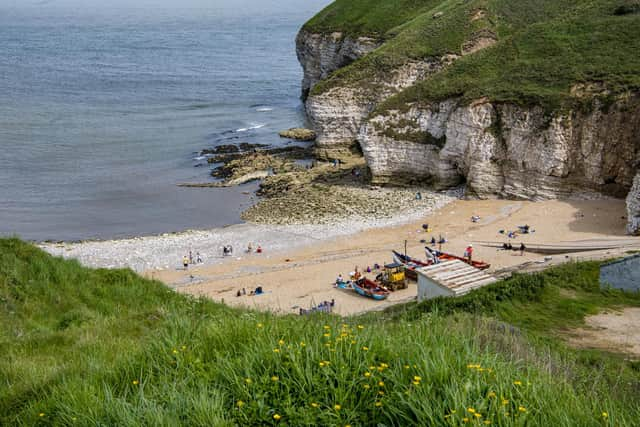
Designated a Heritage Coast site, some 4,000 puffins annually make their way from the Bay of Biscay, or having spent the winter at sea, to re-establish the country’s largest mainland seabird breeding colony on the 400ft-high formations, coves and shingle beaches outside the village. That’s not to mention the mass of auks, kittiwakes and gulls.
An encroaching colony of Atlantic grey and common seals often takes a nap on the shingle beaches or play near the lighthouse, the foghorn beside it or by the distinctive Drinking Dinosaur rock formation. The world’s second largest fish, a basking shark, has been filmed swimming off the headland.
North of the village, ornithologists like to watch small birds such as warblers making landfall after crossing the North Sea at RSPB’s flagship Bempton reserve, which forms part of the headland. Within the area, Flamborough Bird Observatory, one of 20 centres sited at key migration hotspots in Britain and Ireland, will later this month host naturalists at its seabird festival, hot on the heels of the Yorkshire Wildlife Trust’s annual puffin festival.

Visitors were also drawn to the prominent peninsular last month for the fifth edition of its festival of flowerpot figures and to see the flowering of species such as pyramidal orchid and carline thistle near the clifftops and scarce species such as long-stalked cranesbill, fragrant orchid and rue-leaved saxifrage in cuttings through the chalk. So when Daneswood Caravan Park, in Bridlington Road, put forward a successful proposal to double its pitches, it was met earlier this year with residents expressing “tourism saturation” concerns.
The dramatic coastline sees more than its fair share of human drama too. Last week Bridlington and Filey Coastguard Rescue winched to safety a resident who became stuck trying to retrieve a bag dropped down the cliff at Pigeon Hole. It came just weeks after the crew rescued someone trapped at Thornwick Bay. April saw two others rescued at Flamborough Head after being cut off by the tide.
The shoreline is popular with locals too. The Flamborough Flippers sea swimmers meet most mornings before work, to plunge into the invigorating waters. More dramatic still, in 1779, an epic naval battle, involving a Franco-American fleet attacking a Royal Navy convoy, paving the way for the US Navy took place beneath Bempton Cliffs.
Alongside two designated reserves touching the shoreline, the 148-acre Danes Dyke reserve extends across the headland to a pebble beach and comprises an ancient wooded ravine and a huge earthwork believed to have been created in the Bronze Age from compacted stones overlaid with chalk blocks.
In addition, to the north-west of the village and south of Bempton, earthworks forming a scheduled monument emphasise the medieval village of Newsham, which was deserted by 1600 due to enclosures and sheep pasture changes. Flamborough is protected by an array of designations, including one protecting its unusual submerged chalk reefs, Europe's most northerly outcrop, which extend miles out into the North Sea, and a conservation area characterised by many of its buildings having been constructed with the headland’s chalk.
These include Flamborough’s most remarkable building, in a field off Lighthouse Road - an octagonal four-stage tower built in 1674 as a lighthouse to which passing mariners were supposed to pay a voluntary tax on reaching port. However, with sailors denying they had passed the bright white tower, its owner Sir John Clayton soon became bankrupt. At the end of Lighthouse Road there’s another lighthouse, which dates to 1806, with a 27m-high conical tower.
Other chalk buildings include the ruins of the tower of Flamborough Castle, which cuts a solitary figure in a grassy field, off Tower Street, at the heart of the village. Despite being crenalated in the 14th century the building was never a castle, but rather a fortified manor house which became derelict after owner Sir Robert Constable was executed in 1537 for helping lead the Catholic Pilgrimage of Grace uprising. The castle is overlook by an imposing yet simple stone cross war memorial. On Tower Street there are also poignant memorials to the six sailors who died in the 1909 Flamborough Coble Disaster and the seven lost in the 1984 May Day double fishing vessel tragedy off the cliffs.
Other green spaces include an extensive and immaculate village green, Camerons Gardens off Tower Street, a former pond site at North Mere Green, a manicured area featuring the village’s conserved water pump on Crofts Hill and the 8.5-acre wildflower meadow and woodlands Whelkie Wynds, just to the east of the village, near the cricket pitches at Woodcock Memorial Playing Field.
The centre of the village, four miles north-east of Bridlington town centre, features cottages and farmhouses mostly built in the 18th century from chalk found on the beach at North Landing or local quarries, and there are many impressive walls built using it, while other historic buildings incorporate shoreline cobbles.
These include the grade II* listed St Oswald’s Church, on Church Street, which dates from the 11th century and has a list of previous incumbents including the father of 17th century poet, satirist and politician Andrew Marvell.
The church is appropriately dedicated to the regional patron saint of fisherman and seafarers, given the fishing heritage of the village, a bustling small port from the early 14th to the later 16th century, when two 40 tonne fishing vessels were added to the fleet for deep sea fishing.
A family, which has been fishing off Flamborough from cobles for centuries and runs East Coast Shellfish and The Boathouse at North Landing, is set to relaunch The Ship pub on Post Office Street next month. Meanwhile, on High Street, there’s the popular live music venue the Rose and Crown Hotel as well as Lighthouse Fisheries, which has secured a place in the final of the English Fish and Chips Awards.
The Fishermans Memorial
The Parish Council thanks Paul L Arro for the following which tells of the day of the fishing disaster that lead to the erection of this memorial to remember those who perished:
"There was no indication on the morning of the 5th February 1909 the weather would deteriorate so rapidly and with such ferocity. The offshore men who worked off to east'ard had not put to sea as the weather was poor but it was thought to be alright for the inshore men. Some 40 or 50 fishermen had put off to the inshore grounds in their sailing cobles but by 0800 the wind had veered quickly from the south west towards the north and a full storm developed. The force of the gail whipped up the sea into mountainous white topped waves which threatened to engulf the whole fleet.
The cobles made a run for the North Landing and all were doing the best they could to get home. One coble, the Gleaner, was passing the West Scar and almost safely into the haven of North Sea Landing, when she was struck by a big sea and knocked completely down. Sea after sea struck the coble and she was overwhelmed, her crew of John Cross and his sons Robert and Richard were thrown into the raging water.
The No. 1 station lifeboat, Forester, launched and although double manned, twenty men pulling on the oars instead of the usual ten, she could not get more than fifty yards from the beach.
Another Flamborough coble, the Two Brothers, crewed by Melchior Chadwick, Tom Leng Major and George Gibbon had been running for the haven astern of the Gleaner. When it was seen she had been overwhelmed, the Two Brothers ran up alongside the coble. With great difficulty the three men in the water were grabbed by the crew of the Two Brothers, each man clicking hold of one of those in the water and pulling him into the coble.
It was feared by those who witnessed the event from the shore that the Two Brothers could not survive, as she was in the midst of a boiling, raging sea. In an instance of getting those three fishermen aboard, a sea came up and hit the Two Brothers turning her head into the cliff and then another sea totally swamped her. The six men were struggling in the merciless sea and in a very short time had all disappeared beneath the raging waves.
Another Flamborough fisherman, Robert Knaggs, who had been in the coble Felicity that day, and who get ashore safely, stated that the Two Brothers and her crew would have landed safely if they had not gone to the rescue of the crew of the Gleaner. As soon as they saw them in distress, they went to them without any hesitation whatsoever.
The funerals of four of the six drowned were held on the 8th February 1909, George Gibbon (34), Tom Leng Major (18), John Cross (44) and Richard Cross (17), the four coffins being carried by local fishermen to the Parish Church of St Oswald. The body of Melchior Chadwick being recovered from the sea near the King and Queen rocks on Tuesday 16th March 1909. All five fishermen were buried in the local cemetery and their graves marked with identical headstones. The body of Robert Cross was never recovered.
This day was described as one of the saddest days in the history of the village.
A monument was erected in Chapel Street, paid for by public subscription, as a fitting tribute to the heroism and bravery of the crew of the Two Brothers. This was unveiled on 19th August 1909 by the Mayoress of Bridlington, Mrs C G Southcott, who had inaugurated the fund for its erection. Together with the names of the six fishermen who perished that day is the inscription "Greater love hath no man than this that a man lay down his life for his friends". A very fitting tribute indeed.
One member of the Flamborough Lifeboat crew that day vowed that he would devote the remainder of his life to the saving of life at sea. His name was Robert Cross, the brother and uncle of the ill fated crew of the coble Gleaner. He became a famous coxswain of the Humber Lifeboat and one of the most outstanding and decorated lifeboat coxswains of the Second World War. During his service with the Royal National Lifeboat Institution at Spurn, he won the George medal and was awarded two Gold Medals, three Silver Medals and two Bronze Medals by the Institution."
Paul L Arro
The Carol Sandra Memorial
This memorial is located on Fishermans Gardens next to the Fishermans Memorial at the junction of Tower Street, Carter Lane, Chapel Street and Post Office Street. The Memorial was erected by the Parish Council to commemorate those who lost their lives on 7th May 1984 on the vessels "Carol Sandra" and "North Wind".
On that day the Carol Sandra and crew left Bridlington harbour to move crab pots and were not seen again. The coble was found upturned in Silex Bay at the Lighthouse and all the crew (Guy Brigham 62, son Peter 29, Robert George Gray 19 and a friend Barrie James Shilton) were missing. Fishing boats joined lifeboats from Flamborough, Bridlington and Filey and a helicopter from RAF Leconfield to search for survivors. This included the fishing boat the North Wind, which had been hired by a party of five from Doncaster to go line fishing for the day from Bridlington. The sea overwhelmed their boat and washed all five overboard. The boat's owner tried to pick up the men but huge waves turned the boat over and the owner and his son (Palmer and David Cockerill) were trapped underneath the boat until they managed to get out and were rescued from the rocks. Two of the five who had been swept from the fishing boat were rescued from the sea.
All from the Carol Sandra and anglers Stephen Burton, David Bunting and Charles Priestly perished that day.
Flamborough's Coastguard Vic Crosthwaite was honoured for services beyond the call of duty by Britain's chief coastguard, Filey lifeboat man Malcolm Johnson was thanked for his bravery by the RNLI and Flamborough man Steve Emmerson was awarded a bronze medal from the Royal Humane Society.
The Parish Council minutes of 3rd December 1984 shows a decision was made to erect a permanent memorial to commemorate those who lost their lives and by 1st April 1985 approval had been given by the bereaved relatives. A 2' 6" square stone was erected by D Mooney, Bridlington, on the fishermans gardens, facing south, by "May Day" of 6th May 1985.
Due to public request, this memorial was restored in early 2005 when the marble plaque was taken away and cleaned, the anchors and inscriptions were re-cut and black re-enamelled. The stone was re-fixed and a railing was erected in front of it to try to prevent vandalism. The work was paid for by a donation from relatives and the Parish Council.
Flamborough Methodist Church
Chapel Street
Danes Dyke, the spectacular two and a half mile ravine that separates the outward five square miles of the headland including the village from the rest of England, it a massive ancient earthwork shrouded in mystery. The southern half was formed by nature but the rest up to the cliffs in the north was dug by men who threw the excavated earth on the Flamborough side for a high defensive bank to protect against attack from the west. One theory is that the artificial half was dug by the Angle invader Ida who landed his army here from a fleet of ships in 547 AD. When the Vikings came between the 8th and 10th centuries they would also use it for defence, and maybe did more work on it, hence the name. However, someone before the Angles and Vikings could have created it and they simply followed. More has happened here than we will ever know.
The origin of Flamborough's name is unclear but one speculation drawn from an Icelandic saga is that it comes from Flayn or Fleyn, brother of the founder of Scarborough, because a medieval name of the village was Fleyburg. Another guess is that it comes from a Norse word for spear because the headland is like an arrowhead pointing out to sea.
By 1066 when the Normans came, Flamborough manor was owned by King Harold who died at the battle of Hastings. Norman rule led to the Constable family from Chester settling here in the twelfth century and they stayed 400 years. They built their great house across from the parish church of St Oswald's, which they may also have built. All that remains of the house is the old tower, now a white stone ruin in Castle Field near the village centre, but humps in the ground where other buildings stood will surely attract archaeologists to explore more fully in future. The Constables got royal permission to crenellate - make battlements - in 1351. In their time there was a pier at South Landing on Bridlington Bay used by traders and fishermen but
Flamborough produced a chancellor for Elizabeth I in Sir John Puckering, who went to London to study law, became a barrister, an MP and Speaker of the House of Commons and was made Lord Keeper of the Great Seal by the Queen in 1592.
However, village families who go back furthest from today and make it unique are those of fishermen. For many centuries they overcame perils and hardships of living a mile from the sea with no harbour, only two launch-and-land beaches in gaps in high cliffs and, because they were on a headland, rapidly rising seas and exposure to gales and sudden North Sea storms in small open boats. Until marine engines came in the 20th century, drowning was a major cause of premature death. Engines for vehicles as well as boats brought profound changes in the 20th century. They enabled Flamborough men, previously limited to fishing daily from the headland in small open oar-and-sail cobles, to go five miles to Bridlington Quay and sail in much bigger boats with engines from the harbour. However, a few cobles still use the landings and stacks of crab pots and gear can be seen outside village houses.
In earlier times cottages were built of chalkstone from cliffs and beaches and thatched with wheat straw from headland fields but most older buildings of today were brick-built in the 1800s. Headland roads and village centre streets are almost unchanged from centuries ago except that tarmacadam has replaced broken stone surfaces. Features as well as the church and castle stump include signs of medieval fishponds near the main road into the village, the old lighthouse built in 1674 and the new lighthouse nearby which dates from 1806.
Flamborough Village Hall was built by local people in memory of the sons of Flamborough who gave their lives in war. It opened in 1938