
Flaxton, North Yorkshire: Much more than just a village green
A century ago a historian wrote Flaxton was "a large hamlet with a station on the York and Malton line... built on either side of an extensive green".
While the station to the north of the former Ryedale District village closed to passengers just a few years later, the settlement has remained small, with about 150 properties and a population which fell by almost ten per cent between the 2011 and 2021 census surveys to 316.
Despite being just nine miles from the centre of York and three miles from its suburbs, the village has also retained the rural character of a bygone age, with cattle grids, several working farms, a main thoroughfare named Bull Moor Lane, and a sprawling green.
Registered as common land, Flaxton Green is recognised as a Site of Interest for Nature Conservation. The scale of the common land is remarkable, stretching from the main street and Rice Lane from the cattle grid at Scotchman Lane, the cattle grid at the Strensall end of York Lane and along Cross Lane and Oak Busk Lane.
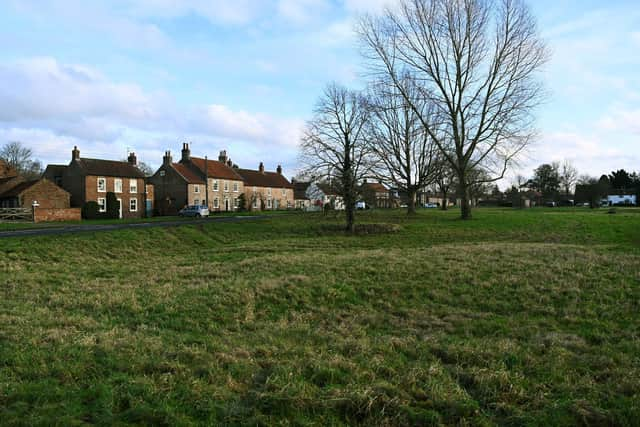

The appearance of the vilage green is just as remarkable. Its custodians, voluntary asssociation Flaxton Green Gait Owners, encourage "vegetation suitable for grazing animals" and leaving grass uncut to encourage the proliferation of wildflowers. Residents are advised early and frequent mowing affects Environmental Stewardship payments used to maintain the green.
Numerous rules governing the Green have ensured its conservation. While everyone has the right to walk across it, people have "no right to stop or deter others by putting up fences, stones or other materials". However, cars are allowed to drive across the Green and park up to 15 yards from the road.
The parish council website states: "If you have not established a right of way for yourself and found your car was blocked in by a large lorry parked on the common land next to the highway, so called the police to get it moved, you might find that the lorry driver had committed no offence, but you had!"
Police were called to the village and residents evacuated from their homes last May when a suspected Second World War bomb was discovered during renovations of an outbuilding off the main street before being detonated by the Army.
Another discovery, in a field to the west of the village, has included a lead casket, unearthed in 1807, the same year the slave trade was banned in the British Empire.
Thought to date to the early 10th century, it contained a Viking silver armlet which has been displayed at the Yorkshire Museum, 270 well-preserved Saxon silver coins, silver rings and several pieces of spurs and was named the Bossall/Flaxton Hoard.
The village's heritage has been preserved through a conservation area, covering much of the central area and The Crofts, northeast of the main street. which will this year reach its 40th anniversary.
On the east side of the green, stand buildings such as the 18th century Village Farmhouse, Elm Tree Farmhouse and the Tuscan columned Flaxton House as well as the 19th century listed Greenside and Westfield.
Probably the most striking building in the designated area, almost opposite the main thoroughfare's junction with York Road, is Flaxton Old School, which remained a Church of England school until 1987. Going against the grain in the village, the listed mottled red brick building features blue slate roofs with deeply overhanging eaves, a tower featuring a clock by William Potts of Leeds set behind a white picket fence.
Notably, the school was built to educate Flaxton's residents, with specific reference to the children of the labouring, manufacturing and other poorer classes, three years before the Education Act established a legal framework for providing elementary education for children aged five to 13.
Above the north-west porch a stone plaque states the school, positioned centrally on the main village street, was built with funds raised parishioners and the rector. The school was established 14 years after the nearby Church of St Lawrence, which unlike many Anglican places of worship in Yorkshire villages, has not been deemed worthy of being listed or be described as a landmark. Set back from the road, the small stone 13th century Gothic style place of worship features a bellcote with two bells. Its lych gate serves as a memorial to 12 men from the village killed during the First World War.
Another community building, Flaxton's village hall, which stands alone on the green, is set to mark its centenary next year and remains used for community events and parish council meetings. The authority is overseeing the implementation of an extensive Village Plan designed to not only protect and enhance the village’s character, but also help to foster and strengthen a sense of community.
Ahead of the plan being agreed, during a survey villagers identified the Green as the most important feature, followed by the trees and hedgerows, footpaths and bridleways, and wildlife and habitats. The village’s historic properties were ranked the least important. However, owing to the village hall’s poor state of repair and being unsuitable for many of the activities villagers want to pursue there, plans have been lodged to demolish it and build a new community hub with an increase in floor area of 114sq m. Due to the protections on the common land consent will need to be sought from the Secretary of State to to resurface the car park.
Just to the north of the village the family-run Thompsons Arms which was named York CAMRA’s Spring Pub of the Season in 2023. It is open nightly, has a beer garden and welcomes dogs.
Another key community venue, The Blacksmiths Arms on Rice Lance closed in 2021 due to staffing issues. However, residents say they are looking forward to the inn reopening refurbished and under new management in the coming weeks.