
Forest Poultry, Alne: ‘We need more help in poultry sector’
Food security, high health animal welfare standards and providing secure employment and accommodation for an increasing team are all high on the agenda for Harry Shepherd’s Forest Poultry enterprise that has grown massively from one shed to thirty-one in the past thirteen years.
It is Harry’s passion for developing the business and his dedication to the sector that saw he and his right-hand man Tom Kendal pick up the Poultry Farm of the Year title at the recent Yorkshire Post Rural Awards held in Harrogate.
Harry started with broiler chicken on his parents’ family farm near Easingwold after studying at Harper Adams and having worked harvests in Australia and for an agricultural contractor in Lincolnshire. He is now one of the most respected in the latest generation of poultry farmers in the country and believes that in order to keep heading in the right direction support is required.
“I believe that food security for the UK in the poultry sector is so important,’ says Harry. ‘And If we don’t get support for the developments that are required to make us more self-sufficient, through local authorities giving the go ahead, we will see even more chicken coming from abroad at a lower standard of bird welfare and the whole sector’s future in this country could be at risk.
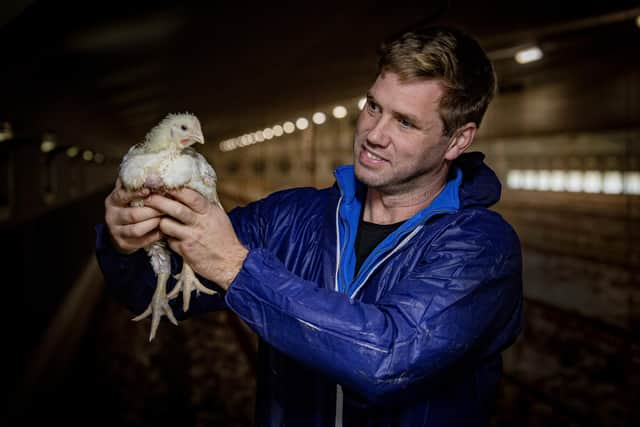

“We’re only 60 per cent self-sufficient in chicken broiler production, which is crazy given the amount of chicken consumed in the UK. Our stocking densities are 25 per cent less than on mainland Europe. We look after our birds better than anyone else. That all translates into better quality chicken.
“I’m passionate about the broiler sector and expanding our business. I’m looking at the development side, with Tom in charge of the day-to-day business as general manager.
Forest Poultry has accelerated its output massively in the past two years and having employed a team of six in 2023 it now employs a full-time team of 17 that includes a production manager, area manager, farm managers, farm assistants and poultry sheds washing team over several sites from the Easingwold area to Selby.
“Getting the right people is vital,” says Harry. “You cannot increase the way we have without them, and we want them all to remain.
“The first thing we look for from anyone who wants to join us is their attitude. Is it positive? Our roles involve long hours. We need commitment and you can’t be any further than 10 minutes from the farm if you get the chicken alarm. There are night checks, there’s catching at stupid o’clock in the morning which affects your sleep pattern.
“We’ve invested heavily in accommodation and have some really good homes on our own farms. Forest Poultry has purchased houses in local villages and on the farms. We make a point of getting the wives or partners involved in the properties too. We really try and make sure we build and give good accommodation for their families so that they’re hopefully going to be with us for a lot of years to come.
“We offer career progression too. We want to have more chicken sheds and more broilers, so there are opportunities to take other roles including a farm manager’s role on a new farm.
“At one point we were struggling in getting the performance we wanted for the broilers out of the farms and thought the problems were the washing out standard for the sheds. We now employ our own members of staff and have invested in our own equipment to wash all the sheds, and the birds’ performance is a lot better.
Forest Poultry now has 1.3 million birds on the ground at any one time across its various sites. Harry says it is all quite different to when he started.
“I started the business on my parents’ family farm with one shed and 40,000 birds. Our latest and fourth phase took place last year with two new sites further from our initial base.
“All our birds are high welfare under the Red Tractor standard, they all benefit from having low stocking density and go into the retail sector with full traceability and accountability. Where we are at is stocking at 30 kilos per square metre, mainland European is at 40 kilos.
“Most of our broilers go to M&S, Sainsbury’s, ASDA and Tesco. It can be quite a volatile market but at the minute it’s pretty good. That’s because of the lower stocking density as in doing so this has reduced capacity. We now just need more sheds to increase our capacity while keeping the stocking density where it is.
“Growing consistent chicken quality and growing our business are my two main drivers and lower stocking density changes have given us a platform where we really need to look at greater development in the sector.
Tom, who also studied at Harper Adams, as well as working in broiler production in Australia and recently earned a poultry scholarship, tells of Forest Poultry’s commitment to the birds.
“We get day-old chicks brought on to the farm from local hatcheries and ensure that every shed is in the best condition for those chicks to thrive in a happy environment. Everything we do is about allowing the bird to grow naturally so that it can support itself and perform to the peak of its genetic capability through a balanced and sustainable feeding programme.
“The chicks receive a starter diet of easily palatable crumb and then three further rations applicable to growth. We have a transition feed that takes the bird on to a grower ration for the grow-out period, and a finisher ration to maintain the weight. Those rations are all specifically designed to give the bird what it needs at the right time. They are reared to around 1.8 kilos.
“Our current bird is the most predominant broiler breed in the country using Ross 308 genetics. There is constant work undertaken by industry professionals assessing for traits to bring into breeding programmes in a holistic approach, not selecting for one trait in particular, such as growth.
Tom says that Forest Poultry is currently averaging 7.44 crops a year on a 7-week cycle and that high bio-security standards are essential.
“We are all in and all out on all our individual sites and avoiding cross contamination. Our cleanout periods are approximately one week.
Harry says that Forest Poultry is still on its journey and that its five-to-ten year plan is to build more sheds, have more birds on the ground and in so doing employ more in the poultry sector. He’s a busy man, as is Tom, and Harry puts his desire down to his dad.
“My work ethic has come through my dad, David, and support from my mum, Shirley. Dad was a dairy farmer and he’s still working now in his mid-70s. I now have a young family of my own with my partner Sam and our two young children Fena and William. Tom has great support from his partner Rach.
“It’s all important. We are always really concerned about making sure we do things the right way at Forest Poultry, and the support we all receive from families and others allows us to move forward.