
Hunmanby: A seaside village with a host of history lessons
Local legend has it Hunmanby, or Farmstead of the Houndsmen, was the last place in England where 12th century monarch King Stephen, William the Conqueror’s grandson, kept wolfhounds to hunt wolves on the Wolds.
There’s nothing wild about the modern day village, but with the coast about a mile to the west of much of Hunmanby, it benefits from the fresh coastal air.
Despite its location the village remains both unspoilt and retains a strong proportion of homes alongside numerous holiday cottages.
The main thoroughfare through the village, Bridlington Street, changes to become Castle Hill after passing a picturesque of pantile roofed shops and restaurants, including the family-run hardware and general store Ellisons, which has been trading for 70 years.
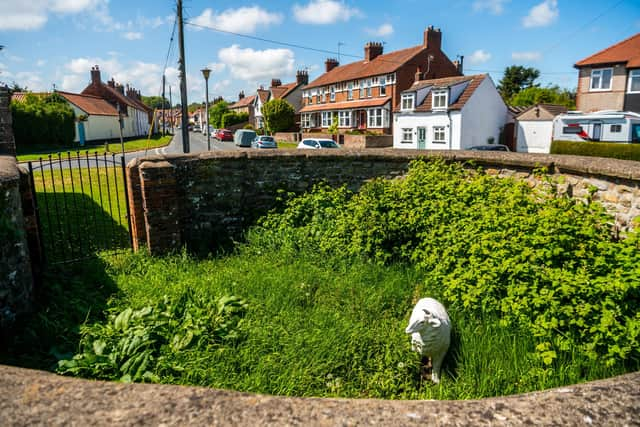

While there’s an array of shops and services ranging from an opticians to a delicatessan, there are several reminders of Hunmanby’s agricultural heritage in the central area, including several farmhouses, as well as a listed dovecote and carriage entrances.
Just behind the commercial area, on Cross Hill, a medieval market cross stands on a green. While documentary evidence has been unearthed of markets in the village in the 13th century, the cross was the site of an annual gathering on Martinmas Day in November for the East Riding custom of hiring farm hands annually.
Overlooking the green is Cross Hill Methodist Church, which replaced the village’s 19th century Weslyan Chapel, which now serves as the Co-op supermarket on the high sreet.
The Methodist Church dates from 1958 and is a particularly large place of worship for a village, seating up to 400 worshipers.
Also beside the green is a particularly striking obelisk-style memorial to the 40 men from the village killed during the world wars.
Each of the pediments features a carving in relief, such as an infantryman within a laurel wreath, flanked by an 18-pounder quick-firing gun and a 60-pounder breech-loading gun, as well as a scrolled cartouche, displaying the motto Ready Aye Ready.
Bookending the commercial area, the listed 18th century White Swan Inn is being refurbished and is set to reopen for a Father’s Day Roast.
The historic inn however is vastly predated by the 11th century All Saints Church opposite and its imposing Admiral’s Arch entrance, named after Robert Mitford, who was promoted to the rank at the age of 80 in 1861 and is said to have been the last Lord of Hunmanby Manor to live at Hunmanby Hall.
The church features a fortress-style tower and a chained Great Bible dating to 1541, so named as it was chained to the pulpits.
The main thoroughfare ascends past a wooded area where 11th century wooden fort Hunmanby Castle stood until its owner, Gilbert de Gant was defeated in a battle during a period known as The Anarchy. It was raised to the ground and all that remains are its 60m-wide motte and bailey earthworks.
Also in a commanding position above the village, opposite arable farmland off Hall Park Road, is Hunmanby Hall, an expansive red brick early 17th century mansion that was occupied by a girls’ boarding school until 1991.
Alongside flats and a leisure club in the hall, the site has since become home to a nine-hole pay and play golf club.
Last year saw a plan to build nine holiday cottages and demolish a sports building at the hall given the go-ahead despite objections from the parish council and more than 50 residents over the loss of a community facility.
Stonegate, a road featuring whitewashed and pantiled roofed historic homes, runs to the north side of All Saints Church.
It leads out of Hunmanby, towards the sea, but before the village limit there is the compact former village lock-up, built three years before Victoria became queen. the Black Hole.
Between the village and the sea stands an area known as Hunmanby Moor, lies the Primrose Valley Holiday Park, one of Haven’s largest family-oriented resorts, as well as a growing housing estate.
It’s 48 years since a rail link, known as The Butlins Branch Line, part of the Hull to Scarborough line, last brought holidaymakers to the resort as part of a package Billy Butlin negotiated with the London and North Eastern Railway for “campers”. However, as the station was to the west of the Royal Oak North crossing on the A165, holidaymakers then boarded a road train with their luggage which took them through a subway tunnel to reach the resort.
At the end of the summer holidays in 1956, it was the quick thinking of the Humanby Moor signalman that saved the day when a runaway train from Bridlington could not stop in the village and ended up smashing into the holiday camp station’s buffers. Steam locomotives such as Flying Scotsman and The Bittern used the Butlins Triangle while travelling to Scarborough on special excursions before the branch line’s closure in 1977, six years before Butlins closed its camp.
South of the tourist development there’s Sands Road, a popular destination for those seeking a beach-side car park.Last year a proposal for a house extension on the road was rejected due to fears the site will be lost to coastal erosion within 33 years. North Yorkshire Council’s coastal strategy states it is “an area that will not be defended and adaptation to coastal change is recommended”. While the tourist development has lost its station, the village has retained its stop on the Yorkshire Coast Line, which some have claimed was so sited at the village’s southern extremity due to the lord of the manor wanting trains to pass a distance from the hall.
Beside the station there’s a significant business park, which includes the Spirit of Yorkshire Distillery, which produces the region’s first single malt whisky.