
'It has been a tough couple of years' - Yorkshire arable farmer on the potent mix for cereal producers
Poor yields and plummeting grain prices are a potent mix for cereal producers right now but for arable farmer Richard Pears of Huddleston Hall, Sherburn in Elmet, those problems are exacerbated by his concern for all sectors of farming in his position as NFU West Riding County Chair.

“Since March this year we have the complete uncertainty of whether we will have the SFI available again, we have no indication of what comes next and it is unclear what funds the Government will have for any new scheme if the SFI is to be replaced,’ says Richard.
“The NFU received notification that the SFI scheme was to be curtailed just 20 minutes beforehand and following threats of legal proceedings from NFU-backed farmers three thousand applicants who had already submitted their forms received some form of agreement.
“Using its lobbying position, the NFU has been pressing the Government very hard to be honest about what money is available because without knowing we can’t have a serious discussion about how it could be best allocated.”
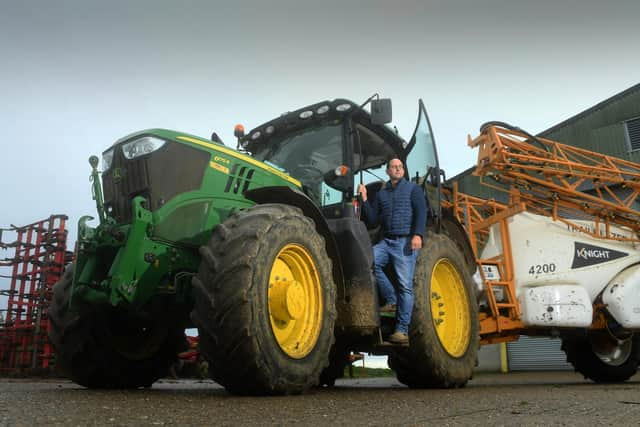

Richard says the IHT situation had already caused untold damage prior to the withdrawal of the SFI.
“In November last year IHT came out of nowhere. The fallout from that prompted demonstrations that are still ongoing. It has upended the whole farming industry.
“The biggest issue in all of this, as shown on television recently, is the damage being done to the wellbeing of people of a certain age and health, where gifting over seven years isn’t an option.
"It was very upsetting watching those telling what this has done to them. It raises the question of whether anybody in Government really understood what they were doing when coming up with this.”
Richard says the Cabinet reshuffle in September has lengthened the process of decision making.
“We now have RT Hon Emma Reynolds, the new Secretary of State for Defra; and Dame Angela Eagle, the new farming minister.
"It is frustrating because we’re all waiting on what’s next in ELMS and SFI and whether we’re being listened to over IHT, while Dame Eagle ‘understands the brief’.
“We feel there’s a very strong case that upland farmers have really lost out over what’s been delivered so far, where they were previously in HLS or Mid-Tier, which hasn’t been compatible with SFI.
"The options were heavily linked with restrictions on stocking limits and supplementary feeding. It’s never been a great offer for the uplands.
“Since Brexit the idea was to have a seven-year transition from direct support payments. We are now one year away and the formula proposed, about supporting environmental measures of society value, has gone.
"No-one has ever come out and said that’s no longer the vision, but we’ve no new schemes and no clarity of what is going to come.”
Richard says the NFU will continue lobbying ‘until the cows come home’ and there are plenty of policy issues actively being pursued on farmers’ behalf, specifically fairness in the supply chain reviews.
Back home on the 550-acre arable farm, where he farms with his father Nigel it has been a second successive challenging year.
“Our yields this year are 20 per cent down on average. Our five-year average was about four tonnes per acre up until two years ago.
"It has all been down to the weather conditions and establishment, which impacts on cropping and rotation. One bad year can take you a couple to get straightened out. It has been a tough couple of years for arable farming.
“We’re growing biscuit wheats for milling; spring and winter barley both for malting. We growing Laureate for distilling and Craft for beer, and we grow spring beans as well.
“For next year’s harvest we have 200 acres of winter wheat with quite a lot of Bamford, a biscuit wheat; Solitaire, a new Grade 3 biscuit we are trying for the first time; and a little bit of Zealum feed wheat.
"We’ve 75 acres of winter barley; and we’ll have 125 acres of spring barley and 75 acres of spring beans, growing Lynx ; with another 45 acres let out for potatoes. We store grain on farm.
“We have a bit of everything land-wise. We’re largely based on a ridge of limestone, but also have deeper medium clay loams, and on our small hilltops it can be thin and almost brashy.
"The home farm runs to around 380 acres and I’m the third generation. My grandfather Guy Pears came here in 1939, and we purchased the farm we had previously tenanted in 1997, which had been part of the Lotherton Estate.”
Richard says the farming focus is very much on improvement.
“The name of the game has been about cutting costs, using less inputs and creating more output. We have invested in new technology at times when equipment has naturally come up for renewal.
“We didn’t use any GPS such as autosteer and variable rate up until a couple of years ago because we had found it hard to justify on our area and we were lucky that we have a very skilled employee Martin, who has been here 50 years and followed his dad working here as well.
"But in the past two years we’ve managed to go from no technology to a lot of it without having to use a big injection of capital to get it.
‘Whenever you’re investing you’re calculating whether you’re going to get a return and we didn’t quite see it, but as time goes by and it comes to buying new machinery we found that a lot now comes as standard, and we managed to make use of a grant system.
“We used the Small Productivity Grant to get a GPS system, variable rate control and section shut off for our seed drill. We’ve also started doing less cultivation and more min-till. The SFI in 2024 offered funds for variable rate fertiliser application.”
Richard says the farm also has cover crops and 20 acres of permanent pasture.
Richard worked in London as a civil engineer until 2012 when he returned to the family farm and is married to Louise. They have two young sons – James and Edward.
“There was never any pressure on coming back home,’ says Richard. “Dad was very relaxed about it.
“I became involved with the NFU when I did the Cereals Development Programme in 2014. I now have a role with the Combinable Crops Board as well as being NFU West Riding County Chair.
"Hopefully, our lobbying will bring about better news for all of us in the future, even if we can’t lobby very effectively for better weather.”