
Langdale Moor fire: How Yorkshire communities are pulling together after devastation of moorland blaze
The huge blaze on the North Yorkshire moors has had a devastating effect on the region but communities pulled together and now calls are being made to prevent future catastrophes.

A month on and as the dust settles, literally, from the worst moorland fire seen in North Yorkshire for more than 20 years, thoughts have turned to damage limitation and whether the threat of fire – just metres from wiping out farms, homes and businesses – will return.
The cause of the fire has not yet been revealed, but what is known, is the warmest spring and summer on record and drought conditions made the stunning North York Moors landscape vulnerable.
Roads may have re-opened, businesses which closed are welcoming custom again, the smoke which has clogged the horizon, valleys and villages lifts a little every now and then depending which way the wind blows.
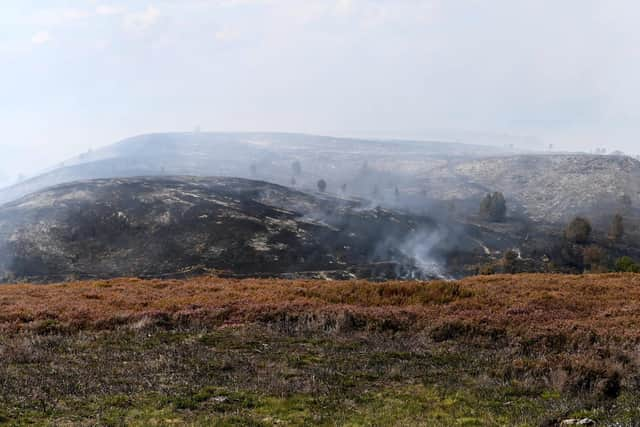

But this return to normal as people travel between Whitby and Scarborough for work, school and leisure is overshadowed.
Over the last few weeks images have been captured by drones, helicopters and photographers but it is not until you see it in person you really get an understanding of the scale and devastation of the fire which has covered 10 square miles.
This part of the North York Moors National Park skirts around Whitby, Scarborough, Robin Hood’s Bay and for years has been treating residents and visitors to the most spectacular sight of rolling countryside meeting the coastline.
A beautifully clear and bright day in September should be no exception, but now the sparkling blue sea and few remaining lush green fields somehow frame a charred landscape where smoke still seeps from underground and lone trees stand in isolation like blackened, splintered matchsticks.
Grit bins are melted, the road is pitted, footpaths have disappeared into ash, fences and gates are scattered like the remnants of a tornado. The sheep which grazed here are gone.
Yes you can hear cars passing by and the wind blows but the sound is drowned out by an eerie silence. The kind you get after a seismic event which fundamentally changes everything.
Andrew and Caroline Butterfield own Grouse Hill Caravan Park, off the A171 between Whitby and Scarborough. Andrew’s late father Wally started the campsite in 1976 to diversify his poultry farming business.
Everything they had worked to create was so close to going up in smoke.
Andrew said: “It was like a tsunami of fire and smoke.That is how it felt with the speed it was coming. There was a four mile wall of fire from Lilla Cross to the end of Maybecks. How can anybody deal with such a thing as that?
“I just thought ‘what will be will be’, you can’t do anything about it, we just had to deal with it. We did everything we could and it paid off. There was somebody looking down on us and I know who it is. My dad died at 90 and was coming up here three weeks before he died. He just loved this place.”
Cara Shardlow, who lives in Sneatonthorpe, said scenes were reminiscent of wildfire reports from abroad.
She re-located her horses to offers of safety at stables miles away and then watched as farmers, including her own family, fought for their farms and the landscape they call home.
“I had heard reports it was kicking off a bit more on the top moor but I could not believe what I was seeing”, she recalled. “It was like something on the news abroad.
“My dad jumped out of bed and got on his little digger and set off to the moors to start digging fire breaks. Every farmer in the area literally just headed to the moors. It was crazy. My dad’s brother was up there, his lads and that panicked me because my whole family were up there.
“They had no fire-fighting equipment. Even the firemen said if it was not for farmers it would have been different and it would have hit farms.”
Heroic farmers have been dubbed locally as the Farmy Army and a JustGiving page set up by local woman Amy Cockeram to help cover fuel costs for their fire-fighting efforts was only expected to raise £100.
It now stands in excess of £70,000 and is being distributed to farmers to pay for repairs and maintenance to the tractors and tankers they used to dig fire breaks and ferry water from the River Esk to the Moors.
Ms Cockeram said: “All the air filters on the tractors are knackered, they need new tyres because they are burnt. We also had a load of hay delivered to a farmer who has lost 200 acres of grazing land.”
Drop off points were set up at a local vet and supermarket for people to donate food and drinks for fire-fighters and farmers while local fish and chip shops and Bothams bakery sent food parcels.
Whitby ship builders, Parkol Marine, carried out tractor repairs as they arrived at the harbour to fill up with water and boat maintenance firm, Coates Marine, set up a generator on the slipway with a kettle, tea, coffee and snacks for fire crews and farmers to use when they were collecting water.
These are just a handful of the gestures made by local residents and businesses.
Ms Cockeram added: “It started for drinks and food and I set it up for £100. I didn’t even think I would get that and it just got going. When it got bigger I got the NFU involved because it was too big for me to handle. They will help distribute where the fund will go.
“It has been incredible how everyone has come together. It makes you proud to live here. The farmers are overwhelmed and it has given them a real boost.”
The North York Moors National Park (NYMNPA) is also now looking at grant assistance for farmers whose land will need repairs and maintenance works.
Tom Hind, chief executive, said the devastation was “incredible and quite significant”.
Short-term measures will include dealing with issues such as erosion, replacing and repairing signposts, gates and fences but moving forward, he added: “Discussions are now starting to think about how do we recover in a better and more resilient way that tries to reduce the risk of it happening again?”
When asked if those measures included land management tools such as controlled heather burning, he said: “It would be premature to speculate on what needs to happen next but we are mobilising and deploying quite a lot of resources across the organisation to play our full part in making sure we do that recovery and do it well.
“How best do we restore the natural environment but build in resilience needed to try to mitigate the risk in the future, recognising the reality of climate change?
“It is really important to learn lessons and learn lessons well and don’t start casting things around.
“That would be a discussion to the experts, people involved and landowners affected, led by evidence and science.”