
Limestone Ridge Nature Recovery Group's fertile grounds playing part in nature’s recovery
While many nature recovery schemes have traditionally been sited on marginal farmland, a group of conventional farmers working some of the country’s most fertile soils have embarked on a two-year project to demonstrate enhanced nature recovery alongside modern farming practices.

The Limestone Ridge Nature Recovery Group, based on the west side of Doncaster and comprising seven core farmer members, has been working to establish high-quality, grey partridge-friendly wildlife habitats on their land with the help of Dr Francis Buner, Head of Wildlife Recovery at the Game and Wildlife Conservation Trust (GWCT) for the past three years.
Partridge numbers across the Limestone Ridge farmers group have increased compared to last year’s first count, in line with indicative figures from GWCT’s Partridge count scheme for Yorkshire, where the last two years have seen grey partridge numbers more than double. The new habitats include numerous plots of specialist wildflower mixes developed by Oakbank and GWCT for patridges, four new beetle banks, and several kilometres of newly planted or traditionally laid species-rich hedgerows alongside fields predominantly featuring milling wheat, barley, potatoes and sugar beet.
The farms have recently sown five one-hectare patridge blocks which could be left to deliver for wildlife for a decade, but the GWCT is asking the farmers to manage them in a rotation to prevent the structure from becoming monotonous and to create a checkboard pattern across the plot. Within the blocks, strips of cereals have been introduced to provide additional partridge chick-rearing habitat and to help farmers to clear up potential weed burdens within the plots.
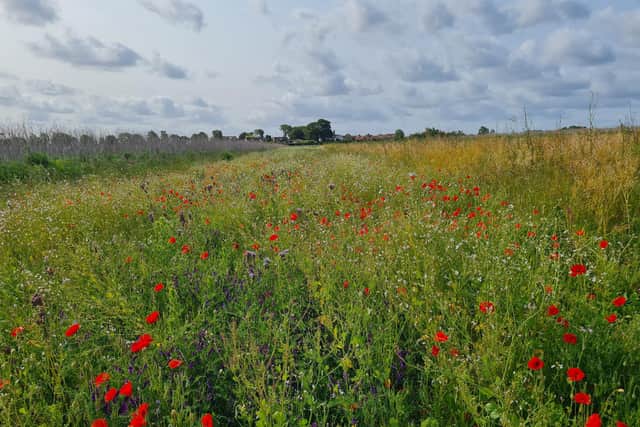

Dr Buner said: “Farmers are inherently reluctant to take any land out of production, especially on fertile soils. What is different in this project is that the Limestone Ridge nature conservation group farms on one of the best soils in Britain, if not the best, in terms of fertility, so traditionally they have not engaged much in agri-environment schemes, as the money they get from taking land out of production for wildlife-friendly habitats doesn’t come near to the profit they make from growing a commercial crop.” The group’s members use the grey partridge, the population of which the RSPB says has declined by 92 per cent since 1967 due to the loss of insect and seed food sources, nesting habitat and predation on farmland, as a motivator for the scheme, while understanding it is a strong umbrella species for farm biodiversity.
The grey partridges stay in the area all year round, meaning they need a range of habitats, including ones with an abundance of insects, as the birds’ chicks only eat insects in the first two weeks after hatching. Dr Buner said: “We know we need about 10 per cent of wildlife-friendly habitat on a farm to maintain high levels of biodiversity on farmland, including insects. You will only have lots of insects on farmland with lots of flowers. To recover one of the fastest-declining farmland birds of the UK, projects like the one carried out by Limestone Ridge Nature Recovery Group are key to saving this iconic species and to keeping their metabolism going.”