
Lister’s Crisps: The farming family behind the crisps which are ‘born and bagged in Yorkshire’
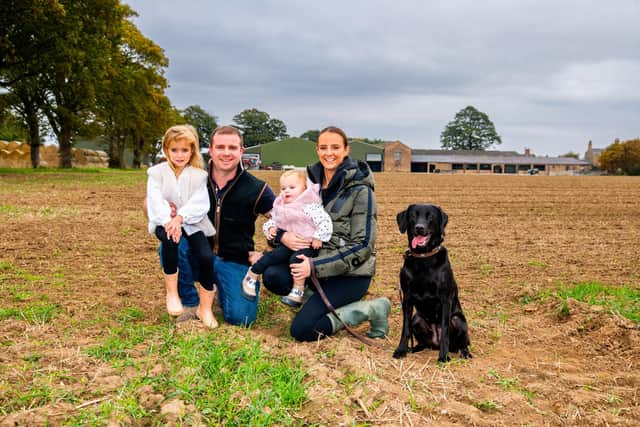
Six years ago, third generation farming couple Tom and Laura Platt of Sandhall Farm near Howden, saw the birth of two babies, one being their first child Autumn, the second their new brand business Lister’s Crisps, now promoted as ‘born and bagged in Yorkshire’.

Theirs is a very real farming success story that started with just one acre of potatoes for their hand-cooked crisps, produced on site in a converted garage.
They now grow 50 acres of their 300 acre potato crop for their crisps that sees production take place every day Monday to Friday in their now larger factory, still on-farm, employing a team of seven and selling 60,000-70,000 bags, of 40g or 150g grab bags per week.
“We run it together," says Laura, also from a farming family, the Brunyards of Haddlesey.
“I run the day-to-day side of the crisp business and Tom is the mastermind behind the factory. We both have our strengths, and we are both passionate about Yorkshire produce.
“When we first started we were small scale, using an old doughnut fryer. In 2020 we converted an existing barn and went to a much larger scale.
"We put in some brilliant secondhand machinery. We grew and things took off. Suddenly demand started to outstrip supply.
Get all the latest news straight to your phone with our new WhatsApp channel. Join here.
"We’ve since expanded again and recently put in a completely new line and new fryer. Everything is now British built and we’re far more efficient.”
Tom and Laura are both proud Yorkshire farmers and love the fact that the product they have created is wholly based where they live and farm.
“We grow our own potatoes, take them out of the field, into the yard, through the grader, through the washer, and into the holding hopper.

"From there they go through the slicers, into the fryer and are then packed, with a dash of seasoning added for customers to enjoy. Everything is done here, on our family farm.
“Our desire has always been to create the best tasting hand cooked crisps, offering a good crunch and amazing flavours,’ says Tom.
“We undertook a lot of research into how to get the exact consistency we wanted, making sure our crisps are not too greasy, that they’re thick enough and that they are the perfect crisp.
“We have been potato farmers here from the word go.
"My grandfather Roger and father William before me grew them and we’ve always been conscious of growing the right varieties of potato for all the markets we supply, carefully selecting the best varieties and choosing the correct soil types in which to grow them.
“The varieties we use for Lister’s Crisps are Lady Rosetta, an early variety, that keep us going until Christmas time, and then we move on to either Opal and Heraclea until the next season comes back around.”
Laura says the family and business ethos around what she and Tom have grown has also seen progression for their team too.
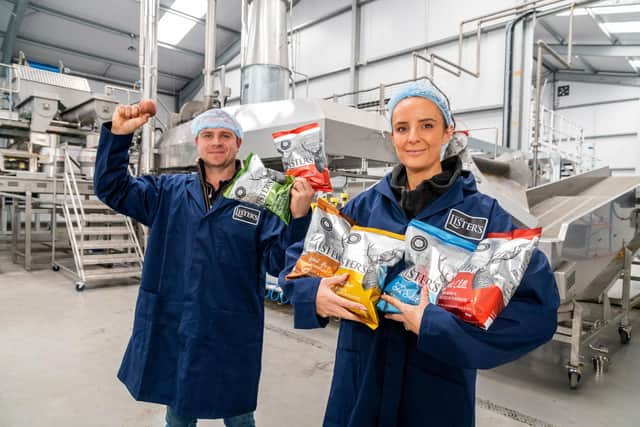
“Our factory manager has been with us since day one and she’s grown with us and the business. Amy is an integral part of our leadership team.
"We’re still a small but growing business where every member of staff can dip their toes into whatever part of business that fits for them whether that’s growing social media presence or the wholesale side. There are always mutually beneficial opportunities that will help us all.”
Laura’s university and former business career was in women’s wear, buying and merchandising.
“Crisps are a completely different market but we’ve a genuine brand story about a farming family and quality Yorkshire produce that people really buy into and once we gain customers we retain them through great customer service.
“The crisps market is pretty saturated but we’re doing well. We supply independent retail outlets, farm shops, hotels and as well as our really good coverage and presence in Yorkshire we’re expanding nationwide with wholesalers and distributors that like to work with independents.
“We currently have six flavours in our range. We’d love to try another and we’re just figuring out what that is. Our best seller is cheese and onion, closely followed by steak and ale.”
Tom says choosing the name Lister’s instead of Platt’s is a nod to his granddad William Lister, on his mother’s side.
“My granddad had his farm taken from him by the Coal Board. I wanted to do this to honour him. I think he’d be very proud of what we’ve achieved.”
The rest of Tom and Laura’s potatoes go into the prepack market, supplying supermarkets and into the chip shop trade.
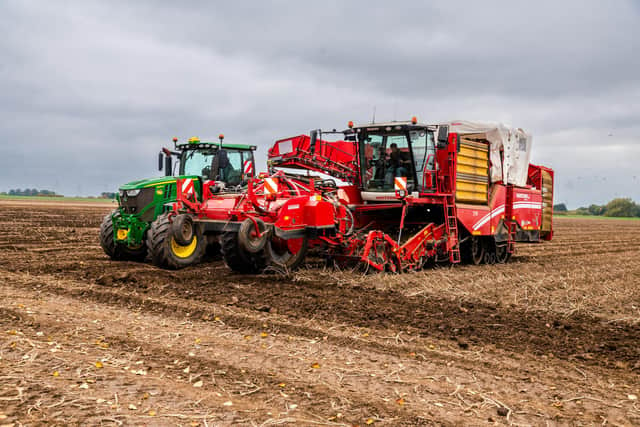
“We’re using potato varieties Sagitta, Nectar and Melody for the non-crisping side,” says Tom. “We’re currently lifting Nectar. Yields are proving very mixed depending on whether the land was irrigated or not.
“I never like to do any less than 18 tonnes per acre and on some varieties we can get to about 22 regularly and up to 25-26 tonnes. Unfortunately, the potato market is not looking too good at the moment.
“Roughly half of the 300 acres of potatoes is rented. On our own land I try and grow potatoes one in ten years as that is ideal if I can, to keep the soil as clean as possible.”
Tom grows around 2000 acres of cereals, made up of 1500 acres of winter wheat, 300 acres of spring barley and 200 acres of oats. He also grows 150 acres of spring peas.
“Our soil is a mix of heavy clays to heavy silts averaging around Grade 2 land. In a dry year, like this, you get the benefits of heavy land retaining moisture.
“Anything that was late-drilled either autumn or spring suffered, but as a rule our yields have been at least average on wheat this time, doing at least 4 tonnes per acre this year across our varieties Costello, Graham, Skyfall, Beowulf and Dawsum.
"In common with most, this was our earliest ever harvest for start and finish.
“We do make a bit of milling grade wheat but we are predominantly growing feed wheat. The proteins are a bit higher this year, so a little more will go for milling.
"I must have had a crystal ball last year, with the price being as it is now, because I sold a lot forward for this year.
“Our spring barley can sometimes pass for malting but is mainly going as feed this time, but my worst crop this year is oats as we were caught out with a storm at the end of harvest that blew all the oats out of the heads.”
There’s one other element to Tom and Laura’s farm. Their 100-strong suckler herd.
“We’ve a mix of Limousins, Blondes and Angus,’ says Tom. ‘We’re currently running two Blonde bulls and one Angus.
“We calve everything here at Sandhall. They’re weaned at six months and they then have another year or so. We finish them at around 550 kilos. Everything goes into Selby Livestock Market which I can’t rate highly enough.
“I also have a great team of six on-farm who do a great job.”
Tom and Laura now have two daughters Autumn and Alana, and all of what were their babies including the crisps, are growing very nicely.