
Long Bank Farm, Keasden: Farm always being at one with nature
The Tye Trophy is the most prestigious award for conservation and environmental improvements among farms in the north of England and Yorkshire Agricultural Society will announce its latest recipients at this year’s Great Yorkshire Show.
Last year’s title went to Long Bank Farm in Keasden near Clapham where Alan and Colin Price farm 250 acres with their herd of 50 pedigree Holstein cows and 250 Dalesbred ewes. They have always worked with nature and have a specific interest in summer wading birds.
‘Someone from Forest of Bowland Natural Landscape put us forward,’ says Colin, a staunch Yorkshireman. ‘The area covers all the way to Clapham. I’ve been involved in advisory committee meetings for over twenty years. I like to point out that two-thirds of the Forest of Bowland was, and still is, in the historic West Riding of Yorkshire.
Alan says it had become clear, some thirty years ago, the number of curlews, lapwings and oystercatchers on the farm was declining and since then their main focus, in addition to making a living on the farm, has been restoring hedges and protecting nesting sites.
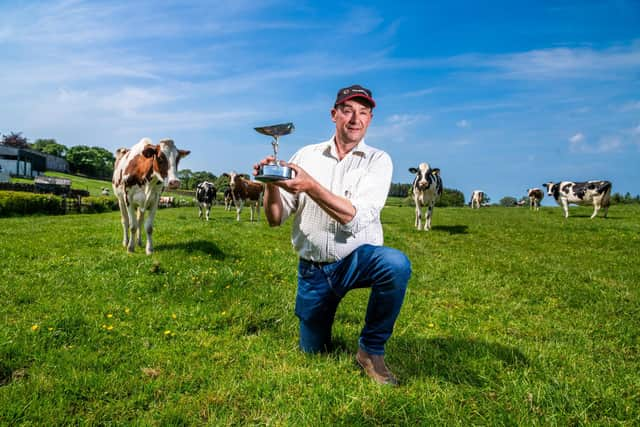

‘We also work with conservation groups,’ says Colin. ‘We’ve a lot of ground nesting birds, and groups who feel the same have latched on to us. We’re not really doing anything new, just more of what we’ve always done. We don’t consider ourselves special, but when you look, we’ve become different to a lot of farms, because we haven’t changed.
Colin works closely with a local team from the RSPB to manage the farm for breeding waders and a survey is carried out each year. Clapham Curlew Project started in 2021 and a camera on a curlew nest in one of the meadows was added during 2022.
‘What we are doing must be working because we’ve seen a lot more wading birds coming back.
‘In recent times we’ve put in 5500 metres of hedges, fenced off all water courses and planted trees down the beck. We’ve been in HLS for twelve years and that means we don’t mow 50 acres of meadow land until July, which provides a lot of species-rich wildflowers. The meadow was restored through the Bowland Hay Time project.
‘We’ve made use of schemes for protecting habitats. We’re in an SFI scheme. We’ve also installed kissing gates alongside bigger field gates, lessening the risk of them being left open by walkers and stock getting mixed up.
Colin and Alan took the farm organic in 2000.
‘We went organic because we felt it would fit well with conservation and environment practices. We could also take advantage of Government schemes and attract ‘low-input’ funds. At the time we were also hopeful that organic milk would provide a better income, but then everyone converged and it was like going to the rainbow before it fell off the cliff.
‘The organic job has sorted itself out more now. We sell milk to Organic Herd. They sell a lot of organic cheese into America, which is a good market. Our herd is all Holsteins and we milk twice daily at 6.30am and 4pm.
‘We farm at 550ft above sea level and are a traditional Craven stock rearing farm. We calve all-year around and put as many as we can to sexed semen, rearing towards 30 heifers a year. I look to sell about 20-plus second and third calvers every year at Bentham or Gisburn and milk my heifers. I retain them for first lactation to select replacements and so that buyers are able to see what they’ve done. The herd is Johnes-monitored, BVD vaccinated and calves vaccinated for lungworm.
‘The rest that aren’t put to sexed semen are put to an Angus bull. I take those calves to Bentham. I’m a big believer in selling through livestock markets.
‘I don’t go for extremes in any trait, but like red and whites and have a good number, not least because my father had Ayrshires, and also because we like the look of them. We have a lot of family cow lines and have used influential sires including Ronnybrook Prelude, April-Day Wisconsin-Red, Claynook Dealmaker and Stantons Adorable.
‘I need to be breeding what other farmers want to buy and we are regularly in the higher prices and show placings.
‘We graze May to October. They’re on chopped bale silage in winter from our two cuts during summer and concentrates are fed in the parlour. Our yield average is 8400 litres.
Colin says the biggest change he’s noticed in the area he has always lived is in the number of dairy farmers.
‘When I left school all our neighbours milked cows. In Craven, after foot and mouth in 2001, a lot never went back into milk.
One constant at Long Bank Farm has been the family’s Dalesbred flock.
‘We like their strength,’ says Colin. ‘My great granddad Ernest Price had Dalesbred sheep when the Dalesbred Society was founded in the 1930s before my granddad Henry came here in the 1940s, originally tenanting from Clapham Estate. Ten years later he got chance to buy what was then 100 acres. In the 1970s dad bought the next-door farm, another 90. We rent about 60 acres. Dalesbreds have always played their part.
‘We’ve had Swaledales too, but over the last couple of years we’ve become wholly Dalesbred. We bought a flock off a neighbour. A good friend of mine, Bernard Capstick, a top Dalesbred man, helped me get them straightened up. When Bernard passed his family dispersed his flock. I bought quite a lot of his younger sheep. Now, we have 250 Dalesbreds and 50 are put to the Bluefaced Leicester.
‘We sell three and four-crop draft ewes in Bentham. We select the best of our gimmer lambs as replacements. Others are sold as stores by October.
Colin is on the breed society judging panel and will be judging at Garstang Show this summer.
‘We don’t get much chance to show ourselves,’ says Colin. ‘We support local shows and had dairy champion at Malham three years ago, and champion tup shearling at Hodder Valley two years ago.
Colin has always worked for other farms and contract wraps for many farms each summer, which helps spread the cost of silage equipment.
‘I started my bale wrapping business 30 years ago. I have three wrappers and a few part-time helpers including fellow livestock farmer Jack Wallbank who milks for me and Paul Robinson who does two days a week all year round and a lot of wrapping.
Colin and Alan have also gone into energy. ‘We have a small wind turbine and solar panels. We put some more panels up two years ago, and a battery.
Colin tells of another change being more extremes of weather.
‘We certainly get more rain. We average 90-100 inches of rainfall a year where it used to be 60. We have always been a wet farm, we are on heavy clay ground and once she’s wet she’s wet. Which we could wade in, let alone the waders!
Colin’s other interests include a small collection of David Brown tractors. He’s been a Parish councillor for some years; and is a committee member of Forest of Bowland National Landscape Joint Advisory Committee.