
Manor House Farm, Denby Dale: It’s lambing prime time for top breeder
Early lambing is a practice that has its roots in the production of lamb destined for meat around Eastertime when stocks of UK-born lamb from the previous year should be running low if the market has operated correctly, but it is also a prime time for those making their mark in the world of sheep breeding.
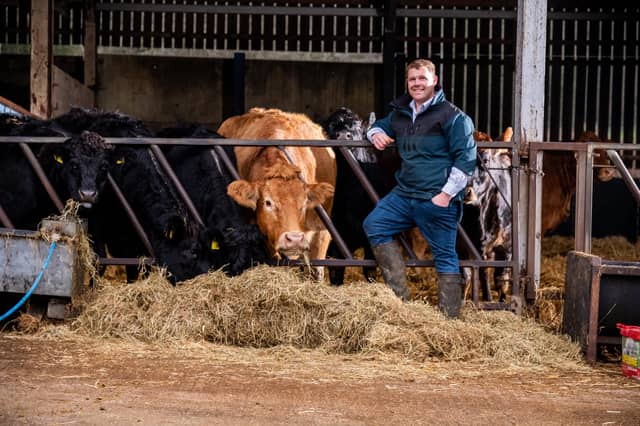

Charollais sheep breeder Richard Bamforth of Manor House Farm in Denby Dale is one such exponent of the practice and his flock of 100 breeding ewes has been lambing since mid-December, in common with most pedigree Charollais breeders, because the breed’s major sales of the best stock destined as breeding stock for the future are held early in the breed sale season and by lambing earlier the stock is bigger than those born months later, which makes a huge difference, as it also does at agricultural shows in summer.
Such has been Richard’s success that he was recently awarded the title Yorkshire Area Charollais Flock of the Year, as well as picking up champion ram lamb with his homebred ram lamb Lower Denby Diesel. Last year (2025) also saw Richard make his highest price yet for one of his homebred tup lambs Lower Denby Django selling for 2400 gns.
‘Everybody wants to get to the top in whatever they do,’ says Richard who was brought up on a working mixed farm in Slaithwaite and then Honley where he never had sheep and instead was brought up around beef cattle, laying hens and pigs.
‘This was the first year I’d entered the breed competitions. I like to think I’ve got a good flock of sheep, but you just don’t know how well your flock stands against others. At the end of the day, it’s all down to everyone’s personal opinion and I’m made up that those who make the decisions looked my way.
‘It’s full-on for me at this time of year, when we hope that we get the right stock for when the major sales for the breed come up at the Carlisle Supreme Sale in the last weekend of June and the Worcester Premier Sale in the first weekend of July.
‘I’ve always been much more a livestock farmer than arable. The majority of my ewes are pedigree Charollais, but there are a few crosses, and my lambing period is mainly December, with anything that doesn’t hold for then lambing at the beginning of March. The pens are already full of quite a few twins.
Richard’s working life on farms started when he was on a YTS at George Wilby’s 200-cow dairy farm before he moved on to another dairy farm for two years before being offered the farm manager’s role back with George in 2005. The cow herd was dispersed in 2013 and Richard took on the farm’s tenancy in 2016, but he’d already taken a shine to Charollais sheep in October 2005.
‘I was never brought up with sheep, but when I wanted to try making my way with my own flock it was Charollais that drew me to them. I bought three in-lamb females at a Skipton sale. I had seen Charollais sheep at shows, I’d gone away and researched them and knew they were the breed I wanted.
Richard says that he’s not currently looking at expanding the flock beyond 100 breeding ewes, but that he is always looking at quality rather than quantity.
‘Everything depends on the quality. Anything that is not good enough for breeding goes. I cull hard, sending anything that doesn’t make the grade as fat lambs. I’ve something in the region of 35 lambs that I kept back from last year. If females are good enough they stay. I may cross those I don’t think will make the right pedigrees, to the Beltex tup or I may sell to someone who wants to cross them.
‘I sell around 30 rams a year for breeding and I’ve kept two. The rest of the tup lambs will go into the fat lamb market.
Richard enjoys his showing of Charollais sheep in the summer and had reserve champion at Ryedale Show and Interbreed champion at Emley Show last year. He had a second at the Great Yorkshire last year with a gimmer lamb and had great success with a homebred aged ewe Lower Denby Una in 2023 and 2024 winning several interbreed titles and sold a couple of tup lambs out of her.
‘I show at the Great Yorkshire Show, Westmorland, Ryedale and some of my local shows. They’re all good in their own way and you get to meet the other breeders.
Cattle have long been Richard’s domain even though he is now probably better known more widely for his Charollais.
‘I’ve about 30-head of cattle of one sort or another of which five are pedigree Limousin cows which are AI’d. All of the rest are bought in as stores at 12 months from Holmfirth livestock market that I take to 24 months. I look to buy Charolais-crossed stock.
Richard has a straightforward attitude to his store cattle enterprise.
‘I buy what I think is going to leave some money behind, selling either privately or at Skipton.
Richard’s farming enterprise runs to 300 acres. Manor House Farm makes up 250 with the rest rented. He grows around 160 acres of cereals with the rest down to grass.
‘I contract out the land work. This year we are growing 80 acres of winter wheat, 40 of winter barley and we will be growing 38 acres of maize. We have heavy land and some easy-going soil. We will usually average around 4 tonnes an acre for wheat. We produce haylage or hay. In 2024 we made 700 bales, but with last year’s drought it was nowhere near that.
The need for another income brought about Richard’s farm diversification Manor House Farm Boarding Kennels in 2019 which offers accommodation for 36 dogs and he says it has proved the right decision.
‘We received a change of use agreement on an existing steel framed building that was previously a cattle building and we are particularly busy from March through to October half-term when we will usually be full. The business tends to quieten off in the winter months, particularly around now and February, but we’ve been pretty much full through into the New Year this year. We don’t really do any advertising, we’ve found it’s all word of mouth and through Google searches on our website where we get our trade. We do really well on recommendations.
‘All of the day-to-day work around the kennels is down to me and one full-time member of staff. The kennels work takes up a significant amount of my time.
‘When we opened it wasn’t long before we had Covid to contend with. That pulled us back from where we had hoped to be, but I always felt that there would be a market.
Richard says he and his partner Kelly (Oxtoby) also have some young stock horse livery.
‘We’ve just a couple on at the moment, but we have had as many as ten. They come to us as weaned foals and leave as three year olds. Kelly works with them day-to-day.
https://manorhousefarmkennels.co.uk/