
MP backs the sites bringing fresh habitats to Yorkshire farmland

The MP for Whitby and Scarborough has given her backing to a series of projects taking place across Yorkshire where unproductive and hard to manage farmland is being turned into habitats for wildlife and biodiversity.
Environment Bank is a collective of sites, which are leased from farmers and land-owners over a 30-year term, and managed so that existing species, and hopefully new and returning ones can thrive. There are eight in Yorkshire and more than 50 across England encompassing several thousands of acres of land. The habitats generate a number of biodiversity units - depending on things like size, quality and location - and these are sold as Biodiversity Net Gain (BNG) to large-scale developers.
Developers now have to deliver BNG as part of permissions for developments. If they can’t do that within the development, or one of their others, they can purchase them from schemes such as Environment Bank.
Environment Bank has already created thousands of Biodiversity Units which provide an effective off-site Biodiversity Net Gain (BNG) solution for developers.
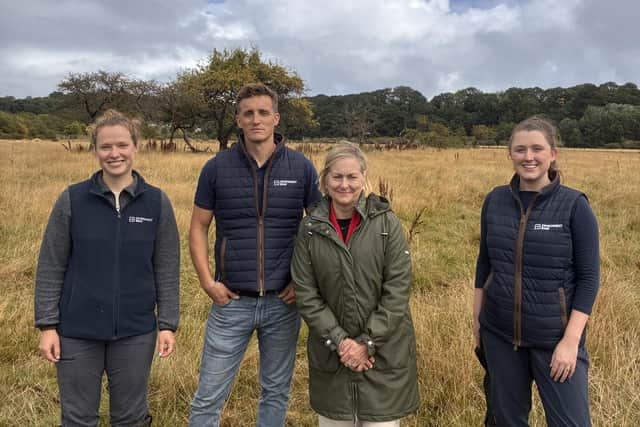

Alison Hulme visited one of the sites in her Scarborough and Whitby constituency recently.
She said: “The UK is playing a leading role in constructing the framework for nature recovery. It was fantastic to see how we're helping to lead the way in Biodiversity Net Gain in Scarborough and Whitby.”
The Whitby Habitat Bank is two sites within the village of Ruswarp. It has taken a couple of years, as it does with other sites, to get the paperwork and logistics in place before the benefits can be noted.
However, Fraser Rutherford, head of marketing at Environment Bank says that each time he visits the Whitby Environment Bank, he notices something new.
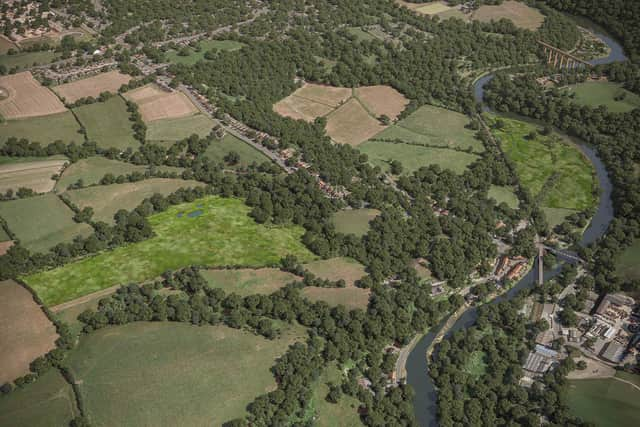
He said: “The one at Ruswarp has been ongoing for two years, but there are a lot of works that have to happen before you see a significant uplift in biodiversity.
“We are seeing Kingfishers and Herons, that were already around here, but we are giving a home for species which would usually struggle to find land.
“Every time I go there is more wildlife there. The site can be seen from the public footpath and that is really important to us.”
The Whitby Habitat Bank has a 30 year lease, which is standard for agreements with farmers and landowners.
As well as working for developers, the scheme provides an income for farmers over a longer period of time compared to Sustainable Farming Initiative (SFI) and Environmental Land Management Schemes (ELMs) which work on a much shorter time-frame.
“The leases on the sites are 30 years, but we do find at these habitat banks, it is amazing how quickly nature returns in abundance” says Mr Rutherford.
“There is one in Devon where there is life and species, not seen for a century which has come back.”
Last month, the Yorkshire Post reported how rare-breed White Park cattle have been introduced for outdoor conservation grazing, and particularly, in wetter grassland habitats on the Castle Howard estate.
The grazing will help to create a more varied habitat structure.
Castle Howard is transforming 440 acres of low-yielding agricultural land into a thriving space for nature with plans to release beavers later this autumn.
Other schemes include Keighley in West Yorkshire where more than 140 acres of sheep-grazed pasture is being transformed into a mix of meadows, fens, scrub, grassland and woodland to boost otters, badgers, curlew, cuckoo, lapwing, and grey partridge.
There is an 80-acre habitat bank between Harrogate and Otley with works to connect the existing farmland with local ancient woodland and 50 acres of grassland near Stocksbridge is being turned into wildflower meadows.
There are plans in the pipeline for habitat banks at Hooton Pagnell near Doncaster and one in Barnsley. Deciding what to do with each site requires careful consideration.