
Newton under Roseberry: The village that comes with a perfect topping
With a summit achievable by many, the distinctive Roseberry Topping is recognisable to more, placing it among Yorkshire’s top landmarks.
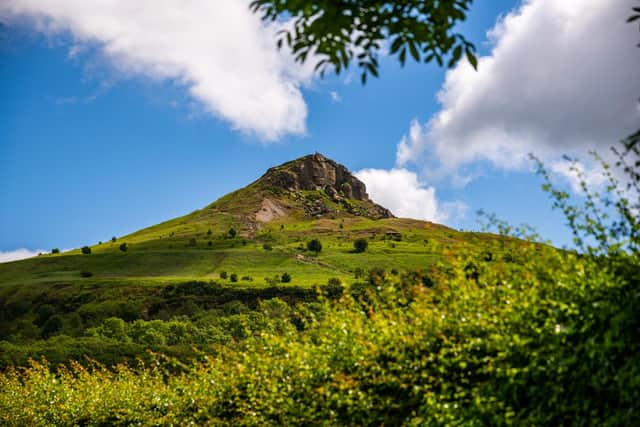
Rising to 320m above sea level, the conical hill featuring a Saltwick sandstone cap on top of layers of Whitby mudstone, Cleveland ironstone and Staithes sandstone can be seen across a vast area.
Nevertheless, it looms particularly large over Newton under Roseberry, which is bookended by car parks leading to it.
Views towards Newton under Roseberry from the summit highlight the village’s profusion of trees, which appear to outnumber the houses, the older of which are typically built from sandstone with the vernacular red pantile roofs of the North York Moors.

Such buildings include the 19th century Roseberry Cottage and The Old Village Hall, at the village’s southern gateway, which served as a school, as well as on Church Lane.
There stands St Oswald’s Church, which continues to hold regular Sunday services. Its leaders say the church with a spectacular backdrop as well as medieval features, is becoming increasingly popular for christenings and weddings.
On Church Lane, Norman archway across the Chancel dating from the 1100s Sunday Services at 11am on the 1st, 3rd and 5th Sundays of each month
C12 chancel arch, either side of which are squints (10cm square). Traces of medieval fresco on south wall of nave. Medieval cross-head used as lintel above piscina of c1900. Norman circular drum-shaped font
The village’s greenness is reflected by an array of flora and fauna on the hill, such as brown hares, roe deer, bluebells, warblers, heather and butterflies, which have proved popular photographers’ subjects.
Attracting an estimated 8.4 million visitors annually, the hill contributes significantly to the small village’s busy feel. Residents have highlighted the impact of traffic and irresponsible parking on the A173, particularly at weekends and bank holidays.
Surrounded by open countryside, the Cleveland Hills village is in the ceremonial county of North Yorkshire, but administered by Redcar and Cleveland Council and just a few miles from the Tees Valley sprawl.
The incursion of urban double yellow lines to the village in recent years represent a response to through-traffic on the main thoroghfare being regularly brought to a standstill by parked cars and pedestrians walking along the main road.
In October it emerged how a council traffic survey in Newton under Roseberry, had clocked one vehicle travelling at 111mph and two others recorded at more than 80mph in the 30mph zone.
The route has been a busy one for hundreds of years, as is evidenced by 18th century coaching stop The King’s Head Inn, behind which Roseberry Topping rears up.
Targeting both villagers and visitors, the pub sets out to provide “an ideal mix of value, comfort and convenience”, with a menu including local speciality, the “world-famous Parmo”.
The hordes of visitors making their way to the summit has this month led to a helicopter team manoeuvring 200 tonnes of rough stone blocks to create drains and aggregate to shore up the well trampled footpaths, some of which have been carved out by locals over thousands of years.
These have included Captain James Cook, whose ascents of the hill as he grew up on Airey Holme Farm, just south of Roseberry Topping, in the 1730s, are said to have inspired his adventurous spirit. The 16m-high Captain Cook Monument on Easby Moor can be seen from Roseberry Topping’s summit.
Last September, a firefighter reclaimed an 'unofficial world record" by climbing Roseberry Topping 50 times in just 30 hours. The record for a single 217m climb to the summit from the Newton under Roseberry car park has stood for the last 34 years at 10 minutes and 20 seconds.
This year marks the 200th anniversary of a Bronze Age hoard being unearthed by a farm worker. The axe heads, curved knife and moulds are on display some 96 miles away, in Sheffield's Weston Park Museum.
A prehistoric menhir, or standing stone, thought to have once been part of an avenue or stone circle, takes precedence on the village green.
Folklore has it that wise men warned King Osmund of Northumbria that his son Oswy would drown before his third birthday, so he ordered the queen to take him to the highest point in the area, Roseberry Topping.
It’s said the prince drowned in a spring near the summit and was buried in Tevotdale, alongside his heartbroken mother, leading to the village name being changed to Oswy-by-his-mother-lay, now known as Osmotherley.
The eminence’s name translates from Old Norse as Odin’s Hill and is believed to be the country’s only site named after the god of the dead and warfare.
With ironstone reserves having been discovered beneath “Yorkshire’s Matterhorn” in the 1850s it became central to the local economy for a short period. In 1906, Roseberry Mine employed 200 men. A labyrinth of underground workings extends underneath the hill and there’s surface evidence of the mine in the form of its tramway, roofless powder magazine and some concrete bases.
Exploratory works for the mine, as well as those formed by 19th century jet miners, have shaped one of the hill’s peculiarities – numerous pits. Some, however, are linked by trenches, suggesting a defensive purpose.
Despite the pressures, the future looks bright, with its western slope having been owned by the National Trust since 1984 and its upper reaches designated as a geological Site of Special Scientific Interest, as well as lyin g just inside the North York Moors National Park.