
North Stainley: A traditional rural community which has had to adapt to survive
While 40 years ago North Stainley had a fraction of the population it has today, which is approaching 800, key elements of its distinctive centre have changed little over the last two centuries.
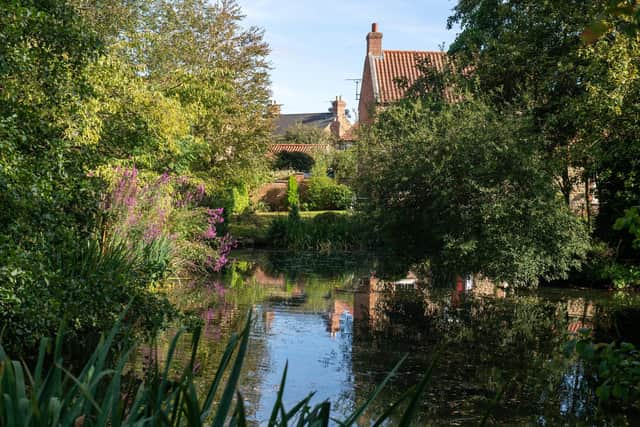
Like a scene from a Constable painting, the heart of the village, four miles north of Ripon, boasts no less than three duckponds, a wooden water wheel, a 19th century church and school, and a manicured cricket pitch.
During a visit on an October weekday afternoon, it’s easy to imagine horses and carts passing by on the Ripon to Masham road, which divides the historic features.
On the west side stands the small, but perfectly formed St Mary the Virgin Church, which was consecrated in 1840 after three landowners got together and decided to promote building a place of worship for those working the rich farmland beside the River Ure.

It hosts fortnightly services and inside preparations are well underway for the community harvest celebration, with floral creations adorning the chapel for the service at which children from the neighbouring school will perform.
While there have long been proposals aired to relocate the school, which was built about the same time as the church, to another purpose-built premises, it has recently undergone another significant change in becoming an academy.
Opposite the school, is North Stainley Cricket Club pitch, which is used by three adult teams and six junior teams, whose players currently represent Scotland, North of England, Yorkshire, North Yorkshire and Nidderdale.
On another green stands a beacon which was erected for the Queen’s Platinum Jubilee and a stag, created by Danny Piper using bicycle parts, to mark the Tour de France passing through the village a decade ago.
The stag is a recurring symbol in North Stainley, including on the village entrance signs, as it features on the crest of the family that has shaped most developments there since the 16th century.
Cardinal Thomas Wolsey, Henry VIII’s chief adviser, gave some 1,000 acres of land to the Staveley family for their loyal service in 1516.
Two hundred years later saw Stainley Hall, the grade II* listed home of the family, built alongside a number of designated heritage assets.
Nearby Stainley Hall stands Sleningford Grange, a country house with mid-18th century additions and Venetian windows and Doric columns.
Perhaps the most unusual of the village’s listed buildings is the early to mid-19th century circular gazebo with a conical roof, fashioned from limestone rubble and cobbles, directly beside the A-road, built into the Stainley Hall’s garden wall.
While the family have conserved heritage, since the 1970s, when Robert Staveley took on the North Stainley estate from his father, Miles, in the 1970s, they have been responsible for sweeping changes which have led to the village being viewed as a template for struggling rural settlements.
To counter the impact of decreasing profits from farming and weight death duties, the Staveley family diversified, launching a pick-your-own fruit business and the Lightwater Valley Theme Park on a pig farm.
The attraction became more widely known as a theme park after the creation of the Rat Rollercoaster in 1987, which at the time was the world’s first subterranean rollercoaster.
Today North Stainley is synonymous with the theme park, at the southern entrance to the village.
Amanda Staveley, who in recent years bought Newcastle United from sportswear tycoon Mike Ashley, helped develop the attraction, which now comprises about 30 rides and draws 500,000 visitors per year. Yet there is little evidence of it in the village centre.
Her brother, James, who took over the running of the estate from his father in 2006, said: “North Stainley has always been a traditional rural community, but just like the estate, it had to adapt to survive.”
The number of homes has risen from just 30 properties to more than 200 houses during the last 40 years.
Whilst one of the village’s pubs, the Cross Keys, closed two decades ago the remaining inn, The Staveley Arms, has been revamped several times and offers the experience of a gastropub while catering for locals with events such as a weekly quiz night.
The menu features items produced on the North Stainley Estate, such as game terrine.
The Staveley family has also played a key role in the development of a significant housing estate off Watermill Lane, with an impressive looking village hall that cost almost £1m to construct.
Another jewel in the crown for the village is High Batts Nature Reserve, on the banks of the River Ure, which last year marked its 50th anniversary. Beside a sand and gravel quarry, it includes 32 acres of mixed woodland with open clearings.
The reserve is managed to optimise biodiversity, and to conserve habitats and species in line with a management strategy agreed with Natural England.
It attracts herons, kingfishers and otters alongside rarities such as nightjar, wryneck, and pied-billed grebe and it was designated as Site of Special Scientific Interest in 1983 due to its plethora of habitats valued for birds such as herons and kingfishers along with rarities such as nightjar, wryneck, and pied-billed grebe.
The woodlands are particularly noteworthy for the yellow star of Bethlehem in early spring as well as the common toothwort.
Also just outside village in a field are the foundations and moat of an ancient property which has been named Castle Dykes.
It was excavated in the Victorian era to reveal “a Roman villa of obvious opulence” and potential evidence of an earlier tribal centre. Its final Roman owners are understood to have suffered a grim death as the villa burnt around them.