
Pateley Show: 'As long as we put on a damned good show we’re happy'
There are iconic moments in Yorkshire’s agricultural show season that people look forward to every year, like the curtain raiser at Otley in May; the buzz of arrivals at the Great Yorkshire during the weekend before in July; and the walk down Pateley Bridge High Street of Nidderdale Show’s president and chairman with the band playing as they troop into Bewerley Park to officially open what many still refer to affectionately as Pateley Show.

It's the last show of the four-month long season and as such attracts a huge crowd of countryside folk, farmers and now more of the public than ever before following a recent move from always being held on a Monday to a Sunday and takes place next weekend September 22.
Dairy farmer Andrew Walmsley is this year’s Nidderdale Agricultural Society chairman, his late father Geoffrey was president when the then HRH Prince of Wales, Prince Charles was guest of honour, and that walk through the town to the showground is something he admits will be a personal highlight.
“I’ll get to walk down the street with the band. If you ever get to talk with Trevor (Stoney) about it he’ll tell you there’s nothing any better. I’m looking forward to that, as well as everything else that goes with being chairman.

‘I started as a cattle steward and was then promoted to main ring steward. It was Eric Jennings, cattle steward, who got me involved initially.”
Andrew says he believes the move to a Sunday from Monday has paid off.
“When it was put to the committee there was only one member who didn’t want it on a Sunday and we’re now pulling a different type of crowd, adding to our numbers on the gate, with a lot that couldn’t come on a Monday.
“Farmers will come to the show whether it is a Monday or a Sunday. It doesn’t make a lot of difference to them, as they work every blooming day. Pateley Show is in a really good position.
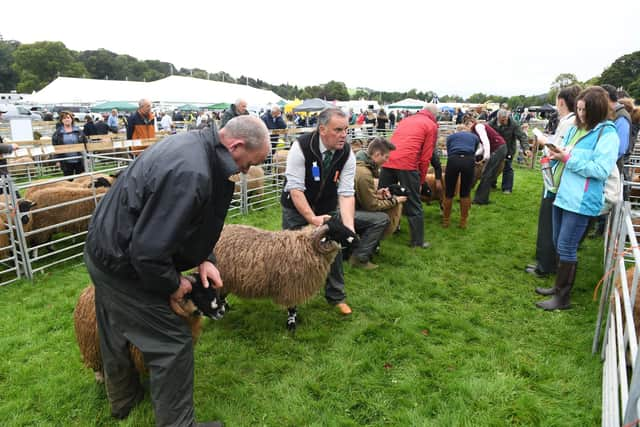
"It owns its own field, we have car parking space and during the year there are a lot of caravan rallies. As long as we put on a damned good show we’re happy.”
Andrew is also involved with his other local show at Ripley where he is a past show chairman.
“Our farm is just up the road from Ripley Show and I’m still heavily involved there, especially with a lot of the setting up. I’ve been there since I was a kid and dad was involved there too, but I also enjoy Pateley, where I have been main ring steward for about 15-16 years. Tom Stockill is taking over from me in the main ring this year.”
Andrew farms at Pasture House, Scarah Bank Farm just up out of Ripley heading towards the hamlet of Bedlam with his wife Alison and with his teenage son Geoffrey now working alongside him while daughter Lucy works for feed company Jameson’s in nearby Masham.
“Dad came to Scarah Bank in 1958 and had a bit of everything with sheep, pigs and beef. I have three brothers and we are all now involved in farming separately. Over the years we streamlined the farm.
"The beef operation went, Peter took on the pigs and the sheep disappeared replaced by cows. My other brothers are John, who has dairy cows too, and Bill who is on with contracting, haylage and horses.
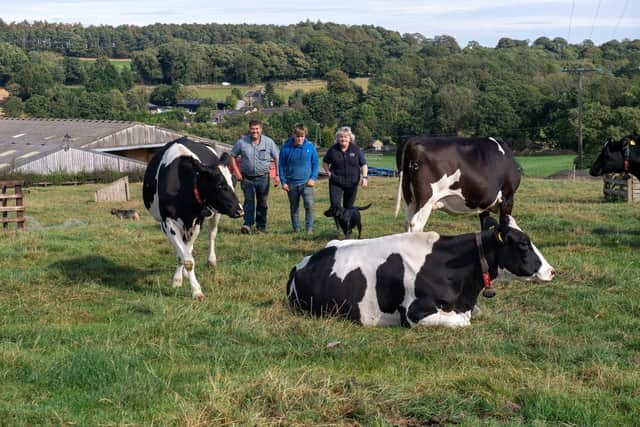
“Alison and I have 150 acres we own and we farm another 80 acres of my brother Peter’s land just up the road. We have a herd of around 215 dairy cows, mainly Holsteins and went into robots13 years ago after having built Pasture House over the road from the old farmhouse in 2003.
“We can’t milk any more cows than we have at present because the robots are at capacity and I’m happy with that. I was really impressed with robots before we put them in and it was the best decision I’ve ever made.”
One of the biggest benefits robotic milkers have made for Andrew has been in his work-life balance.
“We still put a lot of time into our cows, but you just aren’t tied to having to milk morning and night. It is a lot easier way of working when you’re not stuck in a parlour for three hours at each end of the day. That’s the big plus.
“And that has also brought about no issues with staff. We’ve the same staff now that we’ve had here for the last 10 years. And the cows now average 3.1 times per day milking and are producing a herd average of just over 10,000 litres per cow with milk being bought by Payne’s Dairies.
“The robots have allowed us to focus more on the health of the herd. Folk say you don’t see the cows as much, but in my eyes I see them more. It’s a completely different way of managing cows.
"You have the time to wander around and if they don’t come to the robot you know there’s something wrong and you go and find them. We also have great relationships with our vets Forest House and Genus RMS.”
Andrew says the calving programme with Genus works well.
“We’re calving to dairy sexed semen and to both Belgian Blue and a few Angus and those calves are sold at 6-8 weeks old, generally to other farmers.
"We sell any surplus dairy calves as newly calven heifers to another farmer at three weeks to a month calved.”
Although Andrew is happy with the way the farm is at the moment he is aware that Geoffrey, who has just turned 18, may want to change things in the future, but he’s in no rush to push him.
“If Geoffrey wants to push the cows on any further good luck to him. At the moment, I’m quite happy where we are and we can handle what we’ve got.
"Geoffrey also goes out working for a local contractor, has done a year at Askham Bryan and is aiming to go out to New Zealand for six months and I won’t deprive him of that. I think I missed out not being able to do that. I have a cousin who has a contracting business over there.”
Andrew says this year’s weather has been much better than last.
“Last year was an absolute pig, but we got our first cut on silage in May and it’s been a good year. We’ve a fourth cut we should get in early September. We also grow 30 acres of wheat all going to the cows.
"The wheat is all in the shed and has done just over 3 tonnes per acre this year. Contractors come in and do it.”
Andrew has just gone into the new SFI scheme, but he says one thing he is struggling with are herbal leys.
“We’re up with all environmental stuff like putting in hedging and green energy stuff like solar panels on the dairy shed roof which has made a saving of £600-£700 per month, but I’m not putting herbal leys in just yet.
"I can’t get my head around it at the moment.”