
Patrington, East Yorkshire: ‘The Queen’ reigns over rural village
Fifteen miles east of Hull and three miles from both the sea and the Humber, Patrington can be seen from miles around in all directions owing to the 180ft spire of its spectacular English Gothic church, known as the Queen of Holderness.
As such, is inextricably connected with the big skies over the surrounding relatively small and flat farm fields and wetland habitats that form the centre of the Spurn peninsular. The area features a plethora of ponds and dykes, a profusion of plants such greater water parsnip and greater spearwort, and hawthorn and hazel hedgerows. With such landscapes the area has a strong tourist economy. To the south-west of the village Patrington Haven Leisure Park, an owners-only static caravan park, sits in a 40-acre site that was home to the RAF Patrington radar station, a base which was used for ground-controlled interception during the Second World War. The military base closed in 1955 with the opening of the nearby RAF Holmpton.
Land that once was part of the north bank of the Humber Estuary, before the reclamation of Sunk Island, is slightly elevated to the south of Patrington and the aforementioned church, St Patrick's, is higher still, giving it a sense of pre-eminence in the village on the south side of the High Street, befitting its grade I listed status. According to the 20th century art and architecture historian Nikolaus Pevsner, "for sheer architectural beauty few parish churches in England can vie with Patrington".
Due to its construction being interupted by the Black Death sweeping through the area, it took builders and craftsmen an entire century before it was finally completed in 1410. Hundreds of carved faces of villagers, animals and grotesque creatures are among the highlights alongside an ornamental screen at the back of the altar of 1936 in memory of lord of the manor George V and a very fine Easter sepulchre to north side of the Chancel. Alongside a host of 14th century features, the church boasts an octagonal panelled oak pulpit dating to 1612, the same year as the Pendle witch trials. A pre-Conquest cross shaft was found in a wall near the church suggests the site previously had a Saxon chapel on it.
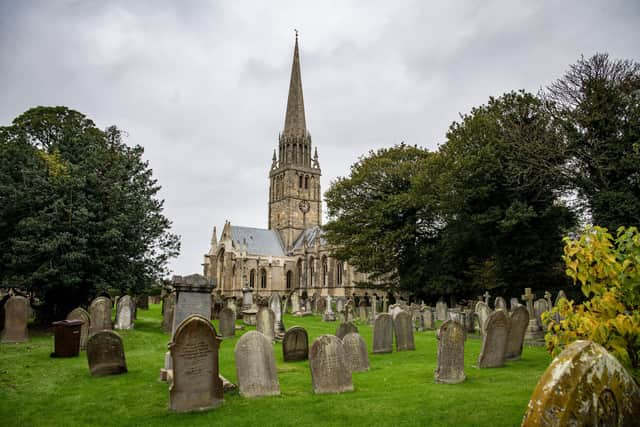

The church forms part of a conservation area with numerous historic properties alongside more modern properties, such as the village hall. This urban-rural, modern-historic mix is highlighted by buildings such as Elmtree Farmhouse on Eastgate, which has a 1750 datestone above the central entrance of its north wing, and the early Victorian Linsdall's Hospital almhouses and Ruston House, which was built for a surgeon in 1810, both on Welwick Road. The village's rural past is emphasised to the north of Welwick Road, near the cemetery and to the village's south-east, with the late 18th century Patrington Mill, a five-storey tapered red brick windmill tower. Formerly also known as East Mill, it ceased operation as a windmill following the outbreak of the Second World War, but has since been employed for small-scale machine grinding.
There's also the mid-18th century Wyke House on Greenshaw Lane, close to the huge Patrington Methodist Church, the main hall of which was built 1811. The village's second landmark church, which is not a listed heitage asset, has been marketed as suitable for continued religious use or conversion into residential.
Patington is unusually well appointed for a village of its size - the 2021 census recorded it had 1,463 residents. It's fairly self-sufficent with services such as GP and vets surgeries and a range of clubs. To herald the village's community spirit, Patrington Parish Council will this month honour a resident who goes beyond what could "be described as an everyday contribution" which benefits the community and the parish.
Any member of the public who is a registered elector in the Parish of Patrington may submit one or more nominations to the Parish Council, to be received no later than 31st October 2025.
The heart of the village, the name of which means Patrick’s town, appears to be Pump Row. It comprises shops, a bakery and a takeaway alongside a Patrington Garage, which includes a convenience store and petrol pumps on an old fashioned style uncovered forecourt. The remnant of a bygone age gives the village a deeply rural feel, however it is just a stone's throw the very wide main thoroughfare, Westgate, which is so broad it is divided by posts, planters and verges, giving Patrington a unique town-like character not found in other villages in Holderness. Westgate has been referred to as the village green, which it may have been before the turf was built over to become a market place. On a grassed area at the junction of Market Place and Northside stands Patrington's square monolith War Memorial, overlooked by listed buildings such as Green Farmhouse and the Manor House.
It is unusual in that Patrington's community erected the memorial a year before the conclusion of the First World War as a permanent testament to the sacrifice of village residents. The cost of the memorial was met by funds raised via public subscription and carries 110 names commemorating the 87 men who served and returned as well as the 23 men who died.
The urban-rural conflict was underlined last month when East Riding of Yorkshire Council told a homeowner in Eastgate to remove flower pots that had been outside of her house for two years as the planters were said to take up a third of the footpath, causing a "safety hazard".
With Patrington being less than an hour’s horse ride from a dozen or more villages, its location helped it to become the market centre for most of South Holderness until the arrival of the Hull-Withernsea railway line in the mid 19th century. The village's station closed in 1964 as part of the rationalisation of the railway system.
It's 50 years since the Council for the Protection of Rural England condemned the emergence of coloured brick and concrete tile buildings in Patrington, such as the fire station on Northside, for being "completely out of keeping with the village”.