
Pig farmer’s fears for industry future
The curtain comes down on the county’s agricultural summer show season tomorrow at Pateley Bridge when Nidderdale Show will continue its position as one of Yorkshire’s best attended one-day shows, usually with an attendance of over 15,000.
While sheep, cattle and horses will be there in their multitudes this year’s honorary show president may have an eye on the pigs as John Dale of Careless House Farm in Bishop Thornton has been a pig farmer all his life.
John’s role at the show has seen him spend time more with the horses, as he has been joint chief horse steward with Sarah Smith for several years and has served on the show committee for 41 years.
“I started on the committee in 1984 after my father Frank finished,” says John. “It’s all far more democratic today. Trevor and Richard Stoney are at the helm along with Martin Smith and they pretty much let each section get on with what it does. Trevor, his son Richard and Trevor’s dad and Richard’s grandfather, the late Joe Stoney have all given a fair chunk of their lives to Nidderdale Show.
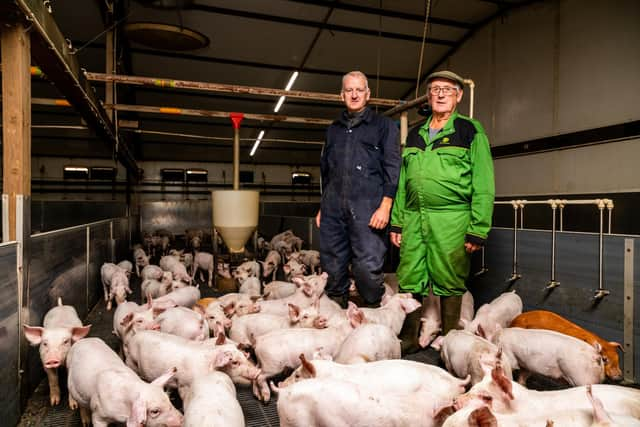

John took over from his father at Careless House and the farm is now run by John’s son Michael with John still active, but things have changed in recent times.
“We came out of having our own sow herd five years ago and now we don’t have any of our own stock as such. We look after pigs on bed and breakfast for Robert Woolhouse, we look after cattle for a neighbouring dairy farm and we have sheep overwintered here for another farmer mid-November to mid-March on our 52 acres.
It’s all a great deal different from when John first arrived at Careless House.
“My father bought the farm in 1955 for £3500. I was 14. Dad had had a smallholding previously where he had a dozen dairy cows and worked for a farmer and racehorse trainer Herbert Clarkson. As I grew up I would ride out racehorses in a morning and farm in the afternoon. That’s where my love of horses comes from.
“Dad increased the dairy herd to around 20-25 with a mix of Ayrshires, Dairy Shorthorns and Friesians that were just coming in. We had dairy cows until the 80s but I was always more of a pig man and preferred the faster turnaround. Pigs then took over and at one stage we were nearly up to 300 sows selling over 6000 pigs a year.
John says his entry into pigs was hardly auspicious.
“My start with pigs, at 15, wasn’t the best. I’d bought a gilt in-pig and went to feed it one morning. At first I thought it was just asleep, but when I gave it a nudge it was dead as a stone, it hadn’t a mark on it. I went to tell my dad and he said, ‘next time you go buying gilts in-pig you’d best buy two, then you’ll still have one left.’
“In the 60s we had about 60 sows. I set off using Saddlebacks which were good mothers but gradually got on to Large White Landrace X and used a criss-cross breeding system. Later we moved on to Duroc or Pietrain. At first I was farrowing weaners. We put more buildings up as we grew, good buildings that improved efficiency.
John says he did a lot of different jobs before coming back to the farm full-time when he was 30.
“I always worked on the farm but I also went farm working on other farms, I worked for a fruit and veg firm for a year, also for a chap called Jennings on an arable farm, but my main job from being 21-30 was with a haulage firm in Markington picking up milk churns and taking them into the Coop dairy in Leeds. I hauled other things as well like fertiliser but with the milk I’d finish around 1 o’clock then come home and concentrate on my pigs.
Prior to their current position of looking after stock for others John and Michael had cattle and sheep as well as pigs.
“The farm is all down to grass and we used to keep about 50 bullocks bought as stores from local markets in Skipton, Pateley and Leyburn; selling in Thirsk. We’d buy at the back end of the year and sell them next back end off grass. We also kept 70 ewes, originally we had Mashams but later we went on to Mules as the demand was more for tight skinned lambs from Texel X.
Michael says the move that was made five years ago to no longer have the sow herd and to go bed and breakfast pigs, and also to look after others’ cattle and sheep came about.
“We’d found it difficult getting pig people. We are in the middle of a dairy area here. I asked the younger of our two daughters whether she was interested in following me into the farm, and she said, ‘No thank you. I’ve seen how much hard work it takes.”
“I look at my parents and my father’s 84 and very fit for his age.
“What happens if I break my leg? Who does the work? We’d then be stuck, the animals would suffer and to me the animals come first, it’s what I’ve always concentrated on. We’re surrounded by dairy farms and no-one knows pigs, so I can’t call on a neighbour. It would be the same as me going into a milking parlour.
“When we finished, we were selling 28 pigs per sow per year, but because of shortage of labour I only had 21 days when I didn’t work in three years. I was losing weight and couldn’t put it back on because of the pressure I was under.
Michael believes there is a national problem with the pig industry.
“The pigs we have with Robert (Woolhouse) are top notch, but overall the pig meat in this country is not as flavoursome as it should be. That all boils down to the stress a pig is under at slaughter. Those that are looked after and only have a short distance to travel have little stress, that’s why their meat, like Robert’s, is tender. We need to have as many strategic placed abattoirs as possible.
John and Michael say that there move into renewable has paid off. They have put up solar panels and put in a biomass boiler in the past 13 years.
“The solar energy produced has been highly effective in reducing our electricity bills by about £300 per month on average,” says Michael. “We’re contemplating putting up more and looking into battery storage. The biomass boiler heats the pig buildings, the farmouse and bungalow.
John is looking forward to his day as President of Nidderdale Show tomorrow with his wife of 60 years last June, Margaret who he met through Harrogate YFC. They have two sons – Michael and Keith, who is a musical director and organist. John also has two granddaughters, Michael and his wife Judith’s daughters Katherine, an astro physicist who is about to receive her PhD; and Alexandra, currently in her final year at Manchester reading English Literature.