
Pool-in-Wharfedale: Green outlook of a modern village
While Victorians described moving nine miles north of Leeds city centre to a “rural idyll” on the south bank of the River Wharfe, Pool-in-Wharfedale can now count itself among Yorkshire’s busier villages.

With its heart the junction of two busy A-roads, including the historic route between Skipton and Harewood castles, Pool’s character has long been shaped by a procession of farm vehicles, lorries and cars passing between Leeds, Harrogate, York, Bradford and, for almost a century, Leeds/Bradford Airport at the top of the hill.
The village’s recently completed Neighbourhood Plan details the ambition to alleviate “long-standing problems of traffic blight, safety and pollution”, particularly during rush hour.
With standing traffic, the resulting poor air quality on Main Street has seen it designated as an Air Quality Management Area by Leeds City Council. The authority is examining how to address an issue with origins dating back to 1754, when the sandstone seven segmental arched Pool Bridge was built by subscription to replace a ford crossing, in response to increased traffic in the area.
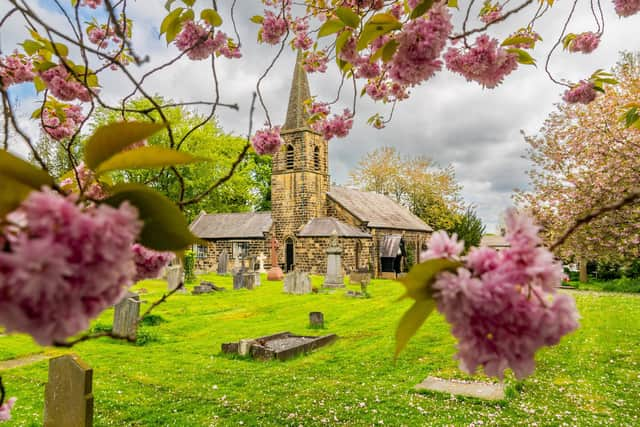

The serious environmental issue is, however, set against a very green backdrop. Not only is there a high number of mature trees leading to and through the village, Pool-in-Wharfedale is surrounded by farmland.
While Tower Drive, a private residential road, is a mature green space, mature woodland covers the area of a former quarry, creating a wildlife haven within a short walk from the village centre. The site is important to both the history and present character of Pool.
A historic major employer in Pool, Pool Bank Quarry, was sited on a vein of sandstone which was used to build most properties in the village. It was worked from the 1770s until the start of the Second World War. During a visit to nearby Farnley Hall, JMW Turner made a pencil drawing, which hangs in the Tate Gallery, of men and horses at work in the quarry, where fossilised tree remains dating from about 2,800 million years ago have been unearthed.
Perched between 46 and 165 metres above sea level, Pool offers sweeping views of open countryside towards North Yorkshire and Almscliffe Crag from numerous points across the village, which is fringed by woodlands that stretch west, across to the stone crags of Chevin Country Park.
Many of the views feature the winding River Wharfe, both banks of which have proved popular for anglers seeking grayling, chub, perch, trout and roach. While concerns remain over pollution in the river, on occasion otters and kingfishers can be spotted.
The landmark bridge is credited with having helped transform the village, from a series of mills and farms to a linear settlement, featuring terraced rows of workers cottages along Main Street and Mill Lane, dating to the 18th century. Church Close, for example, was built for employees at Whiteley’s Paper Mill. Contrastingly, the Jane Whiteley Memorial Homes on Church Lane were built in 1933 as rent-free accommodation with preference to former employess of the paper mill.
Off Mill Lane, between the north of Pool and the River Wharfe, a corn mill stood, where the remains of a mill and its headrace, pen-trough and wheel pit can be seen. The mill was fed by three streams and served by two paths, one of which can be seen running to Bar House at Arthington Lane.
Just outside the hillside village there’s a purpose-built bar house, on Old Pool Bank, where tolls were collected for travelling on the turnpike road until 1874.
At the time wool, paper and leather were manufactured in the village. It is thought there was a mill in the village from the 13th century. Otley’s church register records two mills were washed away by the river “and carried them whole, like to a ship to the sea” in 1673 following a particularly wet summer.
Passing tradesmen, quarry and mill workers helped fuel numerous more specialised services than most villages host, such as a bank and a haberdashers, many of which have been lost in recent decades.
On one side of the crossroads stands The White Hart pub in a former farmhouse boasting traditional windows which are a feature of many older properties in the village. It has an extensive menu featuring dishes such as beetroot carpaccio and tarragon-battered line-caught haddock.
On the other side of the busy Main Street, Pool Bank New Road and Arthington Lane junction lies a garden area known as Stocks Hill, where some stocks are thought to have stood for centuries. Beside it there’s the large 18th century residence Pool Hall, which has segmental-headed wagon doorways in its west side, as well as Pool Farmhouse, dated 1725 on its doorway lintel.
Another nearby listed structure is the war memorial, which is set back from Main Street. Erected in 1923, the tapering ashlar rectangular plan cenotaph lists the names of men from Pool killed during the First World War and comprises secondary plaques for conflicts, including Iraq.
Beside the memorial, there’s St Wilfrid’s Church, which replaced a chapel of ease on the site due to the population’s rapid growth in the 1830s. Its west tower with octagonal stone spire is as distinctive in the village as the grand Wesleyan Methodist Chapel on Main Street.
Much housebuilding followed the opening of Pool Railway Station in 1865, with an increase in higher status houses, such as The Tower, on Arthington Lane. The village’s median house price for the year ending in March was £453,400.
The French-sounding Avenue Des Hirondelles, off Pool Bank New Road, which is thought to have been named after local landowners the Swallow family, features numerous large properties, some with mock Tudor details, set in extensive grounds.
Foreign influences can be seen on Millcroft, where most of the Swedish prefabricated timber houses erected in 1947 still stand.