
Prospect Farm, Lindley: Cattle chairman ready for Otley Show time
We’re just a fortnight away from the traditional curtain-up of the summer show season that starts its five-month show calendar across our three Ridings with the 215th Otley Show, the oldest one-day agricultural show in the country, on Saturday May 16.
Agricultural shows started as a way of livestock farmers showing best practice in, largely, cattle, sheep and horses, when the work of legendary crossbreed pioneer Robert Bakewell had begun to shape livestock farming. Otley Show was founded in 1796, the year following Bakewell’s passing.
Dairy farmer John Houseman of Prospect Farm, Lindley is the newly appointed chairman of the cattle committee, after fifteen years of being steward and chief cattle steward. John is typically frank about the role.
‘A couple of years ago I was made chief steward. I think I got the job because they needed someone to blame. I’m still the same because they’ve given up with chief steward’s job.
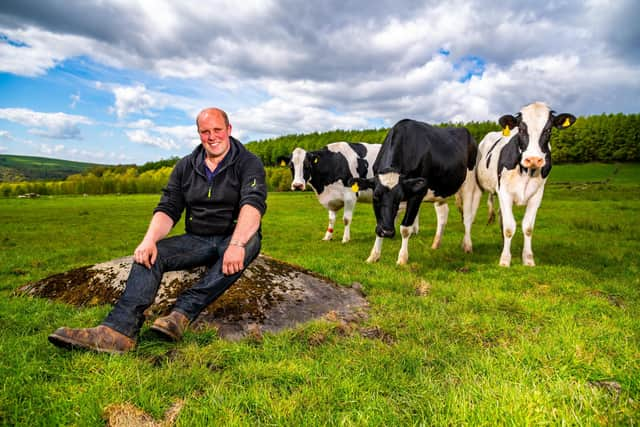

John is firmly rooted in the show. He’s never missed one and has always helped out.
‘I was with sheep a little bit. When I was younger my cousins sold show catalogues, and I’d walk around with them, and I’d take our tractor for any towing in and out that was needed.
‘It’s our local show. You see people that you don’t see from one year to the next. On show day I’m up extra early because my mum is there doing refreshments and dad has been on the sheep committee and is a past show president. I’m also in charge of loading and unloading of cattle, so I’m on the showground for 7 o’clock, having done all my work on the farm before.
Cattle and sheep entries are always strongly supported and John says he’s hopeful that this year will see an uplift on dairy entries.
‘We’ve introduced an Any Other Breed class and we’ve approached the Brown Swiss, Montbeliarde, Ayrshire, Jersey and Guernsey breeders.
Back home, John and his parents Nick and Julie have 200 dairy cows, mainly Holstein Friesian, at Prospect Farm as well as having another farm tenanted from Yorkshire Water at Blubberhouses, where they keep young stock and the beef herd that currently runs to around 170.
They farm 460 acres all down to grass and John says how important the grass is to the farm.
‘We have some very light soil by the riverside, but the majority is heavy stony clay and takes a lot of work, but it does provide us with what we need. At Prospect we will get three to four cuts per year, down at Blubberhouses it will be one to two cuts.
‘We had one field last year that suffered but everywhere else we could grow grass for fun and made as much silage as we ever have done.
The biggest change to dairying at Prospect came nearly seven years ago when the Housemans moved on to robotic milking.
‘We have three robots and it has made quite a difference, but I actually think that we’re doing more hours on the farm now than we did when we were stuck in the parlour for two or three hours at the beginning and end of the day.
‘It’s a different way of using your time,’ says Julie.’ And it’s better for us because we’re fitter. Milking puts a lot of pressure on your arms and back. And the cows are a lot healthier too.
John says that the dairy herd is now all inside, and that it was their preference.
‘When we started with robots we still had them turned out for them to graze, but the weather we’ve had the last few years with extreme heats and monsoon-like downpours meant that when it was very wet they were ploughing up the paddocks, and when it was dry they were stood under the trees.
‘Our milk yields were all over the place and some days there would be some go out and some when none would. How are you supposed to buffer feed at the trough when you don’t know how many are going to go out and how many are going to stay in?
‘Now we know that if the yield’s down or the amount they’re eating is down, there’s something amiss somewhere and we can sort it quickly, whereas when half go out on grass for the day you aren’t going to know what’s wrong with them until maybe it’s too late.
John also says he sees his cows more than ever.
‘We will walk through them, checking them, twice a day; but I’m always in and out the building pushing silage; and we have cameras set up so that I can check on my phone everything is right.
‘We’ve always looked at breeding and we used some red and white Holstein Friesian semen. We had a red calf through it and we’re now breeding off her and she’s had a red calf too. We put up a new calf shed about four years ago.
‘Our Holsteins will average four lactations, but we have some that have done eight or nine; our herd average is just over 10,000 litres. We don’t buy much in, they mainly feed off grass silage and a TMR mix.
‘We calve all-year round to maintain as level a profile as we can. I spread the heifers out with the cows, as I don’t like block calving the heifers because, with having robots, it’s a lot easier to train two new calved heifers than ten.
‘We’ve been genomic testing for around six years. We use sexed semen on the higher end of the heifers and cows; and we use beef sexed semen on fifty per cent of the rest with the others on regular semen. We use Angus and Belgian Blue.
‘Our milk goes to Arla and the price has remained static at 34ppl for the past two months after dropping last year.
John has his own Pottinger silage wagon and does some work for a handful of farms, silaging nearly 2000 acres overall.
‘I haven’t touted, it’s just pretty much come through friends and contacts. It started when an old machine blew up seventeen years ago and we bought a wagon. The money that comes in near enough pays for the payments on what we have now.
John says the beef side has been going well.
‘We produce strong stores at 20-24 months that finishers take on, buying from us at Wharfedale Mart. Our beef calves spend their first six months at Prospect before going to Blubberhouses. We changed what was an old straw shed around last year, which gives us a bit more capacity.
‘We’re trying to make technology work for us. We’ve recently got a grant for a new handling system. We’ve also started using EID tags and a reader, which eases the job a little because calves link up to the calf feeding machine.
The Housemans’ green credentials are also on the up.
‘We now produce more electricity than we use, with a wind turbine, solar panels and batteries.
John and his partner Seyhan have two young children – George and Lily, Seyhan helps with the holiday cottages and paperwork. Julie is also president of Farnley Estate YFC.