
Sandhall Farm, Skelton: Crunch decisions that bagged awards
Two weeks ago a young farming couple picked up not one but two of this year’s Yorkshire Post Rural Awards – Arable Farm of the Year and Farm of the Year, but arguably it was their annual crop of around just 60 acres of potatoes and what they do with them that made all the difference.
Lister’s Crisps is their seven-year old business that has given them what used to be called that other ‘leg to the stool’ something additional to the farm, which should continue to help when their two young daughters are old enough to decide where their future may lie.
Tom and Laura Platt of Sandhall Farm, Skelton, near Howden are of dyed-in-the-wool farming stock, both of third and fourth generation farming families, and while they took the title for Arable Farm of the Year, farming around 2000 acres, they are actually a mixed farm, as they also have 100 head of suckler cows.
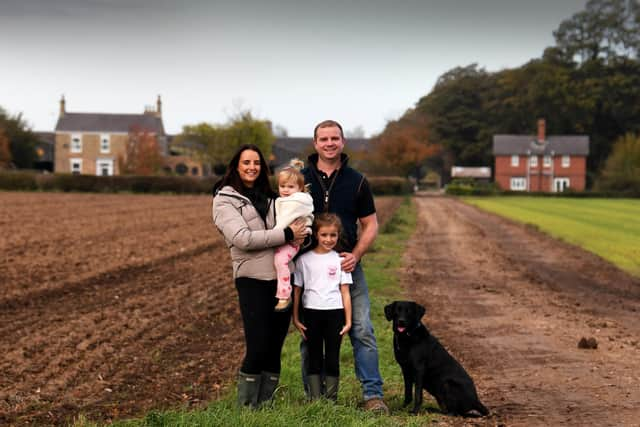

‘We’ve always been a mixed farm, for peace of mind if one market slumps,’ says Tom.
Arable crops form the far larger slice of the business, and it is predominantly wheat that is grown, with 1500 acres devoted to winter wheat, but Tom says that the idea of producing crisps from his own potato crop was an idea that had festered a while.
‘I’d rolled it around in my head for a long time and it got to a point where I had to jump in with two feet. That’s the only way you find out. You’ve just got to do it. Looking back, I don’t think I would have changed anything. We’ve taken all the right steps and it’s still as difficult as it was when we first started. It’s just a different challenge now.
‘Back then I was learning from scratch how to make the product and set it up exactly how I wanted it. I used to go to a friend’s potato field that I was using and dig them out by hand to run them up my small line. I never used to grow crisping varieties on my land because I’ve quite heavy land that doesn’t always grow them well enough. Most of my 300-400 acres of potatoes are still chipping and prepack varieties, so crispers was a new learning curve, as was everything from packaging and machinery.
‘I’ve been changing my crisping varieties nearly every year but we always grow Lady Rosetta, and then to see us through long term storage Opal and Olympus have been good varieties.
‘The new challenges are, now that we’ve an established business, understanding how many potatoes to grow for the crisps, costs involved and having a happy team.
Laura says the non-farming side of the business, the crisp production ex-field, is now a completely different scale.
‘When we first started we just had one and a half members of staff. The person who packed the crisps three days a week delivered the orders. Now we run the factory five days a week, and we’ve seven full-time members of staff. Our delivery van goes out every single day. We send stock out nationwide and have even started exporting.
‘It’s completely different to how we started, but we are still a family-run local business.
‘We currently have six crisp varieties and we’re hopefully launching a seventh in the new year which will be a limited edition lamb and mint flavour. We’ll watch how well it goes before adding it to our regular varieties. Cheese & Onion is still our No 1 seller, closely followed by Steak and Ale.
Tom tells of this year’s wheat harvest, also what he has established for next year and the potato harvest that is just coming to its end.
‘I go for pretty sturdy, reliable varieties of winter wheat and Skyfall, Costello and Graham are my main three. With the weather extremes we now get I need to plan where it all goes. I’ve put in a little of Defiance this time, which is supposed to be up and coming. Skyfall doesn’t grow too tall and I’ll put Skyfall on richer land because it throws a very good grain, with not too much straw.
‘Our wheat was all done by early August. It was our earliest start and earliest finish. I found it exhausting as you didn’t have time to sit down. Sometimes on a wet day in the middle of harvest it allows you to reset a little bit. We pulled our drilling programme forward a week because if the weather breaks and you can’t get your crops in you’ve lost your opportunity and with today’s weather patterns not being the same you just dare not chance it. We drilled steadily over a four-week period.
‘Some of the wheats we established first are coming but you can tell they are desperate for this rain, because they’ve broken the soil and just look stressed. We could have done with the rain we had ideally a week or two sooner.
‘Unfortunately, our yields have not been anything like what we normally achieve. I had some land where you thought it would do 5 tonnes an acre all day long, going in after potatoes, perfect timing, all applications correct, good weather, but it only did about 3.5 tonnes. That was soul destroying.
‘Second wheats only achieved 3 tonnes an acre. I feel that sometimes weather patterns can differ just across a couple of miles, that’s all it is. All the stores are full, but the problem is the grain is lighter and that means we are emptying stores a lot quicker than I’d planned on.
‘There are a lot of mixed reports about this year’s potato crop. For us, I already know our overall tonnage for potatoes is down. I feel that with a potato crop I want to be at least 18 tonnes an acre.
‘When we do shows with our Lister’s Crisps we speak with others and there are some serious problems out there.
Tom is growing 200 acres of spring peas next year and also grows, oats and spring barley as well as having some land in SFI schemes. His suckler herd is made up of continental crosses and he currently runs two Blonde bulls and one Limousin.
‘It works as a good circular business of no waste as I use my own straw for the cattle whose muck goes on to the land; and we feed the waste potatoes to them.
Tom and Laura’s daughters are Autumn (7) and Alana (2). Tom hopes that having Lister’s Crips (named after his grandfather on his mum’s side) adds a bit more security for the family farm in future.
‘You can never predict what they will want to do when the time comes. I just felt with having the two businesses they’ll have a choice. Half setting them up to a degree.
Laura says that she and Tom were both humbled by the awards they received.
‘We’d just like to express our gratitude. Everyone who was nominated were all amazing. Doing what we have done has led to a lot of sacrifices on the way, but receiving these awards has given us that bit more motivation to keep striving on.
https://listerscrisps.co.uk/