
Snaith, East Yorkshire: Rich history of the ‘island’ settlement
It's more than five years since Snaith, a settlement established in the last in a sequence of designated flood basins which form the Lower Aire Washlands, was inundated by flooding.
While the event was described as unprecedented it has been pointed out that Snaith was once an island surrounded by marshland.
According to Snaith and Cowick Together Community Heritage Group, the settlement's former names of Snath, Snayth, Snathe and Sned related to the wooden handle of scythes used to cut reeds in the area.
Nevertheless, following the wettest February on record in 2020, water overtopped flood barriers and uncontrolled flood water spilled into the parish of Snaith and Cowick, which is seven miles west of Goole, in the south west corner of East Yorkshire and close to the M62 motorway.
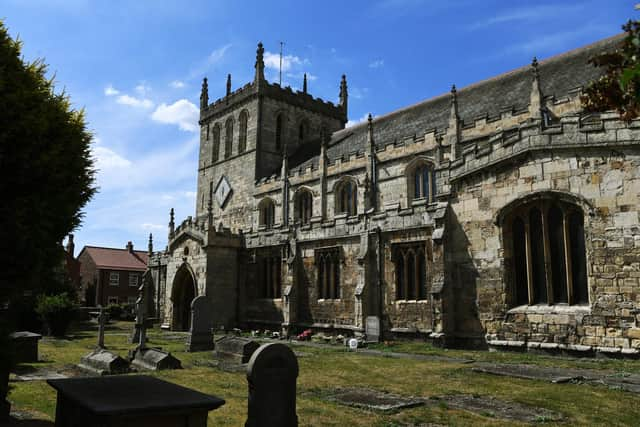

Residents on Gowdall Lane, opposite Snaith's railway station, were woken by a flood warden at 4am to warn of flooding and subsequent days saw Snaith Priory, the construction of which started just 34 years after the Battle of Hastings, used as a refuge centre.
Some 86 residential properties and nine businesses were flooded and pumps were brought in to try to reduce the risk of further flooding to properties, leaving the Environment Agency facing questions over their actions before, during and after the event.
A year later, some residents were still to return to their flood damaged homes, but despite the extensive damage that was caused little evidence of the flooding remains.
Approaching Snaith from both Gowdall Lane and Ferry Lane, arable farmland stretches as far as the eye can see.
After passing the Pontefract line station, which has long since seen its five services each way a day reduced to a single statutory service, and a level crossing with a higher than average risk rating, among the first buildings encountered is farmer and butcher RM Kealey, purveyors of the Snaith sausage. The recipe is closely guarded, but is said to have similarities to those originating in Cumberland.
Opposite is the Black Lion pub, one of a number in Snaith's conservation area. The Plough and the Manor House Bar are others in Snaith's large conservation, while Old Mill Brewery on Mill Street offers tours of the family-owned enteprise which has been established in an 18th century former corn mill, maltings and clog factory since 1983.
From the beginning of the 20th century the clog mill site covered a 1.5-acre site in the heart of Snaith and by the 1920s the British Clog Sole Manufacturers produced about 12,000 pairs of beech and alder soles a week in the mid 1920s.
There's a profusion of historic properties in the area, and in particular along the south side of Market Place and High Street. Snaith boasts some 35 listed, many of the buildings which date from the 17th and 18th centuries.
Market Place features a number of shops, along a relatively narrow parade which opens out onto a square which has hosted markets for 802 years.
While on a trip to the vast Hatfield Chase royal hunting ground nearby, King Henry III granted Snaith a charter to hold markets and fairs and receive rents and tolls. Butter from local dairy farms was a speciality.
Courts of Piepowder, which had unlimited jurisdiction over events taking place at the fairs and markets, such as traders' disputes, thefts and fights, were regularly held on market days.
It has been suggested the Snaith Lock-Up, near the church at the Butter Market, was built to house the temporary prisoners associated with the Piepowder Court.
However, the Lock-Up's Historic England listing states it dates from the late 18th century and was built by the Vestry Board for the use of the Manor Constables.
The tradition of markets has continued with mid-summer and Christmas markets still being staged in the Market Place, which is overlooked by a building that even pre-dates the markets.
Around the time William II died in a hunting accident and his brother, Henry I, succeeded him, the crown bestowed Snaith rectory to the Archbishop of York, who passed it on to Benedictine monks at Selby.
The grade I listed Priory of St Laurence, which continues to hold weekly Sunday services and became a rest centre for residents evacuated from their homes during the 2020 floods, was occupied by a small group of monks between the early 14th century and the dissolution of the monasteries, and provided a significant income for Selby Abbey.
It has been suggested the churchyard is several feet higher than the surrounding streets due to the large size of the parish hundreds of years ago, meaning bodies were taken there for burial from swathes of countryside surrounding Snaith.
Its eight-bell 75ft high tower appears fairly squat, but is particularly striking, with three stages of masonry, a clock dating to Tudor times, battlements and pinnacles and an interior spanning 29 feet by 25ft, and has three stages of masonry.
The monks formed the Peculiar Jurisdiction of Snaith and had the ability to raise taxes and the priory contained a Consistory Court, which decided over matrimonial and probate issues, and due to the lack of other courts in the area, numerous other lower level cases that arose in the parish, until 1857.
While the churchyard also features the 15th century Old Grammar School, which was the first school to be built in Snaith, the priory's 800th anniversary saw local primary schools to create a time capsule. This summer saw Snaith Primary School, which has recently expanded significantly following the occupation of new housing estates, continue Snaith's proud academic history, being awarded outstanding ratings by Ofsted in every category.