
Soil science is promoting prosperity as red clover transforms Oak House Farm
Red clover and ryegrass have transformed a North Yorkshire arable and beef farmer’s business and approach to farming.

Mike Powley of Oak House Farm, Green Hammerton, will be sharing his experiences of how, in concentration on soil structure, his crops, cattle and carbon sequestration have all improved, at next week’s Yorkshire Farming Conference in Harrogate.
Mike has long been an advocate of regenerative agriculture principles practiced by Gabe Brown and his fellow Stateside farmers and he was recently named on a shortlist of three for a national title as Beef Farmer of the Year, which he attributes strongly to the work he has undertaken on his farm over the past dozen or so years.
“Red clover is huge in the whole business. The red clover/ryegrass mix is restructuring the soil. I no longer have the cultivation work I once had and I’m enabling the soil biology to grow. I can produce a higher yielding arable crop and the mix produces a very high-quality feed which saves massively on feeding costs.

“If you’re going to make a difference to your animal business one thing I would say would be to grow red clover/ryegrass. It will transform your soils and if you’re an arable farmer with tired soils it’s well worth looking at too.”
Mike has worked with the Yorkshire Agricultural Society and the Farmer Scientist Network for the past decade, either speaking or hosting events. He also works with Leeds University.
“We guide scientists on what we would like them to look at and investigate for us. They then report their findings back in plain English.
“We farm around 370 acres with 122 acres owned, that we took on in 1987. It was derelict when we started at Elm House Farm next to the village green and we subsequently built a new farmhouse Oak House Farm outside the village with purpose-built cattle accommodation.
“We have 120 cows producing beef cattle that either go into ABP who supply ASDA or we sell our own boxed beef.”
Mike is very well-respected, having previously won the National Beef Farmer of the Year title as well as Overall Northern Farmer and Northern Beef Farmer of the Year, and says the red clover/ryegrass mix and its effect on soil health has driven everything around the farm in recent years.
“Our eight-year arable rotation now sees us with three years of red clover/ryegrass followed by wheat and barley, followed by a cover crop, then beans, wheat and barley.
“‘One of the best indicators of soil health is earthworm numbers. We were seeing less and less seagulls around when we were cultivating because we had less worms in the soil but knew the benefits of them.
“We went to a power harrow combination, but that’s basically a worm chopper. We’d given the worms a bashing, ploughing, and then when the seagulls had picked off whatever survived we were giving them another good bashing going through the power harrow.
"There was nothing left for the seagulls.
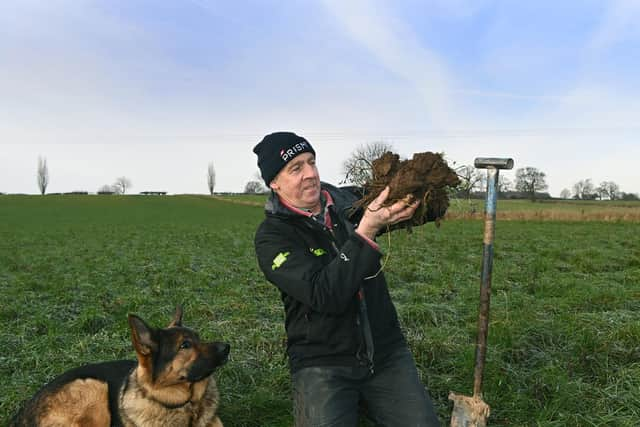
“Our fields are now in good health. We work on what is called the 20/20 principle. You take a spade and dig a square 20cm wide by 20 cm deep, that’s eight inches. If you can find 20 worms, that equates to 5 million worms per hectare. In a 4-hectare field that’s 20 million worms all working for you, providing airways, waterways through the soil, pulling all the crop residue into the soil, so that soil biology can deal with it.
“If you can get to that figure you’re rocking and rolling. We’re now there with the better fields. We’re saving well in excess of £100 an acre, and in some nearly £200 an acre in terms of ag-chems no longer used. We’re also using home-saved seed, which makes it cheaper and seen no detriment. We don’t have a grass weed problem because of our three-year leys and beans. We’ve reduced nitrogen inputs considerably and haven’t used P&K for 12 years.”
Mike says his rotation is helping his land, his efficiency and his cattle.
“We have a field on the road towards Ouseburn. In its previous 12 years it had been producing crops of potatoes, carrots and maize, and the soil was absolutely annihilated. Last year, as a result of our rotation, it yielded 4.5 tonnes of wheat, direct drilled into the grass with no cultivations at all. That’s the difference this system can have.
“‘Our red clover/ryegrass is cut four times a year, we bale it and it feeds the cattle. In terms of soil this is the least impactful method of farming, giving the soil biology time to get itself going.
“I can drill in an hour-and-a-half what used to take me all day if I was going to plough and combi it. This year I averaged 7 litres of diesel per hectare to drill my crops, down from around 50-60 litres, as I’m now just drilling. My machinery costs in wear and tear have reduced markedly too. Less hours on a tractor and the only parts that wear on single disc drills are the discs.
“I no longer have the pressure attributed to getting everything done, and I’m now in the position, with my number of cows up to where I want them to be, where I could take on another 100 acres of arable land locally, if any becomes available.” Mike says his herd is in the best shape it has ever been.
“We switched to South Devons around the start of the century and today the South Devons still form the most integral part of the herd, which we cross with an Angus bull and then the South Devon X Angus is crossed with a Charolais as terminal sire.
“We have just short of 300 cattle and have 117 cows to calve in March/April. We keep our calving period as tight as possible over a nine-week period. We now synchronise the heifers and will have a lot of heifers calving in the first week with 70 per cent of the herd calving in the first fortnight.
“‘I can feed people highly nutritious products, in terms of quality beef we produce. I am also addressing the carbon issue, in terms of sequestration, that could see me carbon zero or carbon neutral in the future.
Mike is married to Sheena and they have a daughter Rosie who has recently qualified as a vet and is working with Bishopton Veterinary Group in Ripon. Mike originally farmed with his father Tom and brother Richard at Elm House that had been taken on from his uncle Dick Jackson in 1987.
The Yorkshire Farming Conference will take place at the Yorkshire Event Centre, Harrogate on Wednesday 28 January.