
South Yorkshire farmer reveals secrets behind growing McDonald's fries potatoes
Where do the fries that you buy in a MacDonald’s meal come from? It is highly likely they are from potatoes grown in Yorkshire. Richard Smith of Barnburgh Farming Ltd is one of those who grows the potatoes that become them and he and his team picked up the Arable Farm of the Year title at this year’s Yorkshire Post Rural Awards recently.
Richard started farming after completing his studies at Writtle Agricultural College in 1989 returning to what was then his father’s 250-acre tenanted farm at Barnburgh Grange in High Melton, near Doncaster.
Today, Richard farms that same acreage, now owned, plus a little more purchased in recent times and owns, rents, contract farms or contracts acreages across two estates and other farms that sees him growing approximately 2500 acres of cereals, 850 acres of potatoes and overall 3500-4000 acres of crops including another substantial crop in wheat, plus barley, oilseed rape, sugar beet and beans.
“Numbers don’t float my boat,” says Richard. “But there won’t be many bigger growers of potatoes for McCain’s. They supply MacDonald’s. The potatoes now form the lion’s share of our income, but every crop is important.
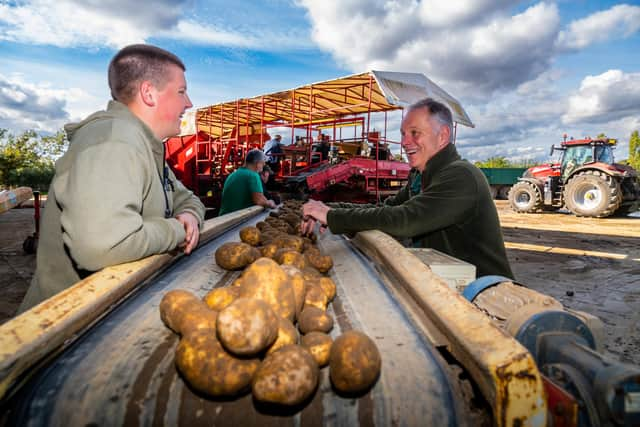

“A majority of our potatoes end up in a MacDonald’s restaurant and the fries are, by a country mile the best you’ll ever purchase because of the varieties we grow and how we grow them.
“We start with Shepody, our early season variety, which we’ve been lifting since the end of August, going on to Innovator, Russet Burbank, Royal, which isn’t destined for MacDonald’s but is instead a McCain’s variety, and King Russet our newest variety.
Richard has 20 acres devoted entirely to trialling new potato varieties using modern growing techniques on what is the Northern McCain’s trials site which also showcases areas in which sustainability and regeneration practices can be demonstrated, tested, proven and then adopted across the rest of the sector. The King Russet variety is a prime example.
“King Russet was initially grown as a small plot trial and is now a MacDonald gold standard variety grown extensively in the UK.
“A friend said to me a long time ago ‘you can’t beat having trials on your own soil, in your own climate, in your own conditions,’ says Richard. ‘It is something we’re very proud of as well as showcasing the reductions being made in Environmental Impact Quotient (EIQ) pesticides and measuring stir value of cultivations, aiming to grow potatoes in a way that releases less carbon and greenhouse gases.
“That doesn’t mean we don’t plough. The plough is not necessarily all bad. We use it rotationally and one ploughing season within a rotation isn’t necessarily a bad thing. Growing potatoes is not a natural bedfellow of regenerative agriculture because in general you need to move far more soil, for deeper depth, but regenerative agriculture should be called good agricultural practice and we and our processing friends have made big strides and commitments to a regeneration programme and we are all on a journey to grow our potatoes in a more environmentally friendly way.
Richard says the past two harvests have seen distinctly average yields across all crops.
“Yields of all crops depend on variety, time of year and weather. On potatoes we aim for 20 tonnes per acre. If we get a good year that’s where we get to. Sometimes we’re down at 18, sometimes above. Last year was the worst it has ever been because of the weather.
“We all need to understand that things are evolving far quicker than we ever thought regarding climate and climate change, particularly the swings between wet and dry. It all brings about even more risk. I think we have to be more fleet of foot as we go forward and learn how to manage risk. If you get it right it’s very satisfying. We tear our hair out for eleven months of the year.
Richard says the aim right across the whole acreage farmed is to maintain output and quality, and Barnburgh Farming has invested heavily in the right equipment, buildings and its irrigation system.
“For us to be sustainable and to manage the extremes of weather we recognised that better irrigation was an issue and we’ve invested in the installation of five kilometres of underground irrigation main and bore holes with neighbouring landowners consent to future proof our crops.
“We’ve always been an adopter of new technology on precision farming which offer us highly accurate operations of application. Fields are mapped, operations logged, it’s all about making sure we’re here for the long term. We’ve also invested in huge refrigerated storage facilities for the potatoes as well as storage for all commodities. We have facilities to now store 65-70 per cent of our potatoes with 40 per cent on long term storage with refrigeration.
Richard says the largest acreage of cropping is winter wheat.
“We grow around 2000 acres, a mix of milling wheats and feed wheats. Our varieties for the 2026 harvest include Group 1 milling wheats Crusoe and Vibe, which is one of the new varieties this year, and others include Extase and Palladium; we also have Group 4 hard feed wheats Typhoon and Dawsum. I’d love to have all milling wheats and them all to do 5 tonnes to the acre and at £30 per tonne premium but the world doesn’t quite work like that.
“Wheat yield has been very average this year, but not as bad as it looked like being with lack of rainfall we’ve had. We’ve now had two years of average yields, but you can’t have biggest and best every year. We also grow winter malting barley variety Craft.
“We typically operate a six-year rotation based on wheat, potatoes, wheat, sugar beet, wheat and oilseed rape/pulses, and on stronger land unsuitable for root cropping it is wheat, barley, oilseed rape, wheat, wheat and beans. We adhere to the Assured Combinable Crops Scheme and Assured Produce Scheme.
“All the land is also part of SFI schemes with cover crops grown post-harvest prior to second cropping.
Danum Farming, a business run with a neighbouring farming colleague since 2004, came to an end in 2022. Richard now runs his whole business purely as Barnburgh Farming Ltd.
“There’s me and my team of four full-timers, plus a part-time secretary and owner operators who come armed with their tractors when we need them. We can have a dozen tractors going at any one time. It’s a great team. I couldn’t do it without them and James Hague, my right hand man, knows exactly what I need him to do.
Richard’s partner is Sarah and he has two daughters – Tillie, who has just started her degree course in medicine at Nottingham University and Florence, who is studying for A levels. Richard says that while he is busy future proofing the farm business he is concerned about the government’s plans for agriculture and what that will mean for his daughters.
“I love farming, but I hope I’m young enough to see the Inheritance Tax proposals being reversed. This government don’t understand that we are asset rich and cash poor. We could all sell up but we don’t, we try to take our businesses forward.