
Stokesley Show: The Yorkshire show where a joke category has become very competitive
There are prizes galore in the agricultural show world but with this year’s summer show season nearing its close there is one that is unique to Stokesley Show that takes place once again next Saturday (Sep 19) – and it’s one that Tom Seymour of Dromonby Farm, Kirkby in Cleveland, vice chairman of the executive committee, has won in the past.

“I managed to win The Tallest Thistle,” says Tom.
“It’s a class that tends to give everyone a bit of amusement each year, puts smiles on faces.
"It’s a little like a joke one in comparison to everything else, but it’s quite competitive. I wouldn’t go as far as to say people take it too seriously, but there are a lot of entries.”
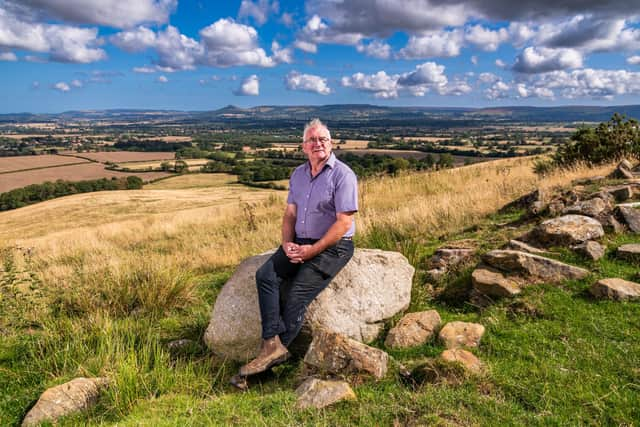

Cattle form the main income at Dromonby, where Tom has farmed for 30 years, and the cattle classes at Stokesley are legendary for the way the scores are delivered in the interbreed championships.
“I’ve stewarded in the cattle classes since I was 16. We are still doing the judging the way that Strictly Come Dancing copied from us.
"Each beast receives points by judges holding up cards. It probably draws the biggest crowd of the day. It’s that sense of anticipation bringing theatre to the event.
“We’ve also a new bull prize for the champion pedigree bull. It’s pretty unique because the company sponsoring is also called Bull.
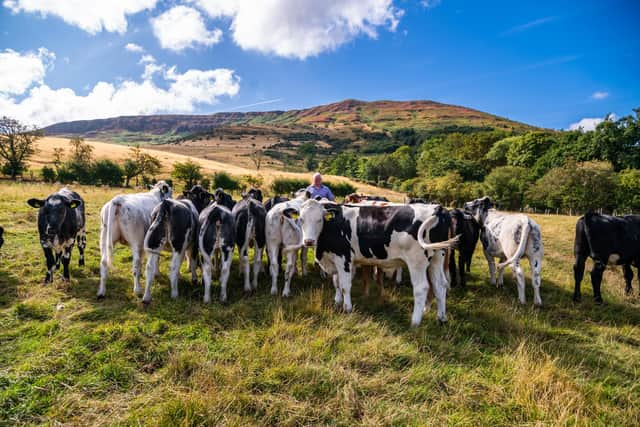
"Chairman of our executive committee is Neal Waters who operates the company Bull Tankers, so it’s a lot of bull,” Tom adds with tongue firmly in cheek.
“Stokesley Show is such a big part of everybody’s life around here, not just in the farming community, but for everyone in the area.
"It takes an incredible amount of work for a one-day show, but when 20,000 come every year it has to be done right.
"It’s always a great day and a wonderful mix of farming, the rural community and all around the Cleveland Hills and Teesside.
“The show has retained its traditional livestock and produce classes while adding other elements that would not be possible without farming like our popular Food Theatre.
"This year we have four excellent chefs appearing. We’ve also added cover for the cattle lines, in case it’s either wet or even a little too warm.”
Tom is the third generation to farm at Dromonby, which grandfather Norman bought in the early Seventies, with father John taking over and subsequently Tom.
“We now farm across 1,000 acres. We had three dairy herds until the early Eighties, here and at two other farms. In those days it was run by my grandfather, father and his brother.
"My uncle emigrated to Australia. Granddad and dad came out of dairying when we had 500 cows, a significant number back then. We also used to grow a lot of potatoes.
“I didn’t come back to the farm until 1997. I went to Australia for a year; to Newcastle University for three years and worked as a post-graduate at Malton Bacon Factory for five years. I was 27 when I came back.
"At the time dad was quite involved with NFU and consultancies. I’d married Alison and we were expecting our first child.”
Tom says today’s farming at Dromonby sees them with 750 acres of arable land, finishing 250 beef cattle each year, overwintering 300 gimmer lambs and an increasing flock of Dutch Spotted ewes.
“We’d had a suckler herd but have been specialising in fattening cattle for a number of years.
"We buy-in 20 to 30 each month, usually a mix of Blues, Herefords, Angus and Shorthorns, from the same farmer up near Barnard Castle, for the past 15 years.
"He sources from Lancaster and Penrith livestock marts. We keep them 12-14 months and finish between 16-20 months.
“We look for an evenly weighted batch with stock arriving at 165-185 kilos. Our aim is to achieve 650 kilos for steers and 620 for heifers.
"We normally sell through St Merryn Meats in Merthyr Tydfil and Jewitts in Spennymoor.”
Tom says the cattle price has been healthy for some time but he is cautious over recent developments.
“It has been at a good level for the past 18 months until just lately when it has started to get harder again having dropped nearly 20 per cent, but the calf price that we buy in at, hasn’t dropped, and is still climbing.”
This year’s cropping has produced a mixed bag.
“We finished harvest early again, like many others. Well-known contractor Andrew Gloag looks after most of our arable land. We feed all the barley to cattle.
"The winter barley’s done alright having averaged something like 3.4 tonnes per acre across the 70 acres, but our 70 acres of spring barley didn’t do so well, at less than two tonnes.
"Our biggest crop is winter wheat. We had 290 acres this time. It has done alright. Our overall average of 3.6 tonnes is just below normal. Scope, a new winter wheat variety for us, did well.”
Tom reports a better time for oilseed rape.
“We had 130 acres. That did very well, averaging 1.8 tonnes on a variety that would normally cap at 1.6.
"We did still get some problems with flea beetle, but we were able to drill it very early and then it got the rain, so it got established.
"We direct drill the oilseed rape, and some wheat, and use cover crops. We are also in SFI schemes, and higher level stewardship.”
Tom says Dromonby was previously home to 800 breeding ewes, mainly Mules, Mashams and Texels.
“That was some years ago. Our main sheep enterprise is buying 300 mainly Texel and Mule gimmer lambs from Skipton and the Wombleton sales.
"For quite some time we’ve bought mainly from Alan Saxby who died last year. We now have his son Michael buying for us.
"We over-winter them and sell as shearlings privately and at Darlington and Northallerton.
“We’ve begun a new lambing flock with Dutch Spotted. Our daughter, Kate, decided during Covid that she fancied a few.
"They’re not pedigree, but we are working slowly towards it having bought a tup to start with that we put on to some Texels. We’re gradually grading them up and will have our first Grade 1 lambs next year.
.”
Other elements to Dromonby’s business include three fishing ponds opened in 2003 that have carp, rudd, roach and tench; and they compost green waste too.
Tom and Alison, who works on the farm, have two sons and Kate.
“Will went to Newcastle University as I did and has worked on cereals and dairy farms in Australia and New Zealand; Sam works in America on farming related software; and Kate works in London.”