
The rural voices demanding a fairer deal for Yorkshire's farmers
“It is time for a rural reset” say countryside supporters who have launched a campaign for the government to rebuild rural relationships with the start of a new parliamentary term and a new Prime Minister.

The Countryside Alliance, led by Tim Bonner, says there have been two years of government policy and decision-making which has “knowingly or unknowingly, had a detrimental impact on rural interests”.
Andy Burnham can take a new path, says Mr Bonner, as an invited audience representing a wide range of rural organisations made this known to senior politicians in Westminster on Monday.
It comes as George Dunn, chair of the Tenant Farmers Association (TFA) says public money is being used as an incentive for “corporate, institutional and private landowners” to remove tenant farmers.
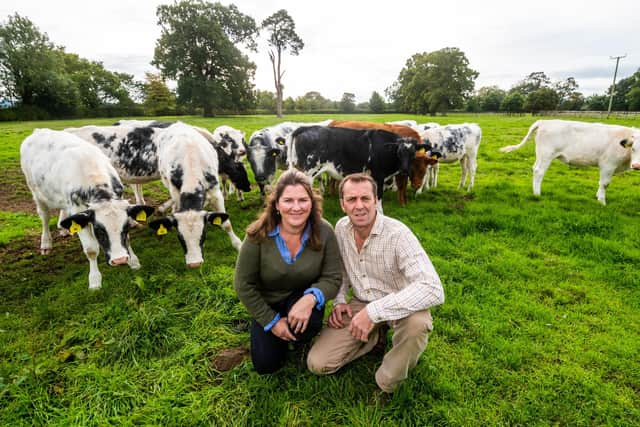

The Countryside Alliance says, that having u-turned on digital ID schemes and higher bus fares, there is no reason the same can’t be done on inheritance tax for farmers and the trail hunting ban, for example.
Tim Bonner said: “Rural people are not asking Ministers to solve every problem overnight, nor are we unrealistic about the multiple demands facing government.
“What we are asking is to be heard, understood and treated fairly. It is time for this Labour government to grasp that the countryside can be a major part of the solution to Britain’s problems, not just a burden or an afterthought.
“The countryside will deliver growth if it is allowed to do that. All we are asking is that the government recognises the needs of rural communities and works with them, not against them.”

With measures over recent years that have landowners financially rewarded for schemes such as solar, tree-planting, taking fields out of management and reducing livestock numbers - tenant farmers have often become “collateral damage”, Mr Dunn has said.
Earlier this summer Rob and Emma Sturdy, of Eden Farm at Old Malton in North Yorkshire harvested their cereal crop for the final time, after 70 years of family farming which saw Rob’s father and grand-father at the helm before him.
However, Harmony Energy are set to build a solar farm and battery storage scheme on part of the farmland which they rent from The Fitzwilliam Trust Corporation - a director of which is Helena Anne Beatrix Wentworth Fitzwilliam Rees-Mogg, wife of Sir Jacob-Rees Mogg, a former Conservative MP and Leader of the House of Commons.
Even though Harmony Energy’s planning application, submitted in 2023, was refused by the local planning authority, it was overturned on appeal in 2025 and given the green-light by housing and planning minister Matthew Pennycock, acting for Angela Rayner who at the time was the Secretary of State for Housing, Communities and Local Government before resigning over a row about unpaid stamp duty.
It was even stated at the appeal there would be “irreversible” damage to their family farming business, but the level of which would be outweighed by the benefits of solar energy.
Last year Adele Riddle made an impassioned plea to Sheffield City Council after discovering it had a vision to build houses and schools on green open spaces, which would have affected Townend Farm, between Grenoside and Ecclesfield in Sheffield.
Mrs Riddle, and husband Andrew, have rented Townend Farm from the council for 44 years and transformed it from a derelict site into a family business.
Writing recently, Mr Dunn said: “We are seeing corporate, institutional and private landowners taking land back in hand because environmental payments, woodland creation, carbon schemes or other changes of use are more financially attractive than continuing to let it to an agricultural tenant.
“In the worst cases, taxpayers’ money can become the incentive for a landlord to remove the very person who has managed the holding, produced food, invested in the land and contributed to the local economy for many years.”
The way current policy works, added Mr Dunn, is that it is more likely to encourage a landowner to terminate a tenancy rather than work with the tenant to reach a mutually beneficial solution.
The TFA has recently called on the government to introduce a scheme where every publicly funded land management scheme declares whether the proposal will affect a tenant, reduce the area of a tenanted holding or lead to the termination or non-renewal of a tenancy.
Mr Dunn argues there should also be a bank of evidence so the scale of problems around tenant farmers being removed or penalised for land management schemes is clear.
He said: “Government also needs reliable evidence about the scale of the problem – an issue identified in the excellent Rock Review into agricultural tenancies.
“Four years on from that review and there continues to be no sufficiently transparent picture showing how many tenants have lost land because a landlord has entered an environmental, woodland, infrastructure or nature-market scheme.
“Ministers should require departments and delivery bodies to collect and publish information on the tenancy impacts of their schemes and initiatives.”
The Rock Review, into tenant farming in England in 2023, made more than 70 recommendations to The Department for Environment, Food and Rural Affairs (Defra).
It said: “An open and collaborative approach between tenants and landlords is sadly not the norm.”
It found that the “state of the tenanted sector” is due to legislative decisions and the impacts of various payment schemes, which have come and gone, and also that tenant farmers face multiple barriers to accessing government schemes and growing their businesses.
More than half of farmable land in England is under some kind of tenancy agreement and a third of all agricultural land in England is tenanted.
In the aftermath of The Rock Review, the government created the role of Commissioner for the Tenant Farming Sector to strengthen relationships between tenant farmers, landlords and advisers with Alan Laidlaw being appointed.
The Farm Tenancy Forum, between the industry and Defra was also set up to explore all issues relating to the tenant farming sector in England, while the Agricultural Landlord and Tenant Code of Practice, to promote fair and responsible behaviour across the sector, was drawn up.