
The Yorkshire hotspot where you can see some unusual dragonflies
In a patch of woodland beside the River Aire I caught a glimpse of something small and brown moving in the corner of an eye, suggesting a newly fledged bird had flitted over the ground vegetation, perhaps a young chiffchaff. But when located with binoculars it turned out to be a brown hawker.
One of our larger dragonflies, the brown hawker has a rich chocolate-brown body and golden orange wings.
A few decades ago it was a species pretty much confined to the south of England but in recent years its range has moved north it often seen on the wing in Yorkshire from late June until the end of September.
It can turn up at garden ponds, as my neighbour knows, while for me it has become an infrequent sighting when walking along the towpath of the nearby Leeds-Liverpool Canal.
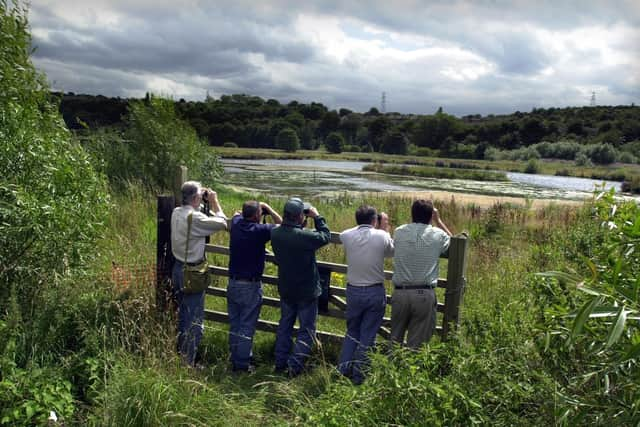

A more dependable location is Rodley Nature Reserve, the decommissioned Yorkshire Water sewage works on the River Aire which has been landscape-engineered to create wetland habitats and special dragonfly ponds.
So successful are the latter that Rodley has been designated a national Dragonfly Hotspot by the British Dragonfly Society, with over a score of dragonfly and damselfly species now recorded.
Whenever I visit in summer the large number of people I see gathered round the ponds with binoculars, telescopes and cameras suggested to me that identifying them has become the new birdwatching. The first brown hawker of the year was seen on June 24.
On one visit, as I approached a man beckoned me over and pointed to one of the ponds.
“There’s a broad-bodied chaser about,” he said with excitement. I strolled across and scanned the surface with its shiny raft of water lilies, but to be honest I wasn’t sure what I was looking for until a woman sitting on a nearby bench helped me out.
“A male broad-bodied was here. Wait a minute . . . there it is . . .”
She gestured to something which looked like a miniature WWI biplane flitting across the pond’s surface.
It had a pale blue body, fatter than most dragonflies, and through my binoculars the wings appeared to be made of cellophane.
It was soon gone but there were plenty of other species around to keep me engaged for the next couple of hours, including the one everyone hopes to see - the magnificent emperor dragonfly.
Roughly three inches long, this is largest found in the UK. The male’s thorax is bright sky blue, the female’s is apple green.
Common blue damselflies seemed to be everywhere, their slender turquoise bodies glowing like airborne streaks of neon. Someone identified an azure damselfly but to me it looked no different to the common blue.
Experts, however, can tell them apart with ease, the diagnostic feature being how thin the black lines are on the azure’s thorax and something called a “beer glass” mark.
I couldn’t actually see this myself, and it felt a bit like trying to tell the difference between our more nondescript warblers in summer, a skill that improves with practice.