
The Yorkshire Vet: I'm unlocking my dog’s DNA code - Julian Norton
For no other reason than curiosity and a bit of fun, some of us at work decided to do DNA tests on our dogs, cats and ourselves. I have to admit (despite having spent tracts of time at university studying genetics, in the very same department where the Human Genome Project was happening) I was sceptical about the validity of what we had agreed to. I understand quite a lot about DNA and its encrypted genetic code, but are there really specific genes for Jack Russell Terrier, Dalmatian or Great Dane? Equally, would the human tests tell us “98% Castleford” or “95% West Yorkshire”, or even “100% Lumley Street”? Or, perhaps, more exotic ancestral provenance might appear. Time would tell.
I understand quite a lot about DNA and its encrypted genetic code, but are there really specific genes for Jack Russell Terrier, Dalmatian or Great Dane? Equally, would the human tests tell us “98% Castleford” or “95% West Yorkshire”, or even “100% Lumley Street”? Or, perhaps, more exotic ancestral provenance might appear. Time would tell.
From my own point of view- or at least that of my quirky dog- it could be money well spent. I have known Jack Russells for as long as I’ve had a memory. But Emmy, with her unfeasibly long body, but ridiculously short legs; her unnatural affinity for swimming and retrieving and her elongated, lurcher-like face and mad hair, does not fit the typical mould. Much as I love her, she wouldn’t win a prize in any JRT competition. So, I rolled the swab inside her cheek to collect sufficient cells to provide enough DNA to analyse, hoping to find the answers.
Whilst awaiting the analysis, some research was required. Quickly, I discovered that humans share 60% similar DNA coding with strawberries and bananas, which prepared me- to some extent- for the results. If Emmy is 60% Great Dane, then I’m surmising that this might also mean she is 60% banana. We should possibly view the pending results with some caution. Humans and dogs share 84% of their DNA code. This might not be such a surprise, since much of the basic working of our brains, eyes, cell and hormone function, for example, is the same, even though dogs have four legs and cannot talk. They can still see things similarly to us and their internal organs are basically the same.
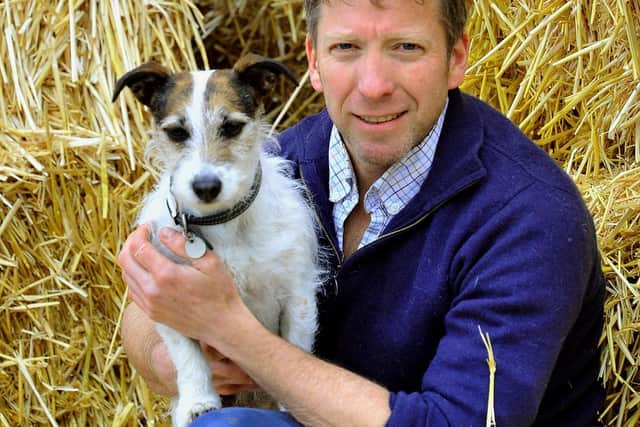

The emergence of genetic testing has opened up huge opportunity for health improvement in the veterinary sphere. We can, with incredible accuracy, now test our animal patients for a bewildering selection of genetic diseases. Some of these are unfeasibly rare, but some are more common, serious and debilitating. French Spaniels, for example, can be affected by something called Acral Mutilation Syndrome- a rare but horrible genetic disease which I, thankfully, have only seen once. The poor affected dogs chew their paws and feet to the point of severe self-harm, all because of one faulty gene. It’s now possible to test for this to prevent the accidental breeding of dogs with this horrendous disorder. Similarly, there are readily available DNA tests to check for things like inherited eye diseases in some breeds of dogs, which is extremely helpful in the drive to eradicate these problems.
But genetics is a complex field. Some years ago, after the crisis of BSE and Scrapie- its sheep equivalent- a test was developed to determine a sheep’s susceptibility or resistance to the disease. Many breeding sheep were tested, the idea being that those with resistance would be used for breeding in preference to those with susceptibility. However, it seemed that some of the scrapie-resistant sheep were woefully inadequate in other ways, illustrating the fact that genes never act in isolation and that selecting for one beneficial or desirable trait may bring with it the undesirable too.
But for now, I’m waiting for a summary of our provenance- I’m fairly certain all my genetics will be concentrated in a small area of West Yorkshire, but maybe Emmy will turn out to be part Dalmatian!