
Wass Farm Charcuterie serves up a prize result
It all started with a shed in their garden and a desire to sell their own fresh produce to local people. Five years on, having switched to producing high end charcuterie from their outdoor pigs, farming couple Nick and Annabelle Taylor of Wass Farm, Ampleforth are now double Great Taste Award winners, the world’s largest food and drink awards, which they received recently.
Five years on, having switched to producing high end charcuterie from their outdoor pigs, farming couple Nick and Annabelle Taylor of Wass Farm, Ampleforth are now double Great Taste Award winners, the world’s largest food and drink awards, which they received recently.
It’s an incredible achievement for a family farm in the Howardian Hills that is steeped in livestock farming and one that they are both very proud of at the 322-acre farm.

‘We started Wass Farm Shop from that little shed,’ says Annabelle. Our original idea had been to offer our community access to wonderful, real, proper farm fresh meat.
‘There’s a lot of competition and we knew, right from the start, that we would like to build it into a lot bigger business. The catalyst, for going to charcuterie produce, was attending an event where we saw somebody else, not from anywhere around us, selling it. We talked with them and they said they could turn our fresh meat into charcuterie. We now have a specialist curer who is very local and we are working closely on developing recipes to our specifications.
‘Our concept remains the same. We want customers to value knowing where their meat comes from. We now attend eight markets a month, summer agricultural shows and our produce is available in major local retailers such as Lewis & Cooper in Northallerton and a Michelin restaurant, as well as online.
Nick and Annebelle’s Mangalitza pigs are responsible for both of their Great Taste Awards.
‘Our Mangalitza Fennel Salami and Mangalatiza Coppa, matured in our own fresh farm apple juice, were both awarded three stars,’ says Annabelle. ‘This year there were 15,000-plus entries in the awards and less than two per cent received three stars, and we had two of them.
‘We have Mangalitzas and Middle Whites and we’ve been growing the pig herd over the past five years. We are currently heading towards two dozen sows.
Nick says they’re still on a learning curve with the pigs.
‘We’ve learned not to put the sows into pig to produce litters over the winter months because, since they are outdoor-reared, they don’t always perform so well at that time. It’s easier for the sows to have litters in more clement weather and easier on the pigs they produce too, so our sows are not producing litters all year round. They usually start producing from March.
Annabelle says that everything produced by the sows goes into the charcuterie and that the pig produce makes up around 75 per cent of their overall charcuterie output, with venison making up around 20 per cent and others the rest.
‘Recently, just a few weeks ago, we launched a limited edition using Scottish Blackface sheep, into lamb, rosemary and garlic salami; and we have air-dried Blackie mutton leg.
While Wass Farm Charcuterie sees a good deal of time and effort put in by both Nick and Annabelle away from the farm, there’s still much to do on it, and Nick points to the recent SFI window opening and shutting within six hours as definitely not helping.
‘I was wanting to put in for grassland options, but with what happened we missed out. We’d been in an SFI scheme for the past five years that saw us in a wholecrop silage and bumblebird mix. They’ve stopped bumblebird mix, which is where you sow a mix of allsorts, some brassicas, some corn and a lot of clover. The idea is it grows and feeds the birds in the next back-end and the clovers come in the spring for the bumblebirds, which include all bumblebees and pollinators. I wanted to continue but we didn’t get in during such a short window.
‘We had 70 acres of arable crops up until six years ago. The arable side wasn’t paying, so we had to make a decision. Presently we have five acres in bumblebird, and ever so much in wild bird cover, plus a 20-acre wholecrop silage option where we have to establish a cereal crop in spring. We’d had an extension of one year to the five-year option but now I’m going to have to go all down to grass and without any grants, because of what has happened with the latest SFI window.
Nick is a partner in the family business that he had farmed with his now late-grandfather George Lupton, who lived until he was 100.
‘Mum’s also a partner,’ says Nick. ‘We have about 50 acres of woodland, 30 acres wild bird mix and the rest pretty much down to grass, or will be soon because of the SFI window.
‘We have cattle and sheep as well as pigs. The suckler herd is made up of predominantly Blues and Angus crosses out of a local dairy herd. This year we will have 20 autumn calving cows; and 40 spring calving cows.
‘I don’t use AI. All our cattle are bulled. I currently have two Blue bulls. We had a Bazadaise but he had to go as he wasn’t firing.
‘In the past two years I’ve sold all the bulls fat at Northallerton or Thirsk livestock markets, all going at between 16-18 months. I’m just awaiting a visit from Northallerton who are coming to have a look at the heifers that are around 20 months, as to whether they will go as stores. They’re fit but not fat because, with the summer having been dry and warm they’ve been running on very little grass.
‘Cattle are still a good trade even though they are back about 50p a kilo from their height. We also now bucket rear calves bought in.
Nick’s latest development came just last week, with a visit to Stoneleigh to buy a packet of Charmoise ewes.
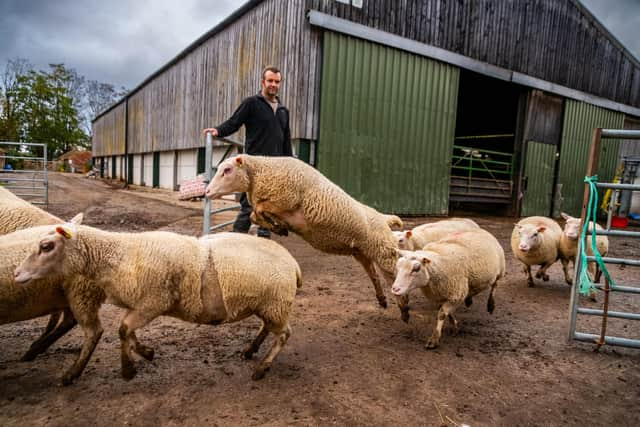
‘We have a flock of around 150 ewes with about 45 of them being Scottish Blackface. The rest are mainly Mules out of Blackies but by a Texel rather than a Bluefaced Leicester.
‘I’ve had a couple of Charmoise tups that have produced easy lambing and they are hardy. They also look the part, they’re tight skinned and I was keen on them. When I saw there was a dispersal sale I went along and bought 10 shearlings and10 two-shears, but no tup, so I now need one.
‘We lamb from March and our lambs go to Malton’s Wombleton sales. When we went the other week we were only a couple of quid off topping the market.
Nick and Annabelle have been nearly as prolific as their livestock as they have six children aged between 18 and 8. They have five daughters and one son, who is the youngest and Annabelle says that Ralph is Nick’s shadow.
‘Ralph just wants to be on farm all the time. He loves the farm and all the animals. With the family and Wass Farm Cahrcuterie we’re always here and there everywhere, whether at the markets we attend, everything else we do with the farm and ferrying children around.
‘We’re currently adding to our workload further as we are going to be launching some fabulous Christmas hampers next week!’