
Why I think we'll be the last family to farm between the M62 - Jill Thorp
The sales are now in full swing which means there’s a constant stream of sheep going through our yard.
Gathering them in, sorting out who’s going where before they head off with Paul and the little guy. It’s rare the wagon returns empty especially if the child has gone as well.
I tend to get forewarned; an excited phone call declaring “they were too good to miss” or “just wait till you see them Mum”.
Our Herdwicks are slowly and very sadly disappearing and being replaced with Swaledale ewes.
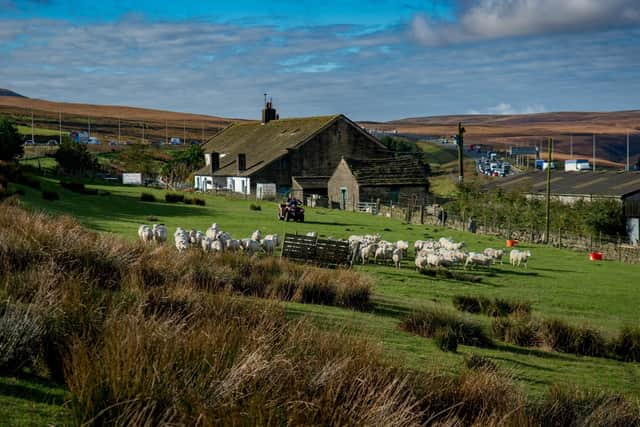

The Herdwicks have been at Stott Hall for many years but their unruly behaviour has meant that their days here are numbered. Paul has threatened them repeatedly over the years but this time he really means it.
They have become increasingly more difficult to keep on the moor, after all, why stay somewhere safe when you can root your way under, over or through a fence and wander aimlessly up and down a road.
I shall miss them, such hardy, wilful little creatures, but too much hard work now.
After living amongst years of disorder we’ve finally started the big tidy up.
When Paul took over the tenancy of Stott Hall, he inherited a generation worth of clutter, things that would be deemed useful at some point down the line.
The barn that forms part of the main linear farmstead is home to piles of interesting hoardings; the beams covered in rusty nails with unrecognisable items hanging forlornly, coated in dust and cobwebs.
Ancient sheep collars or couplings used to join wayward tups together, thankfully no longer used but hanging there as a reminder of past shepherding ways, rows of rusted worn hand shears and of course the obligatory bucket of bent nails, hiding away in a forgotten corner.
Under years of more recent castaway items are some beautiful relics that should never be thrown out and are an intrinsic part of our heritage.
Perhaps untouched for nearly three quarters of a century, the horse drawn hay rake that sits on one of the loft floors is a stark and somewhat sad reminder of how far technology has taken us.
The barn, with it’s opposing double doors would have allowed the working horses to enter, loaded with hay and then walk straight through once the winter’s fodder was thrown up onto the loft.
The rake, that would have been pulled up and down the meadows of Stott Hall, is all that is left of the once peaceful way of existence up here.
On upland farms like this, the tractor wouldn’t have made an appearance until well after the war and once it did, old horse drawn machinery was left to rot away, often under hedgerows or in our case, preserved on a loft floor.
I expect we’ll be the last of the farmers up at Stott Hall, when our tenancy comes to its end, so will generations of shepherding.
Perhaps the hoardings from a bygone era will be brought to light, displayed as part of our farming’s past.
Whilst I’ll happily fill the skip with some of the items found up there, including an old toilet seat hanging from the rafters, anything that forms our story and those of the shepherds that came before us, will be kept and every now and again, we’ll pull the dusty tarpaulin back and rest our eyes on a little piece of history and perhaps for a minute, wish we could be taken back to a time and place long since gone.