
Windleden Farm, Dunford Bridge: Tup of the classes for young Thomas
Everyone born and bred in Yorkshire knows we have the biggest county, but some may not be aware we also have the most breeds of sheep that started here too – Masham, Teeswater, Wensleydale, Swaledale, Dalesbred and another, known as the Penistone Sheep, the Whitefaced Woodland, that takes pride of place next Saturday, 12 September, at Penistone Show.
Eight-year-old Thomas Smith of Windleden Farm, Dunford Bridge, just a handful of miles from the showground, will be there proudly showing his tup that equally proud dad Richard says should have a reasonable price tag on him by the end of the season due to its success so far. “It’s been a good year for Thomas and his tup that I bought for him. He had a champion with it at Emley Show, reserve champion at Honley Show and breed champion more recently at Mottram Show. He will be looking forward to taking it to what is our local show at Penistone.
“He can hold most of the sheep himself, but when it comes to tups, his granddad Jim, or his mum, my wife Stacey, helps him. He’s very keen, and we go to wherever shows put on classes for Whitefaced Woodlands.
“My sister Rachel (Mahon), who I farm with alongside my dad Harold, has Derbyshire Gritstones and shows them. Rachel had a breed champion at Mottram too, and it’s not uncommon for us to take as many as twenty sheep between us to any show, usually taking at least one sheep per class and something for Thomas to compete with in the young handlers classes too.”
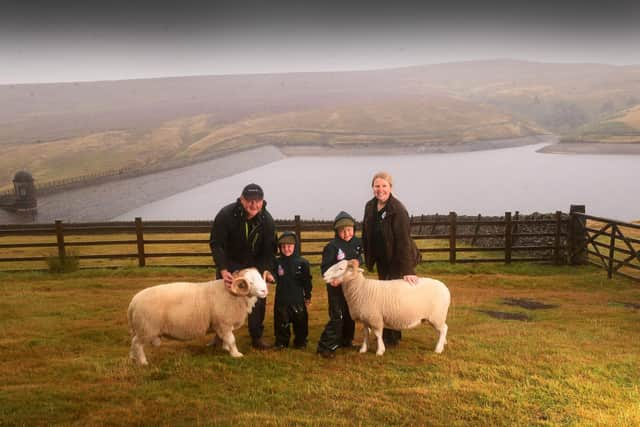

Richard says their history in having the breed and wanting to keep them going is an added inspiration on top of Thomas’ keenness, plus they are a quality sheep that produces quality lamb.
“We’ve always had Whitefaced Woodlands. My granddad used to show them. We increased our number to about 70 ewes originally because we were able to claim a rare breed subsidy for having them on the moors,” he says. “We’ve built up since 2014 when we got interested in showing, and things have snowballed from there. In 2016 we had a breed champion at the Great Yorkshire Show with a tup I bought from the Cramptons of Grassington, which my wife named Ralph. It also won the Champion of Champions of the breed at the Hope Show in 2017. This year we had the reserve breed champion at Harrogate. We’ve had a breed champion at Penistone Show too.
“They’re a local breed and need supporting. We don’t really see them as a rare breed, because around here is where you see quite a lot of them. They really are a good sheep that deserves to be better known for their breeding ability in producing great crosses.
“I have crossed them with the Bluefaced Leicester, producing a Woodland Mule, and with a Texel, and they do throw off a very good Mule and Texel lamb that’s milky. The Mule lamb is more or less a white face but looks like a Mule. They do grow quite a bit bigger than the traditional Mule.”
While the Whitefaced Woodland Champion of Champions takes place at Hope Show in Derbyshire and the breed sale takes place in Clitheroe, Lancashire, Richard says Penistone Show is still the breed’s home. “As many Whitefaced Woodland sheep go to Penistone as go to Hope, but I think when you’re at Penistone, it means a lot to a lot of people,” he says.
Richard farms in a family partnership with Harold and Rachel as a hill farm at 1,250ft with sheep across 4,500 acres of moorland on three different moors, and they own 250 acres of in-bye land. They have a flock of 1,200 breeding ewes, including just over 600 Swaledales, around 450 Mules and Texels, and 70 each of Whitefaced Woodlands and Derbyshire Gritstones.
“I’m the third generation to farm here, and with Thomas and younger son Oliver, who is four years old, we have the fourth generation coming along,” he says. “We run the farm with my wife Stacey helping and my mum Linda and Stacey’s cousin Vicky (Beal) working with us. Rachel’s husband Jamie also helps out, and their two sons Harry and Arthur have their own pet sheep.
“I left school and came straight onto the farm, coming up to 30 years ago. Our Swaledales are all on the moors, and their followers go back on the moor.
"We largely keep them pure, but we do put some to the Bluefaced Leicester and some to the Texel tup, running as Mules and Texel-crossed-Mules, which we sell as store lambs.
“Rachel started with Derbyshire Gritstones at around the same time as I started showing more with the Whitefaced Woodlands as a side interest to the farm for showing.
“We start lambing from around March 20, generally starting with the Texels and Mules, Whitefaced Woodlands and Gritstones. The ‘Swaleys’ lamb on the moor and usually start the last week in April. Everything else is brought in to lamb.
“All our fat lambs go through Holmfirth livestock market, which is just five miles away. Store lambs go to Skipton. Cull ewes go to Skipton, Bentham or Holmfirth, and we go to the pedigree sales for both Whitefaced Woodland and Derbyshire Gritstone at Clitheroe Market.”
While sheep provide the farm’s main income at Windleden, Richard says they also have a suckler herd and three holiday cottages.
“We have 30 suckler cattle, and we’ve moved over to Herefords. We’ve just registered as a pedigree herd. We were selling as stores before, but we are now thinking of fattening up some of our Hereford steers.
“It’s something that is evolving and could see us showing them too. We’ve always had cattle, but this is the biggest number we’ve had in my time.”
Windleden Farm Holiday Cottages were added six years ago following a barn conversion, and visitors look out on to Upper Windleden Reservoir, one of England’s highest reservoirs.
The River Don rises just west of Dunford Bridge and flows into the reservoir before making its way on its 69-mile journey.
“The Don was formerly known as The Dun; hence, Dunford.
“We’re at the highest point of the Trans Pennine Way, so we’re great for walkers and close to Holmfirth, Penistone and the Peak District.
“We’re great for those who want to bring dogs,” says Richard, who can’t wait for the Penistone Show.
“It’s a place where you get to see and talk with a lot of people you know that you probably haven’t seen for months, even though they are local.”