
Winley Hill Farm, Great Ayton: How a six-year-old's idea is helping this Yorkshire farm to stand tall
Four brown eggs is a class that many will be aware of at agricultural shows but rarely hits the headlines and for Alan Petch, chair of Stokesley Agricultural Society’s executive committee, it highlights the complexities of maintaining a show like Stokesley Show that celebrates its 166th year next Saturday (Sep 20).

‘There’s a huge amount of history in agricultural shows and keeping them true to their tradition while also understanding the economics. One of my sayings is ‘4 brown eggs’ doesn’t pay for marquees, but we must have them.
"It’s important, because without exhibitors we don’t have a show, but it also means we need to commercialise where we can to safeguard its future in an era of economic uncertainties.
Alan runs an arable farm at Winley Hill Farm just over the road from the showground towards Great Ayton, he followed his father in being involved with the show.
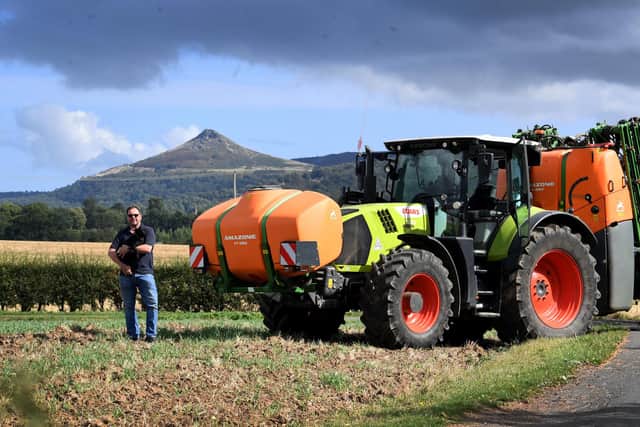

‘We’re next door. I’m the one that gets a phone call if there’s a problem. Granddad (Herbert) was involved and Dad (Mervyn) started in 1975, so this is his fiftieth year.
He was on the show council and steward for the catering for judges and stewards. He passed that to me when I began helping ten years ago.
“I took on the role of chair of executive committee last year when David Evans stepped down. I’d previously taken on assisting our chair of council Neal Waters who does a phenomenal amount of work.
“We are grateful to Paul Russell of Russells Farm Machinery for becoming president this year.

“We have a tremendously strong family link that goes back to his father John Russell and my father when they had a depot in Seamer. Russells made potato elevators at the time. We had the prototype of the first Russell 90 models.
Alan says his family became neighbours to the show when Winley Hill was bought in 1963.
“Buying Winley Hill was the first time land had ever made £200 an acre up here.
“Grandad had started at Whitegate Farm, Great Ayton in 1921. My father was one of four sons Clifford, David, Mervyn and Howard. Father and uncle David carried on farming in partnership at Whitegate until 1985.
“I’ve lived here all my life. We still work very closely with my cousin Martin, who farms at Whitegate. I’ve also always had a good relationship with my uncle Howard who was principal at Bishop Burton College where I studied. Howard has been a great source of advice.
Alan says the farm has been purely an arable concern for the past fifteen years, as well as having been home to a glamping site, wedding venue and holiday park.
“My wife Louise was the instigator of those other ideas. We started with a glamping site in 2010-11. We developed massively including a restaurant/café but Brexit and then Covid hit.
"We sold the park on in 2022. It had become a tremendously big project and we’d gone from two staff to 48. We had and still have a young family with Edward (13) and Margot who was born 2019.
"After Covid we could have carried on growing but I realised the only things I would have at the end would be two children I didn’t know and they are the most important thing to me, as well as Louise.
"Today all we have as diversifications are caravan storage and Margot’s Sunflowers.”
Alan tells of how his six-year old daughter’s idea has brought about so much joy and increased pollinators on farm.
“Margot saw them while we were in Northern France and asked why we couldn’t grow them. ‘Because we’re in North Yorkshire,’ I said.
"But Margot wanted us to have a go and this year we’ve grown Margot’s Sunflowers and they have been absolutely amazing.
“They’ve created a new income, raised money for charity, increased pollinators and provided somewhere that people who are ill or infirm can come and simply enjoy, just seeing the faces of those has been a real pleasure. We have Margot’s Sunflowers programmed in for next year.”
Winley Hill Farm had been heavily into potatoes until the turn of the century but Alan says it is now more or less wholly cereals and SFI cropping.
“We have around 500 acres of our own or rented land, of which we’re combining around 400 acres, with 100 acres in an SFI agreement, plus another 600 acres we farm through agricultural contracting.”
Alan says he’s lost a considerable amount of his contracting to SFI agreements, but that there are positives.
“With my farmer’s hat on I would farm every field, but with business and sustainability hats on there is no future on intensive agriculture on marginal land.
"We have to work with nature. I’m not talking regenerative farming. We have to get back to sustainable levels, with plenty of margins and zero insecticide. I had four hives and lost all my bees.
"We haven’t put an insecticide on here for four years and this year we have seen an amazing resurgence in pollinators.
“Nothing gives me greater pleasure than seeing wildlife, particularly nesting birds and all species we have from raptors such as barn owls, egrets, herons and kingfishers, bullfinches and wheatears.
"We’ve also seen a great resurgence in grey partridge from managing the habitat.”
Alan’s combinable cropping includes winter wheat, spring barley, winter barley and a rapidly reducing oilseed rape acreage.
“We’re putting in varieties Palladium and Beowulf for next year’s harvest. Our combinable land is grade 2-3, medium clay loam. First wheats tend towards a yield north of 4 tonnes per acre.
“We’re using hybrid winter barley varieties Kingsbarn and Kingston. Spring barley is intended for malting.
“The economics are so heavily loaded against oilseed rape that it is too risky. We were growing industrial oilseed rape.”
After the previous harvest being horrendous through poor establishment Alan says this year’s harvest has produced average yields but higher quality. He talks of two men who have been massively important to Winley Hill both over the years and today.
“Dad was 92 on 31 August. He was still driving the combine last summer.
"This is the first year he hasn’t, and we have Matthew (Cook), who’s in his mid-20s and has been working with me developing our contracting side. He’s a farmer’s son from Raysdale.
“Matthew phoned me when he was just 15 and leaving school, looking for a job. He’s a farm machinery genius and can run any of our machines. We’re on GPS, telematics, all through the Cloud, variable rate applications, Matthew understands it all.
“We started non-inversion tillage in 2010. We’ve gone heavily down that route buying our first direct drill, Horsch Avatar in 2019.
“We still use the plough every four to five years. It came to a point where we’d lost so many chemicals in our grassweed armoury that we need it in rotation.
“One of the major things we’ve been involved with on-farm recently has been becoming a Northern Trials Site for Frontier Agriculture, hosting crops trials open days.
"Our agronomist is Andrew Roy of Frontier. He and his family helped with Margot’s Sunflowers too. It’s a very family thing and Andrew is very much part of the team.”