
Woolas Barn: The Yorkshire farm with a historic barn which doubles as a wedding venue
Creating the right impression at a wedding doesn’t necessarily involve being glammed up when you’re a North Yorkshire farmer – and particularly when it’s your family farm’s alternative enterprise at the beautiful Woolas Barn, where three farm buildings originally built in 1863 are providing enchanting memories that live longer than dreams.

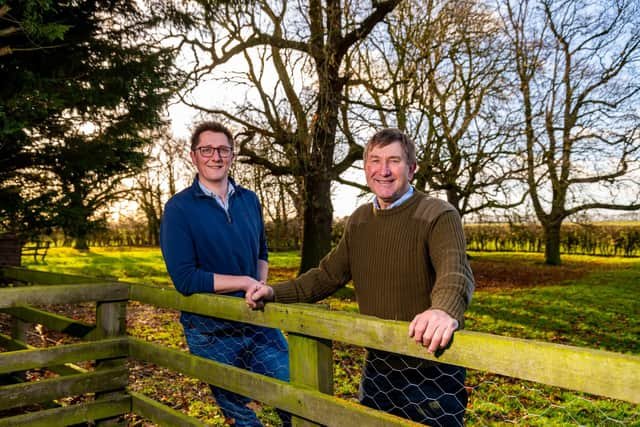
“I wouldn’t say that it always dovetails brilliantly with the harvest,” says James Mills, whose wife Fiona and parents Charles and Jill are the family team.
“When I’m jumping off a combine to help, I don’t always look like I’m dressed for a wedding, but people smile and accept they’re on a farm and that it comes with the territory.”
James says the combination of his move back to the 500-acre farm Woolas Grange, in Appleton Roebuck, and the recognition that farming was to change when the UK opted out of the EU brought about Woolas Barn.
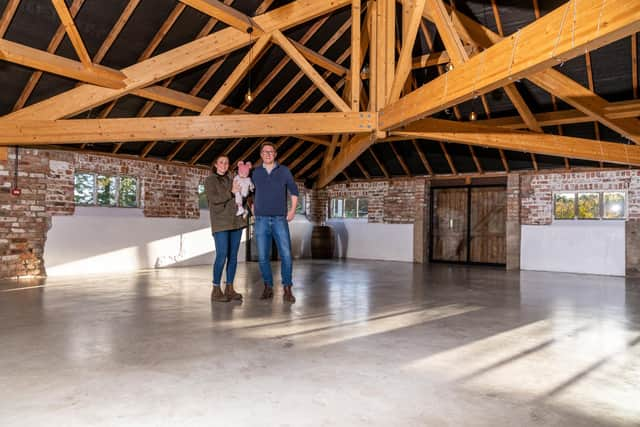

“I came back home the year after Brexit happened. The writing was on the wall. One thing you could guarantee was the moment we left Europe we were going to lose direct payments.
“As a business we’ve always aimed to farm without being reliant upon them but with a second family coming into the farm, spreading risk and de-risking was a driving force.
“We pursued something none of us knew anything about, but you do your research, roll up your sleeves and get stuck in.
“We host weddings from the beginning of April to the end of October, around 30 a year. It’s just us who do nearly everything. We’re cleaning on a Sunday or packing down on a Saturday night.
"We’ve a friend who looks after all the catering and a Michelin-trained chef who fires up the best food you’ll have anywhere.”
James farms alongside his father Charles, who many will know for his work as former show director of the Great Yorkshire Show.
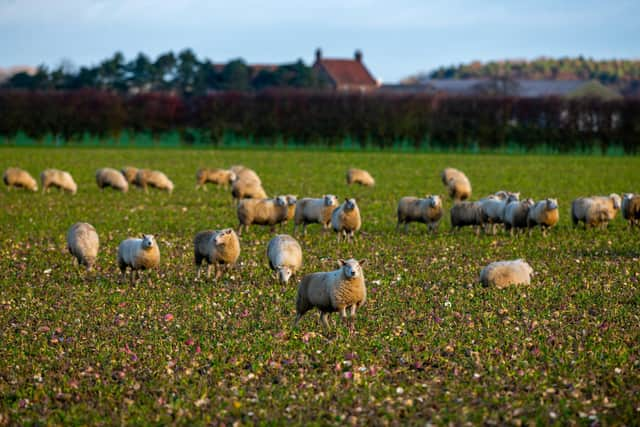
“We are primarily an arable farm with a mixture of feed and biscuit wheat, malting barley, beans, occasionally oats, and sheep in the rotation that are on stubble turnips at the moment,” says James.
“We have two SFI schemes. We’ve not changed anything within our farming business to adapt to them, they’ve got to work for us.
"We pride ourselves on good traditional farming practice. We do direct drilling anyway, so we pursued those payments; and we also cover crop already.”
James says that he’s happy with this year’s establishment of winter wheat and beans.
“We have 250 acres of winter wheat with feed variety Dawsum, plus Hexton and Bamford that will hopefully go for biscuit wheat. Establishment has gone well.
"Hexton is new this time. When we find a variety that works well we’ll stick with it for a few years.
“Average wheat yield is around four tonnes per acre. This year we tipped just below, last year was significantly below.
"This year’s harvest we’ve seen many suffering with drought, but our land stands up well because of our soil types of clay loam and very bodied blue clay.
“In a year like this where malting premiums are pretty much non-existent and wheat prices are down we try to de-risk by hauling a lot of wheat or barley into BATA’s Jubilee Mills at Murton. It’s a fantastic farmer-owned cooperative.
“We work with them if they need a load or two. We also store on farm and have drying facilities.”
James says that Charles likes his sheep and that numbers are back on the increase.
“We used to lamb 250 ewes until we opened Woolas Barn when something had to give. This autumn we’ve put 50 Texel-crossed shearlings to a Beltex tup from Richard Findlay of Westerdale to lamb in March.
“We also buy-in around 250 Texel-crossed store lambs each year from Skipton market that do well in York livestock market.”
James was involved with the NFU in London and Brussels before coming back to Woolas and for the past two years he’s been vice chair of the NFU Combinable Crops committee.
He says his NFU involvement means he tends to know when and where to look for new schemes and grants, but he currently has concerns over a specific legislation relating to crops.
“I was with the NFU for six years after having studied politics and history at university. I did eight months in Westminster. I always had an eye on coming back to the farm.
"Working in those previous areas means I know when to keep an eye out for things like SFI schemes or grants from North Yorkshire Council.
“My main concern for arable farming presently is the EU-SPS deal which will potentially give up all decision-making authority to the EU on plant health and pesticide authorisation and that all means we are moving in the direction of having less chemistry available on farms.
“The SPS realignment is potentially going to hasten the demise of perfectly good and safe chemicals.
"We’re all licensed users, we’re not cowboys flinging stuff on for the sake of it. And the UK will continue to import products from around the world that have used similar if not worse chemistry on it, because we need to eat.”
James and Fiona have two young children – two-and-a-half year-old William who James says is already a mini-version of Charles; and Iris who was born in August, timing her arrival well, says her proud father, because harvest had just finished.
“Mum and dad have always been incredibly relaxed about what myself and my sisters wanted to do. Anna works in advertising and has two children; Sarah has a little boy.
"We were always treated equitably and were told if we wanted to get involved in the farm it was here, but if not, that was absolutely fine.
‘I’m the third generation to farm here. Grandparents Henry and Connie moved to Woolas Grange in 1948, which had been an RAF base during the Second World War, so it was pretty dilapidated.
“In the years that followed, grandpa, dad and his brother Roger breathed life back into it and hopefully I’ll get the opportunity to continue its growth.
“Dad and Roger split the family partnership very amicably twenty-plus years ago. It’s now just myself and dad on the farm with mum helping lead off during harvest and another pair of hands when we’re sorting sheep.
“Fiona helps with Woolas Barn but works in what I describe as a proper job as an insurance broker.”