
Wressle, East Yorkshire: Castle that keeps watch over village
Approaching the diminutive Wressle Station on the Hull to Selby railway line, passengers are offered fleeting glimpses of a ruined castle. Although it’s privately-owned, Historic England has ranked the 14th century palace-fortification among Yorkshire’s most important buildings.
Marketed to visitors as “a unique historical experience” and as “a storied monument to East Yorkshire's rich heritage”, Wressle Castle has perched above the River Derwent, which was used to transport the limestone used to construct it, since the 14th century.
The castle originally comprised of four ranges set around a central courtyard, with a tower at each corner and a gatehouse tower in the eastern wall, facing where Wressle village now stands. It was surrounded by a moat and a deer park to the north. It is thought probable that the late 14th century building was provided with gardens and pleasure grounds.
Historians say the castle was designed to be ostentatious rather than defensive.
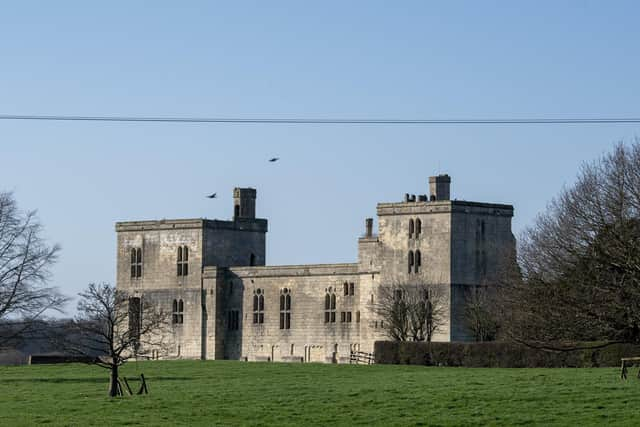

Following extensive restoration work a decade ago by Natural England, English Heritage and the owners of Castle Farm, beside which the castle sits, the once great seat of power survives as a roofless ruin standing effectively to full height, with the Chapel Tower to the east and Lords Tower to the West, linked by a slightly lower central range. The work to conserve the castle follows numerous other such schemes, including it being renovated to enable King Henry VIII and his then wife, Katherine Howard, to stay there for at least three nights in 1541 and works by the ninth Percy Earl, who was implicated in the Gunpowder Plot and imprisoned for 18 years.
The Civil War saw Wressle Castle garrisoned and held for Parliament. In 1646 soldiers were said to have caused more than £1,000 worth of damage to the castle and its surroundings. The decision was taken by Parliament to demolish all but athe south range, leaving it to serve as a manor house to run the Earl of Northumberland’s local estates, after Royalists captured Pontefract Castle in 1648.
Open to visitors on specific open days only and used as a backdrop for re-enactments of the English Civil War, much of the castle is buried or is now earthwork remains, alongside the ruin of an early 16th century bakehouse for the castle.
It was built by the Percy family, one of northern England’s most powerful noble families, and remained an important residence until the later 16th century. However, the castle was taken by the Crown in 1403, the Percy family’s challenge to the throne having been crushed at the Battle of Shrewsbury.
In 1796 the tenant farmer who was then occupying the lower floor of the south range decided to clean his chimneys by deliberately setting fire to them. The fire ran out of control, destroying the surviving 16th century interiors.
The grade II listed Castle Farm was built beside the castle following the fire, which devastated the last remaining habital part of the fortress, and is among several listed structures surrounding the castle, which is believed to be the work of the mason also responsible for Castle Bolton in Wensleydale and Sheriff Hutton Castle in the Ryedale area.
The village is a direct consequence of the low-profile historic landmark near East Yorkshire’s border with North Yorkshire, yet close enough to on occasion to be confused with a North Lincolnshire village also called Wressle.
Wressle in East Yorkshire remained an estate village until descendants of the Percy family sold it in the 1950s, meaning until then all the houses were tenanted and the vicar was appointed by the family.
Nevertheless, despite the scale of the scheduled monument, as it stands behind farm buildings and trees it is only possible to catch glimpses of it from Breighton Road in the village.
There are numerous other interesting and attractive historic features in Wressle, which was listed as a Manor in the Domesday Book of 1086.
On the north side of Main Street stands the mid 18th century Holly Cottage, built using English garden wall bond brick, which was also used for the Church of St John of Beverley, which is set back from Station Road, and a 19th century tapering four-storey windmill tower nearby at Mill Farm on Mill Lane. The church, which has similarities to a non-conformist chapel, is dedicated to one of the most popular medieval English saints, whom King Henry V credited for the victory of his troops over the French at Agincourt. It features a three-stage tower and was built just three years after fire finally destroyed the castle, where services had been held since another church in the village was destroyed in the 17th century.
St John’s, the most westerly church in the Archdeaconry of the East Rding, is open daily for private prayer and holds services on the first Sunday of each month, alongside seasonal services throughout the year. A plaque in the church commemorates the four Wressle men killed in the First World War. The memorial highlights residents’ “appreciation of their patriotism and devotion to the emplre”
Between the church and windmill is a 120-capacity village hall which hosts regular pilates, yoga and art sessions and will this month stage an open mic night and in July a dinner celebrating Punjabi cuisine.
Opposite the village hall is the aforementioned station, which is said to have been spared Dr Beeching’s axe due to a pressing need for it with the rural community having been established. Regular services run to Hull, York and Leeds. However, bus services have dwindled to a once-weelly Goole-Go-Far “hail and ride weekly shopper” service between Holme on Spalding Moor and Goole.
Expansion of the village during the Victorian era led to the building of a school, with attached schoolmaster’s house, for 75 children. However, it closed in the 20th century, leaving children from the village having to travel to school.