
Yorkshire's agricultural shows 'a snapshot in time' of traditional rural values
The one day of the year off from farming duties, a family day out, village neighbours coming together in the countryside and the best of the farm’s wares from cattle to conserves and horses to handicrafts being shown with pride.

This was the basis for the first agricultural and country shows to take place in Yorkshire - the earliest of which were recorded in the late 1700s.
Very little in the world today, some 250 years later, is the same. However, village, country and agricultural shows remain a “snapshot in time” where those values, ethos and traditions have not changed at all.
The likes of the Great Yorkshire Show (selling out its 140,000 tickets weeks before the event) and Driffield Show (its 15,000 visitors making it the biggest one day country show in the UK) are considered the most prestigious on our region’s calendar.
Then, take Goathland Village Show for example, which welcomed 750 people last year. Moorcock Show was delighted with 80 entries across its classes. Kildale Show only adopted cashless payments two years ago.
The value of these shows is just as, if not more, salient than the commercial crowd pullers. They cultivate a community and create solace from manoeuvring a modern world.
Catherine Park Peyton, is chair of the Yorkshire Federation of Show Societies (YFSS) and chair of the Aldborough and Boroughbridge Agricultural Show.
She believes going to a village show is like “stepping back in time”.
Ms Park Peyton told the Yorkshire Post: “The village show is one of those snapshots of time, a moment of pause where it is about families, enjoyment and peace - everything the world is not now.
“Farming never stops, agriculture never stops, but the whole point of agricultural shows in those early days was it was a day everybody had off. They had a huge pride in showing their pigs or cattle and would live off what they got for them. There was a feel good factor.


“We are almost stepping back in time by doing it, but it is good for our souls.”
The earliest recorded show in Yorkshire was Otley Show, which starts the season of agricultural shows on May 16.
It was founded in 1796, but organisers say a show of “some type” had been held before this.
Otley Show’s appeal has stood the test of time because of its “accessibility”, says show secretary Claudia Beutelspacher.
She said: “We have some fantastic archives and at one point, Otley Show was a huge event for the area. There was nothing like it and almost everybody would go.
“Not everybody can get to, or afford to go to the Great Yorkshire Show. The smaller shows keep traditions alive, keep people interested and are accessible.
“Otley Show is right in the middle of the town and people can walk to it, we have a good presence and don’t do everything online because it doesn’t work for everybody.”
In a world now overwhelmingly conducted by screens, digital presence, social media and AI, the country show thrives on practical and physical, from baking biscuits to breeding award-winning animals.

Catalogues of classes for the 2026 show season read largely the same as they did 50, 80 and more than a hundred years ago.
Out of several hundreds of classes at Otley Show, one of the most hotly contested is class 37. A Victoria Sponge in the Handicrafts section.
Ms Beutelspacher added: “The class has been there for decades and is incredibly competitive, it is a crown in its own way.
“There is a sense of pride in taking part in something that has a long tradition, some families have been involved for generations.”
With the absence of agriculture and food production from the National Curriculum, country shows are now seen as a form of education and a connection between urban and rural lives.
David Tite is Society Manager at Yorkshire Agricultural Society (YAS) and the previous CEO of the Driffield Agricultural Society,
YAS has its own education secretary to host learning events in the countryside, teacher training, get youngsters involved in vegetable growing competitions and highlight careers in the rural sector.
Mr Tite said: “In the past, agricultural shows have been about farmers seeing the latest technology and kit. Now it is about telling the public food comes from that animal or that field, using this kit to produce it.
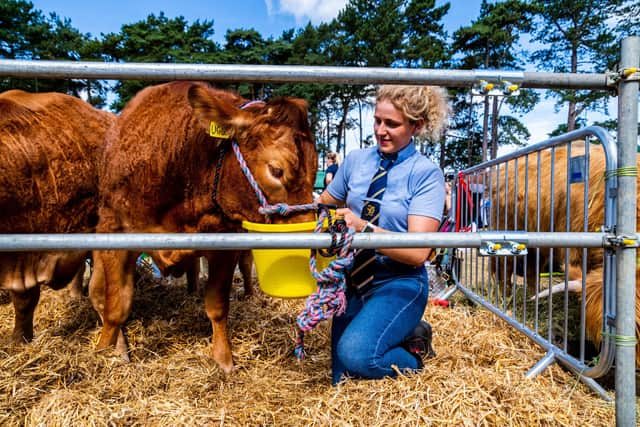
“We have an education secretary as we have realised there is not that knowledge and some children think milk comes from a plastic bottle in a supermarket. Part of our remit is to tell the story to the wider public, bridge that gap between town and country, give people a chance to stand in a field and watch people do that job.
“One of my favourite things about the Great Yorkshire Show is seeing people enjoying their day and experiencing things they don’t always have access to. Lots of people won’t have seen a combine harvester in real life if they live in the middle of a city, some kids would never see this so it is a fantastic opportunity at a show.”
The economic boost agricultural shows can bring to areas is also significant.
The Association of Agricultural Organisations (ASAO) estimates ten per cent of the UK population (around seven million people) attend agricultural shows on an annual basis. Research of its members found events generate an estimated annual income of £128.6m.
Figures show businesses and events, held at the Great Yorkshire Showground in Harrogate, home to the Great Yorkshire Show, contribute £73.7m to the economy and result in 688 full-time equivalent jobs.
There are more than 60 shows across the region listed with the Yorkshire Federation of Show Societies (YFSS), which along with YAS are members of ASAO.
These bodies are there to support Yorkshire’s local shows and people behind the scenes, mainly volunteers, working tirelessly to make sure they run each year amid increasing challenges such as falling income streams, increasing costs and regulation.
Applicable from this year is The Terrorism (Protection of Premises) Act 2025, known as Martyn’s Law. It requires certain premises and events, including agricultural shows, to plan how they would respond to a terrorist attack and steps to take to reduce vulnerability to an attack.
Mr Tite is also a council member of ASAO.
He said: “Huge changes are coming in and I can understand how volunteers are nervous about these. That is why YFSS and ASAO can really step in.
“We can ask questions for societies to government departments and come back with the answers to help them. YAS is also a big supporter of local shows. There is support from the top down.
“If we can help shows keep going, we have fulfilled what we need to do. They all feed into the GYS and bigger shows and are shows people can be proud of for their local communities.”
Ms Park-Peyton added: “We always have to adapt, and not just to the market. Location landlords want a piece of you, insurance people want a piece of you, everybody has a new set of rules and regulations. That is where YFSS comes in. It is the overarching thing that gives us peace of mind we are doing the right thing.
“It is about not feeling alone. As we know, with agriculture as a whole, it is a very lonely environment to be in.”