
Plea to change approach on Free School Meals to help struggling families

A postcode lottery of provision for free school meals is outlined in new claims today as campaigners call for the most disadvantaged children to be automatically enrolled.
The number of children able to claim in Yorkshire has risen astronomically, nearly doubling as the cost of living crisis tightens.
Now, after Labour announced plans last week to extend provision to any child in a household on Universal Credit, there are warnings the government "must go further".
The Education Policy Institute (EPI), in a new report published today, suggests families in some council areas find it much harder to apply than others, widening inequality.
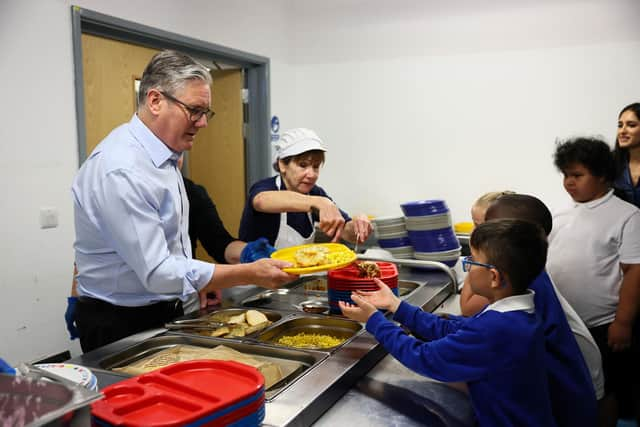

And the youngest children, who face the highest risk of poverty, only benefit if they attend some council-run nurseries, it finds.
Senior researcher Kerris Cooper said: “Our research shows that while the extension of free school meal (FSM) eligibility is a very positive step, more needs to be done to ensure that all children entitled to free meals can actually access them."
There are still "significant barriers" for families, she warned, and where a child lives plays "too big a role" in their chances of success.
"Introducing national auto-enrolment and including children in early education would enable this expansion in FSM eligibility to more meaningfully extend access to more children in poverty.”
Yorkshire has seen a sudden and steep increase in the number of children eligible for free school dinners, rising 80 per cent since 2015.
Close to a quarter of a million children were registered in need in the last academic year, with one-in-three children now able to claim in some council areas.
In Hull, the number of children affected has risen from close to 9,000 to nearly 15,000 this school year, while in Sheffield it has nearly doubled from 14,888 to 29,096.
Earlier this month, the Government announced a major change to expand even further, easing the burden of poverty. From September next year, families receiving Universal Credit (UC) will be eligible regardless of their income - until now, they needed to earn less than £7,400 a year to qualify.
But today's EPI report, funded by The Nuffield Foundation, finds there are differences in who is identified as ‘disadvantaged’. In some areas, it warns, parents have to apply themselves despite language barriers, digital access and a significant social stigma. The only way to eliminate inequality is to auto-enrol all eligible families, it argues.
Pepe Di’Iasio, a former Yorkshire headteacher who is now General Secretary of the Association of School and College Leaders (ASCL), said it would be a "logical" step.
“The expansion of free school meals is a positive move that recognises there are children living in poverty who have been missing out," he said. “Moving to a national system of auto-enrolment would be the next logical step to ensure that everyone who is now eligible will actually receive a meal and the intended benefits. Auto-enrolment is something ASCL and many other organisations have been calling for for some time, and has been shown to work well at a local level.”